


Was Vienna enough to restart Karabakh negotiations?

There has been a cautious welcome by the international community of the meeting held on Tuesday (19 November) between the presidents of Armenia and Azerbaijan in Vienna as part of efforts to resolve the Nagorno-Karabakh conflict.

The United States, one of the three co-Chairs of the OSCE Minsk Group that has been mandated to help find a solution to the conflict, welcomed the meeting in a comment by the spokesperson of the State Department, Jen Psaki:

"We commend the presidents of Armenia and Azerbaijan for this first step, and are encouraged they have agreed to a follow-up meeting in the months ahead. Their first meeting in almost two years, this summit is an important step toward restarting dialogue and demonstrates the leaders' shared commitment to bring an end to the Nagorno-Karabakh conflict. As a co-chair of the OSCE Minsk Group along with Russia and France, the United States urges both presidents to work actively towards a peaceful resolution to the conflict, which has taken a heavy toll on the people on all sides."

The meeting was also welcomed by the Organisation for Security and Co-operation in Europe (OSCE) under whose auspices it was held.The OSCE Chairperson-in-Office, Ukraine's Foreign Minister Leonid Kozhara said, 

"I trust that the highest-level dialogue between Armenia and Azerbaijan will contribute to strengthening confidence and mutual understanding between the parties and will provide a positive incentive for the negotiation process on the Nagorno-Karabakh conflict settlement."

"We believe that such negotiations serve as a warranty for peace, stability and opening new opportunities for regional co-operation. The Ukrainian Chairmanship stands ready to further facilitate the efforts of Azerbaijan and Armenia with the mediation of the OSCE Minsk Group Co-Chairs on the establishment of the regular dialogue aimed at reaching comprehensive peaceful settlement of the Nagorno-Karabakh conflict on the basis of international law."

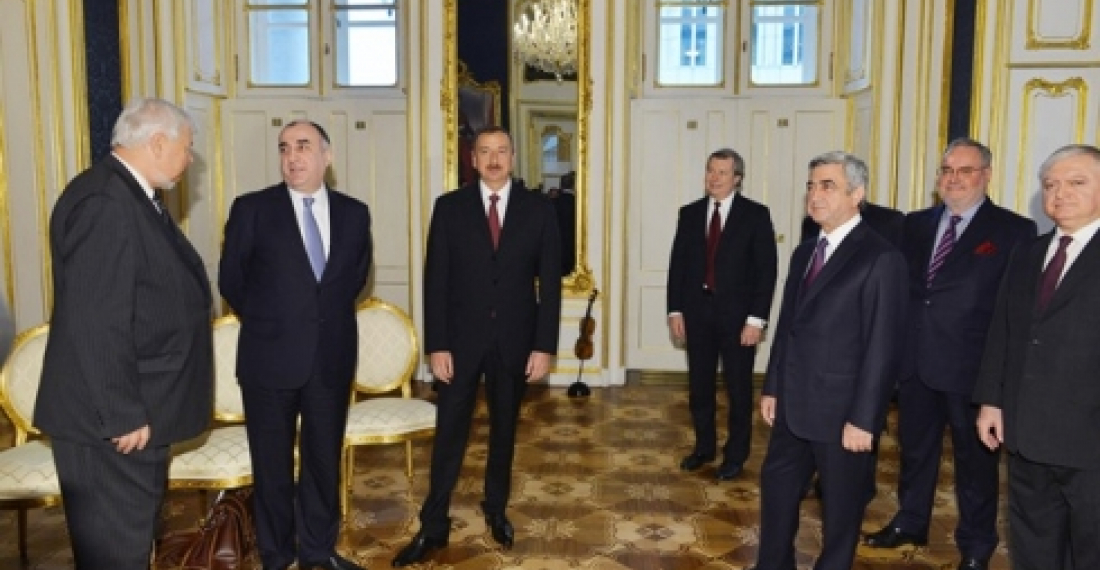
Reporting the meeting, the Russian News Agency RIA Novosti said that the tete-a-tete meeting between the two Presidents lasted for two hours and was followed by a brief meeting attended by the Foreign Ministers of the two countries and diploamts from the OSCE Minsk Process. The agency quoting other media sources said that the Presidents did not shake hands at any point during the meeting. The only comment was made by the Armenian President who described the meeting as "normal". The Press Offices of both Presidents carried pictures of the meeting on their websites with a short one sentence report saying that the meeting had taken place. None of the pictures of the meetings released by the two sides show the two Presidents looking at each other, let alone shaking hands.

Commonspace.eu political editor said in a comment:

"This meeting was never going to be easy. Nearly two years since their last face to face meeting in Sochi the two leaders had first to find a reference point from where they could re-start the negotiations. The fact that they have made many tough statements in this period also does not help the process. The very fact that a meeting has taken place is a positive and welcome step, but far from being a breakthrough.

As has happened often in the past the international community may be reassured by the fact that the two leaders are now talking again. But this would be a big mistake, for the lessons of the last twenty years on Karabakh show that unless the talks are followed quickly with change in the situation on the ground, the momentum, if any exists, quickly fades. Over the next days the propaganda machine in both countries will give their spin of the meeting, and its significance from the point of view of the two countries. At this point we will know if there is room for optimism or not. In the meantime the world waits for the next episode, as the Foreign Ministers prepare for a follow-up meeting in Kiev in early December, on the margins of the Ministerial Meeting of the OSCE.

As the statement of the American government says, Vienna was 'a step forward in restarting dialogue', and for this reason it should be welcomed. There are many steps that are yet to be taken before we can say that peace negotiations are taking place in earnest, and those that have been affected by this conflict have no choice at this stage but to also welcome this first step, and hope for more in the near future."

source: commonspace.eu with RIA Novosti and other media sources.

photo: President Ilham Aliev of Azerbaijan and President Serzh Sargsyan of Armenia prior to their tete-a-tete meeting in Vienna on 19 November 2013 (picture courtesy of the press Service of the President of Azerbaijan.)
Related articles

Editor's choice
News
Council of Europe launches new International Claims Commission for Ukraine

Council of Europe launches new International Claims Commission for Ukraine

Thirty-four countries and the European Union have signed a new convention establishing an International Claims Commission for Ukraine at a diplomatic conference co-hosted by the 46-nation Council of Europe and the Netherlands in the Hague. The diplomatic conference was attended by leaders and high-level representatives from over 50 states, including the President of Ukraine, Volodymyr Zelenskyy, the President of the Republic of Moldova, Maia Sandu, and the Prime Minister of the Netherlands, Dick Schoof.  “Today marks a major step forward in ensuring accountability for Ukraine. The International Claims Commission represents justice and hope for tens of thousands of victims—our determination that those who have suffered will not be forgotten. I call for quick ratifications so we can get the commission rapidly up and running for the people of Ukraine,” said Council of Europe Secretary General Alain Berset. Ukrainian President Volodymyr Zelenskyy said: “We expect that every mechanism for compensation from the Register of Damage and Claims Commission to the actual payments – will start working and receive strong and sufficient international support, so that people can truly feel that any kind of damage caused by the war can be compensated. This war, and Russia’s responsibility for it, MUST become a clear example – so that others learn not to choose aggression.” “Accountability is about creating the conditions for peace that endures. And therefore, accountability is a condition of security – today and for the future. But accountability is not only about Ukraine. And it is not only about one aggressor and one victim. Accountability is about Europe. About every country in Europe. It is about whether Europe, as a whole, is willing to defend its peace,” said Maia Sandu, President of the Republic of Moldova, which currently holds the Presidency of the Council of Europe’s Committee of Ministers. The Prime Minister of the Netherlands, Dick Schoof, said: “Every day Russia is deliberately bombarding homes, destroying businesses and damaging infrastructure in Ukraine. Russia must compensate Ukraine for the damage caused. That is why we have launched the International Claims Commission for Ukraine and we are honoured to host it.” The International Claims Commission will be the second part of a comprehensive compensation mechanism related to Russia’s war of aggression, building on the existing Register of Damage for Ukraine. The claims commission will be established within the framework of the Council of Europe and will also be open to other countries. The Register of Damage for Ukraine, created in 2023, collects and records compensation claims submitted by individuals, organisations and public bodies in Ukraine. Forty-four states and the European Union have so far joined the Register, which has already received 86,000 claims. The International Claims Commission will review, assess and decide upon claims submitted to the Register of Damage for Ukraine and determine the amount of compensation, if any, which is due in each case. The convention establishing the commission will enter into force once it has been ratified by 25 signatories, as long as sufficient funds have been secured to support its initial work.

Popular

Editor's choice
News
Council of Europe launches new International Claims Commission for Ukraine

Council of Europe launches new International Claims Commission for Ukraine

Thirty-four countries and the European Union have signed a new convention establishing an International Claims Commission for Ukraine at a diplomatic conference co-hosted by the 46-nation Council of Europe and the Netherlands in the Hague. The diplomatic conference was attended by leaders and high-level representatives from over 50 states, including the President of Ukraine, Volodymyr Zelenskyy, the President of the Republic of Moldova, Maia Sandu, and the Prime Minister of the Netherlands, Dick Schoof.  “Today marks a major step forward in ensuring accountability for Ukraine. The International Claims Commission represents justice and hope for tens of thousands of victims—our determination that those who have suffered will not be forgotten. I call for quick ratifications so we can get the commission rapidly up and running for the people of Ukraine,” said Council of Europe Secretary General Alain Berset. Ukrainian President Volodymyr Zelenskyy said: “We expect that every mechanism for compensation from the Register of Damage and Claims Commission to the actual payments – will start working and receive strong and sufficient international support, so that people can truly feel that any kind of damage caused by the war can be compensated. This war, and Russia’s responsibility for it, MUST become a clear example – so that others learn not to choose aggression.” “Accountability is about creating the conditions for peace that endures. And therefore, accountability is a condition of security – today and for the future. But accountability is not only about Ukraine. And it is not only about one aggressor and one victim. Accountability is about Europe. About every country in Europe. It is about whether Europe, as a whole, is willing to defend its peace,” said Maia Sandu, President of the Republic of Moldova, which currently holds the Presidency of the Council of Europe’s Committee of Ministers. The Prime Minister of the Netherlands, Dick Schoof, said: “Every day Russia is deliberately bombarding homes, destroying businesses and damaging infrastructure in Ukraine. Russia must compensate Ukraine for the damage caused. That is why we have launched the International Claims Commission for Ukraine and we are honoured to host it.” The International Claims Commission will be the second part of a comprehensive compensation mechanism related to Russia’s war of aggression, building on the existing Register of Damage for Ukraine. The claims commission will be established within the framework of the Council of Europe and will also be open to other countries. The Register of Damage for Ukraine, created in 2023, collects and records compensation claims submitted by individuals, organisations and public bodies in Ukraine. Forty-four states and the European Union have so far joined the Register, which has already received 86,000 claims. The International Claims Commission will review, assess and decide upon claims submitted to the Register of Damage for Ukraine and determine the amount of compensation, if any, which is due in each case. The convention establishing the commission will enter into force once it has been ratified by 25 signatories, as long as sufficient funds have been secured to support its initial work.

