Theme

Diplomacy

Editor's choice
News
European leaders set out their plan for Ukraine

European leaders set out their plan for Ukraine

The leaders of Germany, Denmark, Finland, France, Italy, Netherlands, Norway, Poland, Sweden, and United Kingdom, together with the President of the European Council, and the President of the European Commission, o  Monday (15 December) issued a statement, outlining their plan for Ukraine. In their statement, Chancellor Merz, Prime Minister Frederiksen, President Stubb, President Macron, Prime Minister Meloni, Prime Minister Schoof, Prime Minister Støre, Prime Minister Tusk, Prime Minister Kristersson, Prime Minister Starmer, as well as President Costa and President von der Leyen spoke about "Peace for Ukraine". The Leaders welcomed significant progress on President Trump’s efforts to secure a just and lasting peace in Ukraine. They also welcomed the close work between President Zelenskyy’s and President Trump’s teams as well as European teams over the recent days and weeks. They agreed to work together with President Trump and President Zelenskyy to get to a lasting peace which preserves Ukrainian sovereignty and European security. Leaders appreciated the strong convergence between the United States, Ukraine and Europe. Leaders agreed that ensuring the security, sovereignty, and prosperity of Ukraine was integral for wider Euro-Atlantic security. They were clear that Ukraine and its people deserved a prosperous, independent, and sovereign future, free from fear of future Russian aggression. Both the US and European leaders committed to work together to provide robust security guarantees and economic recovery support measures for Ukraine in the context of an agreement on ending the war. This would include commitments to: Provide sustained and significant support to Ukraine to build its armed forces, which should remain at a peacetime level of 800,000 to be able to deter conflict and defend Ukraine’s territory. A European-led ‘multinational force Ukraine’ made up from contributions from willing nations within the framework of the Coalition of the Willing and supported by the US. It will assist in the regeneration of Ukraine’s forces, in securing Ukraine’s skies, and in supporting safer seas, including through operating inside Ukraine. (Click the image to read the statement in full).


Filter archive

Publication date
Editor's choice
News
Key leaders skip Arab League summit in Algiers (Updated)

Key leaders skip Arab League summit in Algiers (Updated)

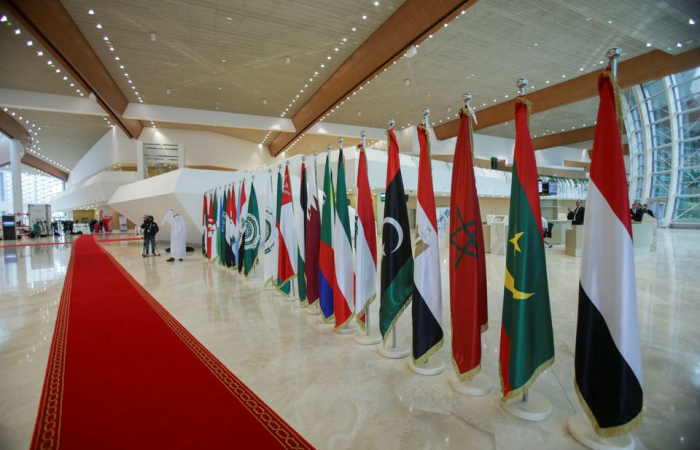
The summit of the League of Arab States opened in  the Algerian capital, Algiers, on Tuesday evening (1 November). In the opening address, Algerian president Abdelmadjid Tebboune called for a strong Arab economic block that protects the common interests of Arab countries. “We must all build a solid Arab economic block that protects our common interests, while working to define priorities and areas of common action, with an immediate and perceptible positive impact on the Arab peoples,” said President Tebboune in his speech to the participants in the 31st Arab Summit. “We still face complex crises with multiple challenges and risks, especially after the Covid-19 pandemic, which has led to instability, tug-of-war, and the exacerbation of the scourge of polarization. This situation has contributed to the proliferation of crises with effects on international peace and security and impact on several countries, particularly in terms of food security,” the Algerian president said. A number of heavyweights are missing from the Algiers summit, including Mohammed bin Salman of Saudi Arabia and Mohammed bin Zayed of the United Arab Emirates. Other Gulf countries, except Qatar will not be represented by their head of state. Another notable absentee is King Mohammed VI of Morrocco, who initially was thought would attend the summit.  AFP quoted Morocco’s Minister of Foreign Affairs Nasser Bourita, saying that Morocco’s monarch initially confirmed his willingness to attend the Algiers summit. “The Moroccan delegation did not receive any confirmation from Algeria through its channels” after inquiring about information on the arrangements for the King’s reception, Bourita said. On the instructions of the King, the Moroccan foreign minister is leading a delegation, representing Morocco during the summit meetings. Relations between Algeria and Morrocco have been strained for a long time because of differences on the future of the territory of Western Sahara.
Editor's choice
News
In Sochi, leaders affirm committment to Prague principles but leave space for a role for Russia

In Sochi, leaders affirm committment to Prague principles but leave space for a role for Russia

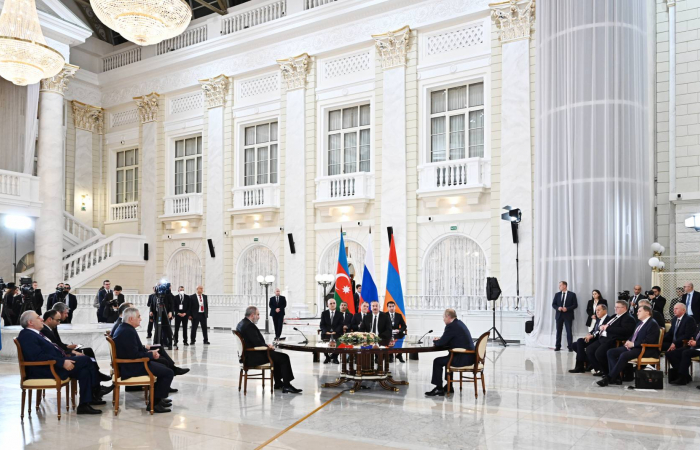
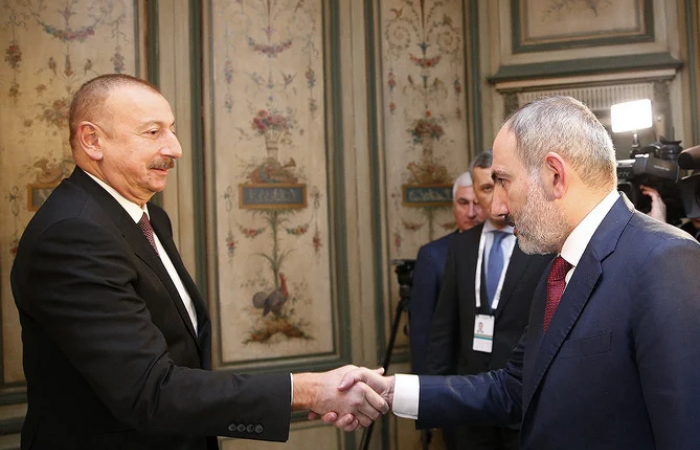
The president of Russia, Vladimir Putin, on Monday (31 October) hosted in Sochi the leaders of Armenia and Azerbaijan, prime minister Nikol Pashinyan and president Ilham Aliyev. Putin met separately with the two leaders, before hosting a two-hour trilateral meeting to discuss the current state of Armenia-Azerbaijan relations. The highly choreographed meetings in the grand settings of the Kremlin's summer residence in Sochi did not, it seems, result in the expectations that the Russian leader had of the sessions. After concluding the discussions only Putin made press comments, saying that they could not agree on many issues, but that he still felt that the meeting was "useful". The Russian president said that many elements that had been included in the draft of the statement prepared by the experts had to be deleted. In the joint written statement eventually issued at the end of the meeting, the three leaders touched upon the current state of Armenia-Azerbaijan relations, and the role of Russia. The statement appeared to endorse most of what was included in the Prague statement of 6 October 2022 between the president of the European Council, the president of France and the leaders of Armenia and Azerbaijan. The statement appeared to give a nod to a continuing Russian military force in Nagorno-Karabakh, and spoke about dialogue between representatives of societies.
Editor's choice
Monday Commentary
Monday Commentary: Why Central Asia matters

Monday Commentary: Why Central Asia matters

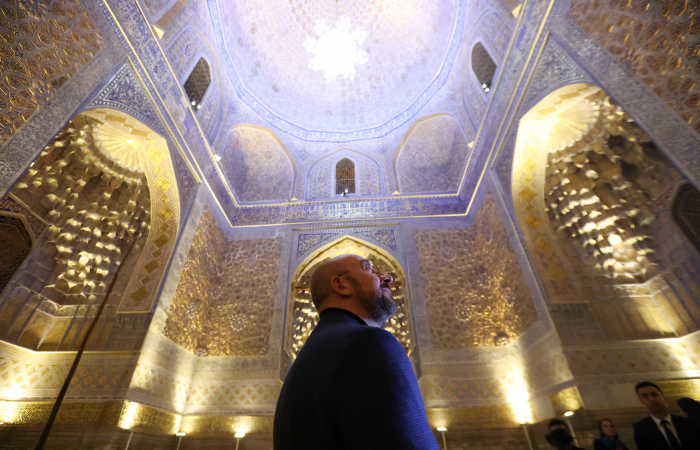
Very often, Central Asia is referred to as Russia’s back yard, even though today the region feels more like China’s front garden. But whilst the two “inseparable” friends, compete for influence and resources, the five Central Asian countries have set on a course to integrate themselves in global processes, break out of their geographic - and more importantly their geo-political constraints - and deliver better for their people. In this week's Monday Commentary on commonspace.eu, Dennis Sammut says that the Central Asian states have been reaching out to the EU and the US, whilst domestically some of them have embarked on deep reforms considered all but unimaginable until recently. The visit of European Council president Charles Michel to the region on 27-28 October marked a high point in a new phase in the relationship between the EU and Central Asia. In Kazakhstan, Michel not only met the Kazakh leadership, but also held a summit with the five Central Asian leaders in Astana, before travelling to Uzbekistan. For both the Central Asians and for the EU this is a watershed moment, and the beginning of a long journey. Europe’s approach to Central Asia needs to be respectful, both to the five countries themselves, and to their existing partners. Arrogance, even of the intellectual kind will simply backfire. But respect does not mean meekness. As a heavyweight in international relations, even if for the moment its economic weight dwarfs its political weight, the EU needs to approach Central Asia neither as a supplicant, nor as a benefactor, but simply as a reliable partner. Furthermore, this partnership needs to be diverse, multi-tiered and nuanced. It must take in relations with citizens, where Europe has much to offer both in terms of being a model, but also in terms of what it can share in areas such as education, innovation, youth welfare, women’s rights and diversity.
Editor's choice
News
Historic first EU-Central Asia regional high level meeting

Historic first EU-Central Asia regional high level meeting

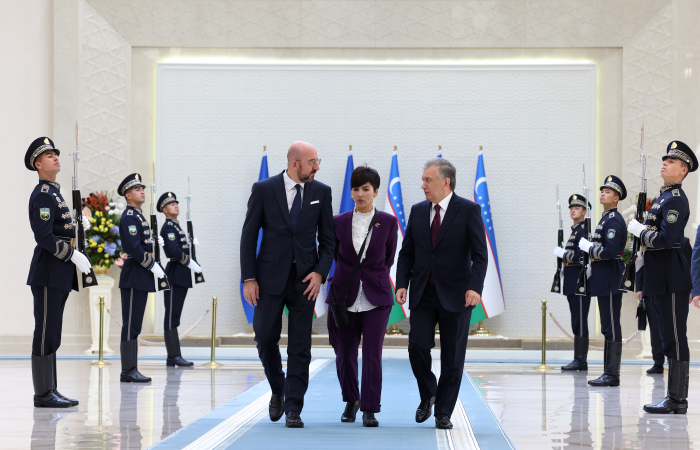
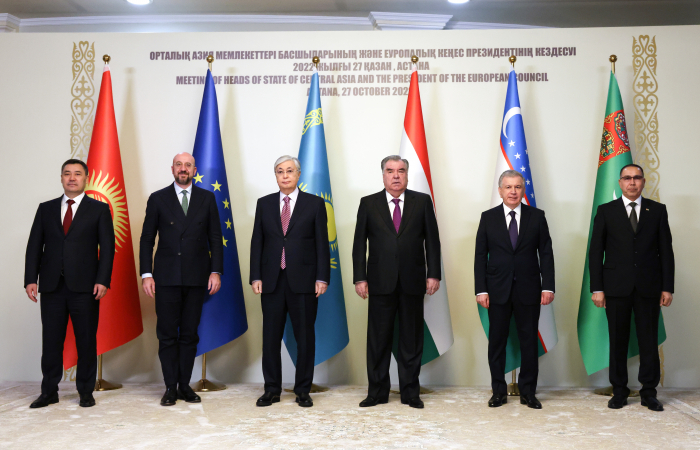
On 27 October 2022, President of the Republic of Kazakhstan Kassym-Jomart Tokayev, President of the Kyrgyz Republic Sadyr Zhaparov, President of the Republic of Tajikistan Emomali Rahmon, President of the Republic of Uzbekistan Shavkat Mirziyoyev and President of Turkmenistan Serdar Berdimuhamedov (represented by Turkmenistan's Deputy Chair of the Cabinet of Ministers) and President of the European Council Charles Michel welcomed the first regional high-level meeting in Astana. A joint statement issued after the historic meeting said that "in an open and friendly atmosphere of mutual respect and trust, the participants summarized the past period of multifaceted and mutually beneficial cooperation between Central Asian states and the EU and reaffirmed their commitment to continue building a strong diversified and forward-looking partnership underpinned by shared values and mutual interests. They reaffirmed their commitment to work together for peace, security, democracy, rule of law and sustainable development in full respect for international law. They expressed continued commitment to uphold the UN Charter, particularly the principles of respect for the independence, sovereignty, territorial integrity of all countries., non-use of force or threat of its use and peaceful settlement of international disputes." In the 30 years since the establishment of diplomatic relations between Central Asian States and the EU, interregional cooperation has advanced in many areas and sectors and serves as an example of a multilateral partnership for prosperity and sustainability.
Editor's choice
Commentary
Moscow surprised "Excitable Caucasians" have become rational

Moscow surprised "Excitable Caucasians" have become rational

For many years after the collapse of the Soviet Union, and the emergence of the newly independent successor states, Russian diplomats counselled their western colleagues on the business of dealing with the people of the Caucasus, and their politics. They often described the Caucasians as the "excitable people of the South", who needed a special kind of handling, and only Russians knew how to do it. It was a Soviet version of "orientalism" that still lingers among the current Russian elite. Putin’s handling of the 2nd Karabakh War - and the subsequent steps he took to establish the post-war order in the region - was very much in this vein. Russia rushed troops to Karabakh to keep the peace, and Russia was to be involved at every stage and in every corner of building a post-war order. There was no space left for others to contribute to this process, except for some general reference to a UN role in providing humanitarian aid. Well content that the excitable people of the South had been calmed down, President Putin turned his attention to other matters – namely what for him were the less excitable, but no less irritable people on the western frontier, the Ukrainians.