Theme

Diplomacy

Editor's choice
News
Israel recognises Somaliland, opening a pandora's box in Africa

Israel recognises Somaliland, opening a pandora's box in Africa

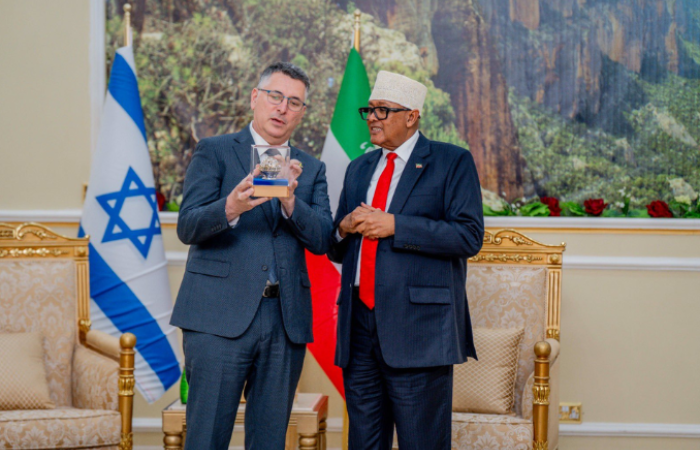
Israel ‍has recognized Somaliland as an "independent and sovereign state," Israeli Prime Minister Benjamin Netanyahu said on Friday. "Together with Foreign Minister Sa'ar and the President of the Republic of Somaliland, we signed a joint and mutual declaration," Netanyahu posted to X. "This declaration is in the spirit of the Abraham Accords signed at the initiative of President Trump," he said. In doing so, Israel became the first country to recognize the breakaway region. Somalia's Foreign Ministry denounced Israel's "deliberate attack" on its sovereignty and warned that recognizing Somaliland as an independent state would "undermine regional peace." "Illegitimate actions of this nature seriously undermine regional peace and stability, exacerbate political and security tensions," the ministry said in a statement. Egyptian Foreign Minister Badr Abdelatty said he held phone calls with his counterparts from Somalia, Turkey and Djibouti to discuss what they described as dangerous developments in the Horn of Africa, following Israel's announcement The ministers condemned Israel’s recognition of Somaliland, reaffirmed their full support for Somalia’s unity and territorial integrity, and warned that recognizing breakaway regions poses a threat to international peace and security, Egypt's Foreign Ministry said. "This initiative by Israel, which aligns with its expansionist policy and its efforts to do everything to prevent the recognition of a Palestinian state, constitutes overt interference in Somalia's domestic affairs," the Turkish Foreign Ministry said in a statement.  The African Union (AU) joined the condemnations of Israel's recognition of Somaliland.  "Any attempt to undermine the unity, sovereignty, and territorial integrity of Somalia... risks setting a dangerous precedent with far-reaching implications for peace and stability across the continent," an AU statement read. Israel said that it has now established diplomatic relations with Somaliland, and the two will soon set up embassies. commonspace.eu political editor said in a comment that by recognising Somaliland Israel has opened Africa's pandora's box. "The borders of most African countries were drawn in colonial times, and in the post-colonial period of the last seventy years, these borders have been considered sacrosanct. The two exceptions are also to be found in the Horn of Africa, where Eritrea broke away from Ethiopia and South Sudan broke away from Sudan." (click the image to read the full article).
Editor's choice
News
Zelensky to meet Trump today in Florida for crucial Ukraine talks (Updated)

Zelensky to meet Trump today in Florida for crucial Ukraine talks (Updated)

Ukrainian president Volodymyr Zelensky will meet with US president, Donald Trump, in Florida on Sunday (28 December) in what many see as crucial talks on the future of Ukraine. The time of the meeting between president Volodymyr Zelensky of Ukraine and US president Donald Trump, in Florida today, has been moved to 1300 hours local time. A Ukrainian delegation arrived in the United States to participate in a meeting between the two presidents. Yesterday, Volodymyr Zelenskyy announced the composition of Ukraine's negotiating team: National Security and Defense Council Secretary Rustem Umerov, Economy Minister Oleksiy Sobolev, Chief of the General Staff of the Armed Forces of Ukraine Andriy Hnatov, non-staff adviser to the head of the Presidential Office Oleksandr Bevz, and First Deputy Foreign Minister Serhiy Kyslytsya. On Saturday, the Ukrainian president outlined five thematic areas covered in the "peace plan" negotiations and which he wants to discuss with Trump at the meeting: "We are discussing security guarantees between Ukraine and the United States. This is one document. We are also discussing security guarantees with Europe. We are discussing the military dimension. This is part of the security guarantees." The fourth section he mentioned was a "prosperity plan, which will include many other documents," which includes discussions on raising up to $800 billion for Ukraine's reconstruction and creating a number of funds. "And fifth, what we want to discuss with the president is a plan of consistent action. That is, we want to propose, step by step, how to ensure that all the plans I've already mentioned actually work. They will, of course, discuss all of this with the Russians, and we will receive feedback," Zelenskyy stated.

Filter archive

Publication date
Editor's choice
News
Armenia and Azerbaijan move towards normalising relations and signing a peace treaty

Armenia and Azerbaijan move towards normalising relations and signing a peace treaty

Armenia and Azerbaijan have issued a joint statement in which they announced tangible steps in implementing confidence-building measures between them as a step towards normalising relations between them "and to reach a peace treaty on the basis of respect for the principles of sovereignty and territorial integrity." The two sides also announced a prisoner exchange. A joint sttament issued in Baku and Yerevan states that following talks between the Presidential Administration of the Republic of Azerbaijan and the Office of the Prime Minister of the Republic of Armenia, an agreement has been reached on taking tangible steps towards building confidence between two countries. Azerbaijan will release 32 Armenian military servicemen and Armenia will release 2 Azerbaijani military servicemen. The two countries will support each other's initiatives in the framework of COP. The statement adds that Armenia and Azerbaijan "will continue their discussions regarding the implementation of more confidence building measures, effective in the near future and call on the international community to support their efforts that will contribute to building mutual trust between two countries and will positively impact the entire South Caucasus region.”
Editor's choice
News
European Commission launches a Global Alliance to Counter Migrant Smuggling

European Commission launches a Global Alliance to Counter Migrant Smuggling

Criminal networks take advantage of people's desperation, and this abuse often leads to loss of life. Migrant smugglers squeezing hundreds of people onto unseaworthy boats, resulted in a staggering humanitarian toll of over 28 000 people having drowned or missing in the Mediterranean Sea since 2014. The main beneficiaries are the criminals, the smuggling networks in countries of origin, transit and destination. The current legislative framework is the Facilitators Package from 2002. Under the Facilitators Package, any person who intentionally assists the unauthorised entry, transit, or residence of a non-EU national into the EU, or, for financial gain, to reside there is to be sanctioned unless they are doing so for humanitarian reasons. On Tuesday (28 November), the European Commission proposed new legislation to prevent and fight migrant smuggling. The Commission has also launched a Call to Action for a Global Alliance to Counter Migrant Smuggling, at an International Conference hosted this week in Brussels. The Commission will ensure that the Global Alliance to Counter Migrant Smuggling will work at bilateral and multilateral level as well as through the work of the UNODC. Regular stocktaking at political level will be ensured, with the first event taking place in Copenhagen in the spring 2024. The Conference will be the first such opportunity to take stock of the achievements of the Global Alliance. Migrant smuggling is a criminal activity that disrespects human life and the dignity of people in the pursuit of financial or other material benefits. Smuggling networks make substantial profits from their criminal activities, ranging between EUR 4.7 – 6 billion worldwide annually.  The modi operandi of smuggling networks change rapidly, adapting to circumstances and responses by national authorities. This is why the Commission is increasing its efforts to tackle this crime at a global scale.
Editor's choice
News
Turkiye and UK sign landmark security and defence agreement

Turkiye and UK sign landmark security and defence agreement

The UK and Türkiye, on Friday (25 November) agreed to work more closely together to help bring greater stability, security and prosperity to both nations. UK Defence Secretary, Grant Shapps, signed a Statement of Intent on defence co-operation, with his Turkish counterpart, Minister of National Defense, Yaşar Güler. This will provide the framework for closer working to deliver additional activities that will benefit the security and prosperity of both countries and, in so doing, enhancing national, regional and international security. Following the signing, activity will see closer collaboration between both countries’ defence industries, the identification of possible joint training exercises in the Mediterranean, and the exploration of security support around North Africa and the Middle East. As well as discussing the need for de-escalation in the Middle East, the British Defence Secretary thanked his counterpart for utilising Türkiye’s influence as the gatekeeper to the Black Sea to enable the export of millions of tons of Ukrainian grain to nations who need it most. There was strong agreement on the need to keep focused on our collective support for Ukraine in the face of Russia’s continuing aggression.
Editor's choice
Opinion
Opinion: A worrying sense of deja-vu prevails in Armenia-Azerbaijan relations

Opinion: A worrying sense of deja-vu prevails in Armenia-Azerbaijan relations

This month marked the third anniversary of the ceasefire statement that was meant to end the second Karabakh war. In retrospect, it might be more appropriately considered a continuation of the first conflict of the early 1990s given that the ceasefire then was hardly implemented too, leading to a new war 26 years later. Meanwhile, hopes that Baku and Yerevan could sign a peace agreement are fading. In this op-ed for commonspace.eu Onnik James Krikorian says that "a deal was possible by the end of the year, both sides pronounced in 2022 and again throughout 2023, but that sounded as vague and sometimes disingenuous then as it does now. Instead, an uncanny sense of deja vu hangs over the process, reminiscent of earlier failures by the now defunct OSCE Minsk Group."
Editor's choice
News
Borrell briefs EU colleagues after damage limitation trip to Middle East

Borrell briefs EU colleagues after damage limitation trip to Middle East

The foreign ministers of the 27 EU member states held an informal video conference on Monday (20 January) to hear from the EU High Representative for foreign and security policy, Josep Borrell, the results of his recent visit to the Middle East. Borrell travelled to Israel, Palestine, Bahrain, Saudi Arabia, Qatar, and Jordan from 16-20 November. A statement from his office in Brussels at the start of the visit said that “the visit will take place against the background of the war against Hamas and the deepening humanitarian crisis in Gaza, following the 7 October Hamas terrorist attacks against Israel, and in the context of EU’s regional outreach, following-up to the latest European Council and Foreign Affairs Council.”Since the Gaza crisis erupted in October, the European Union has appeared to be confused and undecided.  Deep divisions in the position of many of the member states became evident in somewhat contradictory statements by leaders of the various EU institutions in the early days of the crisis, with some rushing to express solidarity with Israel, whilst others reminding of the long-suffering of the Palestinian people. The problem became more acute as the humanitarian crisis in Gaza escalated sharply following the launch of an Israeli military offensive. The divisions within the EU reached a climax at a vote at the UN General Assembly session on 28 October with some EU members voting for and others against a resolution on Gaza, whilst others simply abstained. Many saw this as a low point in the process of developing a “common foreign and security policy” for the EU, whilst others contemplated the damage that current EU positions were having on future relations with Arab and Muslim countries. The situation improved somehow following a meeting of the Foreign Affairs Council, where some sort of compromise position emerged. Borrell is constrained in having to reflect not only his position, and that of the European External Action Service, which he leads, but also the view of all the other European institutions and all the 27 member states. No mean task. None of them however appear to fully comprehend the sense of anger and frustration in the Arab and Muslim world at ongoing events in Gaza. As one young Arab commentator put it, the time the EU spoke from the moral high ground has gone, and will not come back. If the EU wants to communicate with the Arab and Muslim world in the future it has to find a new language. Borrell has taken a step in this direction through his visit and his op-eds, but it is just a small step in what promises to be a long and unpleasant journey.
Editor's choice
Commentary
Commentary: EU muddles along in its relations with the South Caucasus

Commentary: EU muddles along in its relations with the South Caucasus

It has been a roller-coaster sort of week for EU relations with the South Caucasus. It started on Wednesday (8 November), with the decision of the European Commission to recommend that Georgia be recognized as a Candidate Country, opening the way for eventual membership. By Tuesday, (14 November) the Foreign Affairs Council was considering providing military assistance to Armenia through possible assistance from the European Peace Facility. In the days in-between relations between the EU and Azerbaijan appeared to have dipped to their lowest point in a decade, with Azerbaijan accusing the EU of inciting separatism. Except that on Wednesday (15 November), the Azerbaijani presidential foreign policy aide surfaced in Brussels where he was told that Azerbaijan was an important partner for the EU in the South Caucasus and that the EU will continue to support the Armenia-Azerbaijan normalisation process to advance a peaceful and prosperous South Caucasus. One would like to think that all this was part of some grand strategy. Russian foreign minister Sergei Lavrov seems to think so, accusing the EU of trying to oust Russia out of the South Caucasus (and Central Asia). But a closer look at this week’s events suggest that the EU is doing, what it often does: muddling along, reacting to events and situations rather than fulfilling some grand strategy. This is risky, and the EU needs to develop a strategic framework for dealing with the South Caucasus. There is an urgent need for the European Union to develop a strategic perspective towards the region that is based on realism, and that has enough support from different stakeholders – Commission, Member States; Parliament – for it to be credible. Developing a comprehensive EU strategy will take time and will require an alignment of different views and interests that may take months, if not years, to achieve. In the meantime however, the EU should have the ambition to publish by early Spring 2024 a short but ambitious statement of intent with its vision for the region that may provide a framework around which different ad hoc policies and initiatives can be organized. The first half of 2024 may offer a window of opportunity for this to happen.
Editor's choice
News
UN Security Council finally adopts resolution on Gaza

UN Security Council finally adopts resolution on Gaza

The UN security council on Wednesday adopted a resolution calling for urgent and extended humanitarian pauses and aid corridors throughout the Gaza Strip. They should remain in place for a sufficient number of days so that aid is able to reach civilians who need it, the council said, especially children, who are mentioned in almost every paragraph of the resolution. The vote marked the first time council members have managed to adopt a resolution related to the war in Gaza. The resolution also calls for the release of all hostages and for all sides to refrain from depriving Gazan civilians of the basic goods and services that are critical to their survival. It further demands the urgent implementation of recovery efforts to find those trapped under rubble of damaged and destroyed buildings. Throughout the resolution, the council also rejected the forced displacement of Palestinians. Twelve of the 15 council members voted in favor of the resolution, with US, UK and Russia abstaining. Before the vote, Russia’s representative, Vassily Nebenzia, proposed an amendment calling for “an immediate, durable and sustained humanitarian truce leading to the cessation of hostilities.” This was voted down by the council, with only five members voting for it, including the UAE. The US voted against it and the nine remaining members abstained. The US and Russia have both accused each other of blocking attempts to agree on action related to the conflict in Gaza. The council, the UN body responsible for maintaining international peace and security, failed to adopt four previous draft resolutions, exposing the bitter divisions between members. The US has been adamant about rejecting any language that calls for a ceasefire, does not assert what Washington describes as “Israel’s right to self-defense,” or fails to unequivocally condemn Hamas for its actions. The twelve members of the UN Security Council who voted for the resolution were: Albania, Brazil, China, Ecuador, France, Gabon, Ghana, Japan, Malta, Mozambique, Switzerland and the United Arab Emirates.