Russian political expert:

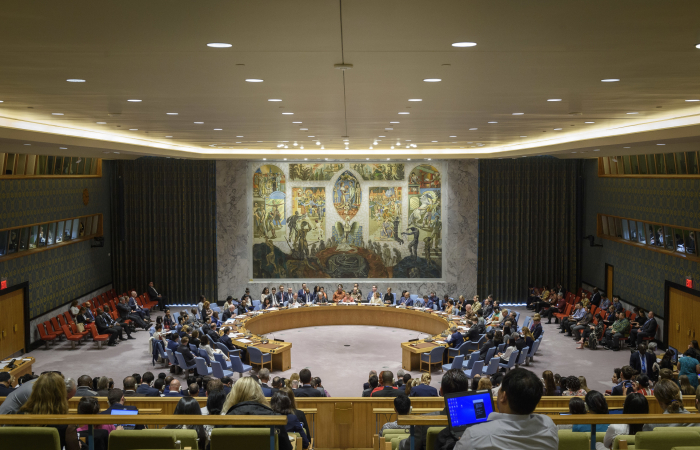
Azerbaijan's leadership has really got an opportunity to use the UN tribune and the status of the UN Security Council's non-permanent member to strengthen its positions on the international arena in 2012-2013. Baku is very likely to use these new opportunities in its diplomatic and information war against Armenia, Alexander Krylov, senior research fellow at the World Economy and International Relations of the Russian Academy of Sciences, Doctor of Sciences, History, told ArmInfo.

On October 26 Foreign Minister of Azerbaijan Elmar Mammadyarov said Azerbaijan is going to discuss the issue of submitting the Karabakh problem to consideration of the UN with the five permanent members of the UN Security Council. Azerbaijan became the UN SC's non-permanent member for 2012-2013 for the first time in its history.

"This war has been waged for years and is now bringing its fruits. In Europe there is no deficit of the Azerbaijani literature translated into many languages. This allows Azerbaijan introducing its own interpretation of the Karabakh conflict and discrediting Armenia and presenting it as an "aggressor" and "occupant". However, this has not yet led to a one sided concessions or capitulation of Armenia in the Karabakh process. The status of the UN SC's non-permanent member will hardly allow Azerbaijan to settle this issue," he said.

At the same time, Krylov said, the Azerbaijani leadership has got a good opportunity to use that status to overcome the mentality of confrontation, enmity and stereotypes, and offer real ways of confidence building and create bases for settlement of the conflict. In that case, it will be possible to speak of real progress in the peace process, he said.


Related articles

Editor's choice
News
Keir Starmer: Only Greenland and Denmark should decide the future of Greenland

Keir Starmer: Only Greenland and Denmark should decide the future of Greenland

Only Greenland and Denmark should decide the future of Greenland, British Prime Minister Sir Keir Starmer has told the BBC. It comes after President Trump again said "we need Greenland from the standpoint of national security". Both Greenland's prime minister and Denmark's prime minister strongly rejected the idea over the weekend. Greenland's Prime Minister Jens Frederik Nielsen responded to Trump's latest comments by saying "that's enough now" and described the notion of US control over the island as a "fantasy". Meanwhile, Denmark's Prime Minister Mette Frederiksen had said "the US has no right to annex any of the three nations in the Danish kingdom". Asked whether he would also say to President Trump "hands off Greenland", Sir Keir's response was definitive, when so often in diplomacy answers are caveated and nuanced. "Yes," he replied. "Greenland and the Kingdom of Denmark must decide the future of Greenland and only Greenland and the Kingdom of Denmark. "And Denmark is a close ally in Europe, is a Nato ally and it is very important that the future of Greenland is for the Kingdom of Denmark and for Greenland themselves and only for Greenland and the Kingdom of Denmark."

Popular

Editor's choice
News
Keir Starmer: Only Greenland and Denmark should decide the future of Greenland

Keir Starmer: Only Greenland and Denmark should decide the future of Greenland

Only Greenland and Denmark should decide the future of Greenland, British Prime Minister Sir Keir Starmer has told the BBC. It comes after President Trump again said "we need Greenland from the standpoint of national security". Both Greenland's prime minister and Denmark's prime minister strongly rejected the idea over the weekend. Greenland's Prime Minister Jens Frederik Nielsen responded to Trump's latest comments by saying "that's enough now" and described the notion of US control over the island as a "fantasy". Meanwhile, Denmark's Prime Minister Mette Frederiksen had said "the US has no right to annex any of the three nations in the Danish kingdom". Asked whether he would also say to President Trump "hands off Greenland", Sir Keir's response was definitive, when so often in diplomacy answers are caveated and nuanced. "Yes," he replied. "Greenland and the Kingdom of Denmark must decide the future of Greenland and only Greenland and the Kingdom of Denmark. "And Denmark is a close ally in Europe, is a Nato ally and it is very important that the future of Greenland is for the Kingdom of Denmark and for Greenland themselves and only for Greenland and the Kingdom of Denmark."