Region

Ukraine and Eastern Europe

Stories under this heading cover Ukraine and Eastern Europe. 

Editor's choice
News
UN General Assembly demands that Russia returns Ukrainian children

UN General Assembly demands that Russia returns Ukrainian children

The UN General Assembly, in a vote on Wednesday (3 December) overwhelmingly voted in favour of a resolution demanding that Russia returns Ukrainian children kidnapped since the start of the Russian invasion in February 2022. 91 countries voted in favour of the resolution, 12 voted against, and 57 countries abstained or were not present. Russia and Belarus were joined by ten countries in voting against the resolution, namely, Iran, Cuba, Nicaragua, Burundi, Burkina Faso, Niger, Mali, Democratic Republic of Congo, Sudan, and Eritrea. From the South Caucasus, Georgia voted in favour of the resolution, but Armenia and Azerbaijan abstained, as did Turkiye and the five Central Asian republics. Also abstaining were the six Gulf monarchies and most Arab countries. The resolution calls for the immediate return of Ukrainian children who were deported to Russia. The Ukrainian government says more than 19,000 children have been taken away from Russian-occupied areas and elsewhere since Moscow's invasion began in February of 2022. The draft resolution submitted on Wednesday demands that Russia "ensure the immediate, safe and unconditional return" of the children. (Read more by clicking the image)
Editor's choice
Monday Commentary
Monday Commentary: Europe needs to continue supporting Ukraine fully in the crucial coming year

Monday Commentary: Europe needs to continue supporting Ukraine fully in the crucial coming year

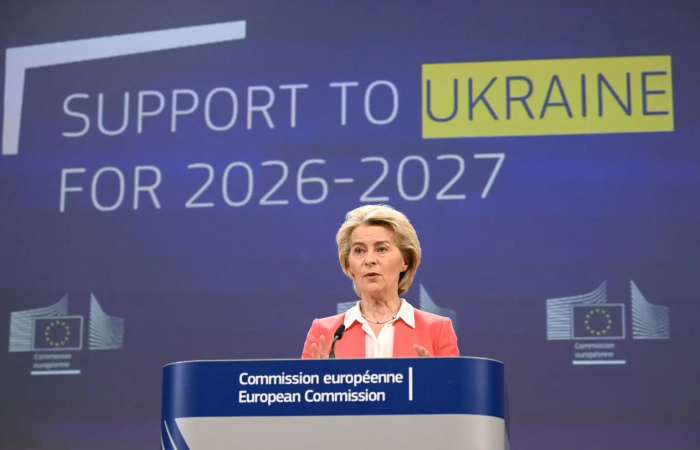
Talks were held in Geneva on Sunday (23 November) between the United States and Ukraine. Also present in Geneva were representatives of the key European countries, France, Germany and UK, and the EU. The talks are expected to continue today. The future if Ukraine is at stake, and so is the future of Europe. There should be no doubt that Putin’s ambitions do not stop in Kiev. The talks are expected to continue today (24 November), and Ukraine’s de facto capitulation is not an option for Europe. The scandalous draft of the plan called “the US plan”, but probably written by the Russians, appears to have been put aside. Officially it is still called the “US plan”, that is what the ego of US president, Donald Trump, requires. But it started to look increasingly like the plan put forward by the Europeans, which is much closer to the Ukrainian position. The Europeans were not represented in Geneva by Ministers and politicians, but by their national security advisors, somber men who are cool and calculating. They have a difficult task: on the one hand they understand very well that Ukraine’s war is Europe’s war, and they know better than anyone else how big the threat of Putin’s Russia is to European peace and security. The risks of the “original US plan” are obvious to them. But they also understand that Ukraine, and up to now Europe, depend on the US for their security. So, they cannot alienate the American president too much. US Secretary of State, Marco Rubio, well understands the European dilemma. He finds himself in the unenviable position of needing to reconcile his president’s views, with the Ukrainian and European one. At stake is Ukraine’s future as a state. Ukrainian president Vlodomyr Zelenkiy quaintly calls it “Ukraine’s dignity”. But it is much more than that. Russia does not want Ukraine to exist as a state in any meaningful way. It should either have a puppet government, as it wanted to impose on Kiev when it launched the invasion in February 2022; or be so weak and dismembered that it will be in all but name a vassal of Russia. Whatever is finally agreed in Geneva, and whatever Donald Trump finally decides, 2026 is going to be a crucial year for Ukraine. European support has so far been steady, but must become steadier, regardless of Trumpian shenanigans. 2026 must be the year of European Ukraine. For this to happen their must be more resolve in Europe, and a stronger determination to support Ukraine fully. (read the full commentary by clicking on the image).

Filter archive

Publication date
Editor's choice
News
Ukraine repels 60 Russian attacks in 24 hours as Bakhmut situation deteriorates

Ukraine repels 60 Russian attacks in 24 hours as Bakhmut situation deteriorates

The Ukrainian military repelled 60 Russian attacks in five areas over the past 24 hours in northeastern and eastern Ukraine, the General Staff of Ukraine's Armed Forces reported in its morning update on Tuesday (28 February). Ukraine repelled the attacks near Kupyansk in eastern Kharkiv Oblast as well as Lyman, Bakhmut, Adviika, and Shakhtarsk in Donetsk Oblast, where Russia is concentrating its main offensive efforts, according to the General Staff. Russian troops reportedly carried out eight missile attacks, 32 air strikes, and launched more than 85 attacks using multiple launch rocket systems  between 27 and 28 February, the statement said. Meanwhile, in his daily address on the evening of 27 February, Ukrainian President Volodymyr Zelensky said that the situation in the Bakhmut direction is "getting more and more difficult". He added that Russia "is constantly destroying everything that can be used to protect our positions, to gain a foothold and ensure defense". The commander of Ukraine's ground forces, Col Gen Oleksandr Syrskyi, has said the situation around Bakhmut is "extremely tense". Russia has been trying to take the medium-sized industrial town with a pre-war population of roughly 70,000 for over six months, and has long been a location where the front line has been the most active. 
Editor's choice
Editorial
Our War

Our War

One year has passed since Vladimir Putin’s Russia attacked Ukraine, plunging Europe into a war that has already claimed the lives of tens of thousands, and devastated a whole country. Putin expected Ukraine to fall into his lap within hours. It didn’t. It resisted heroically. He also expected Europe, the United States and the rest of the international community to give a muddled response, and for things to be back to business as usual within weeks. It did not happen. The response of Europe, the United States and similarly minded countries was fast, resolute and robust. Having grossly miscalculated, Putin had two choices: to admit his mistake and recalibrate, or, to persist, and to keep digging despite the fact that he was clearly in a hole. Most countries have internal corrective systems that in such situations keep leaders in check. In Russia no such systems exist. So Putin keeps digging himself into a hole by threatening to escalate. What has been clear from day one, is that this is not simply Ukraine’s war. Countries can have disputes, and sometimes they also go to war with each other. Usually the world stands by and tries to bring the belligerents to the negotiating table and to restore peace.
Editor's choice
News
Spanish PM arrives in Kyiv after confirmation of Leopard deliveries

Spanish PM arrives in Kyiv after confirmation of Leopard deliveries

The Spanish Prime Minister Pedro Sanchez has arrived in the Ukrainian capital of Kyiv on Thursday (23 February), one day before the one year anniversary of Russia's full-scale invasion of Ukraine. The visit from PM Sanchez comes one day after Spain confirmed that it would send six refurbished Leopard 2 tanks to Ukraine, with the goal to have the tanks in Ukraine by the end of March or early April. Writing on Twitter, PM Sanchez said, "We will stand by Ukraine and its people until peace returns to Europe." He has also visited Bucha, the Kyiv suburb infamously known as the site of many alleged Russian war crimes against civilians in the first weeks of the full-scale invasion. "Bucha and Irpin show the wounds and scars of Putin's barbarism. Russia is not going to win this war. All of Spain is with Ukraine," he said. Sanchez's visit is the latest in a number of high-profile visits to Kyiv in the run up to the 24 February. US President Joe Biden made a surprise visit on Monday during which he pledged another $500m of military aid. Then, on Tuesday, the Italian Prime Minister Giorgia Meloni visited Kyiv for talks with President Zelensky, during which she pledged to continue supporting Ukraine in resisting Russian attacks but ruled out offering fighter jets.
Editor's choice
News
Ukrainian civil society and city representatives meet LINKS Europe in The Hague to discuss future cooperation

Ukrainian civil society and city representatives meet LINKS Europe in The Hague to discuss future cooperation

On Tuesday (21 February), a delegation of six Ukrainians, including two representatives from the National Interests Advocacy Network NGO “ANTS”, and four representatives from the cities of Kherson, Mykolaiv, and Mariupol, visited the LINKS Europe in The Hague. The Ukrainian delegation included: Vasyl Sehin, the Executive Director of ANTS; Yuliya Vusenko, the regional coordinator of ANTS and the head of the investment commission in Volyn Oblast Council; Olexandr Senkevych, the Mayor of Mykolaiv; Serhii Koreniev, the Deputy Mayor of Mykolaiv; Halyna Luhova, the Mayor, Secretary and Head of the Military Administration of Kherson; and Sergiy Orlov, the Deputy Mayor of Mariupol. The Ukrainian delegation were on a two-day visit to Rotterdam and The Hague to meet with Dutch civil society and city representatives to discuss potential future cooperation between the respective organisations and cities, with a particular focus on developing horizontal EU-Ukraine ties and harnessing knowledge for the reconstruction of Ukraine following the ongoing war’s conclusion.
Editor's choice
Interview
Samantha Smith's Group: the global volunteer movement uniting Ukrainians and Russians through English

Samantha Smith's Group: the global volunteer movement uniting Ukrainians and Russians through English

On 24 February 2022, in the town of Kostyantynivka in Ukraine’s eastern Donetsk oblast, Anastasiia woke up at 4am to the sound of explosions. Not in her town, but about 30km away. When the first explosion hit she did not understand what was going on, but once the second explosion hit she rushed to her parents’ room and told them that the war had started. Originally conceived as a protest, Samantha Smith’s Group has evolved into a herculean effort run by a tight-knit, principled and dedicated group of individuals committed to making a very genuine difference to Ukrainians whose lives have been turned upside down by Russia’s invasion of their country. However, although the teachers come from all over the world, from Canada to New Zealand, from the UK to Costa Rica, as well as Ukraine and Belarus, the majority of volunteers teaching English to Ukrainians in Samantha Smith’s Group are actually from Russia.
Editor's choice
News
US President Joe Biden visits Kyiv

US President Joe Biden visits Kyiv

The President of the United States Joe Biden has made a surprise visit to Kyiv ahead of the first anniversary of Russia's full-scale invasion of Ukraine on 24 February last year. On Monday morning (20 February), there were reports of blocked roads and major traffic jams in the Ukrainian capital as speculation built over the potential arrival of an "important guest", according to Ukrainian officials.  The Ministry of Foreign Affairs and St Michael’s Cathedral has been blocked off with a police and military presence. Just before midday, pictures emerged on social media showing the Ukrainian President Volodymyr Zelensky walking alongside the US President Joe Biden in central Kyiv. As Joe Biden was seen walking beside Volodymyr Zelensky outside St Michael's Cathedral, heading towards a memorial wall honouring Ukrainian soldiers fallen in Russia's war against Ukraine since 2014, air raid sirens rang out over the Ukrainian capital. It was already known that Biden would be visiting Poland to mark one year of Russia's full-scale invasion, but his visit to Kyiv has come as a complete surprise.
Editor's choice
News
Ukraine marks the Day of Heroes of the Heavenly Hundred

Ukraine marks the Day of Heroes of the Heavenly Hundred

Today, on Monday (20 February), Ukraine is marking the Day of Heroes of the Heavenly Hundred in commemoration of those who died during the 2013-14 Euromaidan protests, also known as the Revolution of Dignity. It has been marked annually on 20 February following a Presidential Decree signed by then-Ukrainian President on 11 February 2015, "On commemorating the feat of the participants in the Revolution of Dignity and perpetuating the memory of the Heroes of the Heavenly Hundred." "The Heavenly Hundred" refers to the 108 people who died during the Euromaidan protests nine years ago. This includes 105 Ukrainians and three foreigners, one from Belarus and two from Georgia. It was between 18-20 February 2014 that the Revolution was at its most violent, during which time 78 protesters were killed on Independence Square in Kyiv. After 20 February, over 20 protesters died of their injuries. The day began with a short address from Ukrainian President Volodymyr Zelensky. He said: "The time comes when the voices of millions merge into a single voice of the people, saying that Ukrainians want and will live only in a free state. In their own Ukraine. Which will certainly survive. And which will certainly preserve freedom."
Editor's choice
News
Russia may have lost up to 200,000 troops, according to UK intelligence

Russia may have lost up to 200,000 troops, according to UK intelligence

In a security briefing on the Russia-Ukraine war released on Friday (17 February), the UK Ministry of Defence has announced that they believe that Russia may have lost anywhere between 175,000 and 200,000 soldiers since the 24 February 2022. This figure includes regular soldiers from the Russian Armed Forces and private military contractors from the likes of the Wagner group. The briefing adds that the number of killed could be anywhere between 40,000 and 60,000, and that the casualty rate has significantly increased since Vladimir Putin announced his 'partial mobilisation' in September 2022. It goes on to say that by modern standards, "these figures represent a high ratio of personnel killed compared to those wounded", adding that the casualty rate has likely been exacerbated by "extremely rudimentary medical provision across much of the force". Finally, the briefing writes that Wagner forces have deployed large numbers of convict recruits, who have probably seen a casualty rate of up to 50%.