Armenian-Georgian relations are friendly, regardless of some tensions under the surface. During his visit to Georgia this week Nikol Pashinyan should focus on pragmatic issues related to transport corridors, argues Benyamin Poghosyan in this op-ed.
On Wednesday (30 May) Armenia’s new Prime Minister, Nikol Pashinyan will visit Georgia. This will be his second foreign trip, and the first one for bilateral talks. On May 14 Pashinyan was in Sochi where he participated in the Eurasian Economic Union summit and had meetings with Russian President Vladimir Putin, Belarus President Alexander Lukashenko and Kyrgyzstan President Sooronbay Jeenbekov.
Georgia plays a key role in Armenian foreign policy. Given the absence of relations with Azerbaijan and Turkey Georgia is one of only two gateways for Armenia to connect with the world. Approximately 70 percent of Armenian foreign trade passes through Georgia. The country is the only channel for Armenian business to reach both Russia - a critical market for Armenian exports, and Europe - another key spot for Armenian business especially after 2017 November signature of Comprehensive and Enhanced Partnership Agreement with the EU.
The two states enjoy friendly partner relations. No acute problems exist between them. However, there are some tensions under the surface which have negative impact on bilateral relations and mutual perceptions. Georgia's strategic partnership with Azerbaijan and Turkey and the growing Azeri-Turkish economic influence in Georgia cause concern in Armenia. On the other hand, the Russian military base deployed in Armenia is perceived by many in Georgia as a potential threat in case of new crisis in Georgia - Russia relations. The existence of a large Armenian minority in Georgia, mostly concentrated in the regions adjacent to Armenia, is viewed by some in Georgia as a potential source for another territorial problem. Meanwhile, the growing decline in the Armenian population of Georgia due to immigration is a source of concern for Armenia. The disagreements over the fate of Armenian churches in Georgia also negatively impact bilateral relations.
Armenian Prime Minister visit to Georgia takes place in a key moment for Post - Soviet Armenian history. The "Velvet revolution" launched in April abruptly brought to end almost two decades rule of the Republican Party. The Protest leader MP Nikol Pashinyan was elected Prime Minister on May 8. Till now the leader in democracy promotion in the South Caucasus was Georgia, given both its 2004 "Rose Revolution" and the peaceful transfer of power in 2012 parliamentary elections. The Euro-Atlantic community perceived Armenia as a hybrid, soft authoritarian state under tight Russian control, with very limited ability to pursue an independent foreign and security policy, or launch effective domestic reforms to tackle the systemic corruption and lack of good governance. Despite the Armenian Prime Minister's public statements that the Revolution has only a domestic agenda, and nothing will change in Armenian foreign policy, the April 2018 events have raised some expectations in the West that genuine domestic reforms will not have zero impact on Armenia's relations with both Russia and the West, in mid and long term.
Given the 14 years of reform history in Georgia, with its all ups and down, Armenia has something to learn from Tbilisi, and simultaneously to understand how not to repeat the mistakes of the Saakashvili government. Given the overall negative attitude regarding Saakashvili in Georgian society and ruling elite, it would be wise not to emphasize any Armenian readiness to emulate Saakahsvili style reforms, but to seek to get the best of Georgia's experience. Meanwhile, it should be emphasized that during the revolution Pashinyan has always mentioned the importance of Armenia having good relations with Georgia. The early visit to Georgia is a confirmation of Georgia's significant role in Armenian foreign and security policy.
Obviously the first visit cannot solve all problems or bring about some extraordinary new breakthrough in bilateral relations. It would be wise for the Armenian side to concentrate its efforts on two main issues. First is the launch of new corridors to reach Russia via Georgia. Currently the only road connecting Armenia to Russia is the Georgian Military highway through the Upper Lars - Kazbegi checkpoint, which is unreliable especially during winters. The Georgian government has already announced its decision to construct a tunnel along the road and modernize the border checkpoint to improve this corridor. The Armenian side needs to highlight the significance of this project for Armenia, and express its readiness to support the implementation process.
Another important development related with transit to Russia is the Russian government's signature on May 18 of the agreement with the Swiss company SGS (Société Générale de Surveillance SA), a mediator that will monitor implementation of the agreement made between Georgia and Russia in 2011 on cargo movement. The 2011 agreement envisages the monitoring of cargo movement from Georgia to Russia via three "trade corridors," two of which run through the breakaway regions of Abkhazia and South Ossetia. The Georgian government signed the agreement with the Swiss company in December 2017. Thus, both Russia and Georgia have now made a significant step towards the implementation of the 2011 agreement which will create for Armenia additional corridors to reach Russia, and even potentially bring closer the re-launch of Abkhazian railway which will give Armenia railroad access to Russia. The Armenian side should express its satisfaction on these developments both to the Georgians and the Russians.
The second key project which should be discussed during the Prime Minister's visit is the establishment of the "Persian Gulf - Black Sea" multimodal transportation corridor to create an additional trade route from Iran to Europe, passing through Armenia and Georgia. Negotiations have been launched in 2016 first in the format of the bilateral Armenia - Iran consultations, and then expanded to include Azerbaijan, Georgia, Greece and Bulgaria. Three expert level meetings have been held, and the last session took place in Tbilisi in October 2017. The preliminary signature of the agreement is scheduled in the second half of 2018. The strategic significance of this project is the possibility to connect this route to the China - Iran sea and railroad (China - Kazakhstan - Turkmenistan - Iran) transit and thus create an additional China - Europe transport corridor which could be integrated in the Chinese flagship "One belt, One Road" initiative. Georgia is keen to be included in OBOR. Currently, Georgia is involved in the initiative through the Trans-Caspian International Transport Route (it starts from China, runs through Kazakhstan, Caspian Sea, Azerbaijan, Georgia and further on to European countries either via the Georgian Black sea ports or via Turkey using the Baku - Tbilisi - Kars railway). The connection of the "Persian Gulf - Black Sea" corridor to the China - Iran transit will create additional opportunities for Georgia to be included in OBOR, and will allow Armenia to break its isolation from regional infrastructure projects.
Thus, the recent domestic developments in Armenia, some advancement in Russia - Georgia bilateral talks, and additional possibilities for Armenia and Georgia to be included in OBOR create a unique positive atmosphere for further developments of Armenia - Georgia relations.
source: Dr. Benyamin Poghosyan is the Executive Director of the Political Science Association of Armenia. He contributed this op-ed to commonspace.eu
The views expressed in opinion pieces and commentaries do not necessarily reflect the position of commonspace.eu or its partners
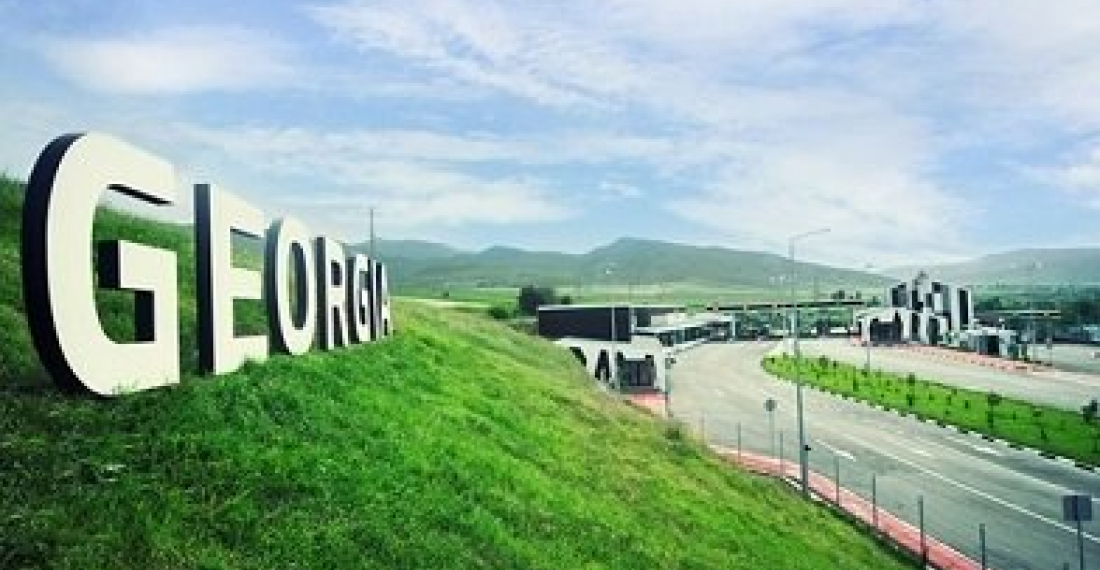
Photo: The newly renovated Sadakhalko border and customs checkpoint between Armenia and Georgia. A large part of Armenia's trade with Russia and the EU passes through Georgia.