On 13 December 2021, after months of backroom negotiations, the then outgoing Prime Minister Mark Rutte of the liberal People's Party for Freedom and Democracy (VVD), dressed in jeans, a shirt, and a blue bodywarmer, announced an agreement on the formation of a new government coalition to run the country from 2021-2024. In the new coalition, four political parties will work together: VVD, D66, CDA, and ChristenUnie. One important feature of the coalition agreement is its positive and optimistic approach towards the European Union. Is this then the end of Euroscepticism in the Netherlands? Maximiliaan van Lange analyses in this article for commonspace.eu the background to the formation of the fourth Rutte Cabinet (Rutte IV) and examines how the Netherlands will now pursue its objectives within the European Union.
In the post-World War II period, the Netherlands was well-known to be a strong supporter of European cooperation, and the so called “European project”. Nonetheless, Euroscepticism has gained a firm foothold in the country in recent years, although it remains a minority view. In 2021, 56% of Dutch people said the EU evokes a positive impression, compared to 13% with a negative perception, and 31% with a neutral view.
Up to World War II, the Netherlands was globally recognised as a neutral player, but since 1949, the country has been a member of the North Atlantic Treaty Organization (NATO) and has been aiming for collective cooperation, especially in the areas of security and peace. Dutch foreign policy since that period has been called Atlanticist, but there have been important nuances. Dutch society took a more critical view of NATO due to the Vietnam War (1955-1975) and the national demonstrations against the placement of American cruise missiles and nuclear weapons (1981 and 1983) on its territory. It is an open secret that nuclear weapons are still kept in the Netherlands. It resulted in the politicisation of society.
The Atlanticist approach prioritised bilateral relations with the United Kingdom (UK), United States (US) and Canada. This is sometimes called anti-continentalism. The Netherlands was traditionally more focused on the ocean than on mainland Europe. However, on 31 January 2021, the UK officially left the EU and the Netherlands lost one of its most important trading partners. In addition, the focus of US presidents shifted from Europe to the Pacific, mainly because of the geopolitical threat from China.
This new situation is impacting the Netherlands hard, and the country is paying the price for having had its back turned to Europe too much. The country is forced to find new allies and trade partners within the EU. In 2020, Minister of Finance, Wopke Hoekstra (CDA), engaged in unseemly arguments with counterparts from southern Europe about financial support to these countries and establishing Eurobonds to mitigate the COVID-19 pandemic and its economic impact, causing a loss of face for the Netherlands. Earlier, Dutch foreign policy had caused much animosity in the Eastern member states when the then foreign minister Frans Timmermans insisted on highlighting rule of law issues. Some say it eventually cost him the presidency of the European Commission. Wopke Hoekstra has just been sworn in by the Dutch King, Willem-Alexander, as the new Minister of Foreign Affairs. Can Hoekstra get rid of his past baggage and help build a new role for the Netherlands within the EU?
Despite the disagreement with Southern European countries and some Eastern European countries, Hoekstra has a wide experience abroad and speaks several European languages, including Italian. The irony is that although he has had his differences of opinion on some issues in the past, he believes that relations with his colleagues in European countries are "excellent". However, Hoekstra realises that Europe is a relatively small and vulnerable continent with half a billion people, a continent that is barely able to defend itself. Hoekstra therefore sees cooperation as a necessity.
In the coalition agreement, the parties are committed to strengthening military cooperation in the EU through joint missions and military exercises. The parties also agreed to explore the possibility of creating a European Security Council (in which the UK is at the table, but small European countries are not), to strengthen European foreign policy, and want to present concrete proposals on the subject. To the surprise of some, this debate has now been reflected in the new coalition agreement of the incoming Dutch government.
On its part, the Netherlands also aims to establish a National Security Council as a tool to counter foreign interference. There will be a structural increase in the defence budget of 3 billion euros. The current military expenditure is 12 billion euros, with an expected increase to 1,85% of GDP in 2024. Official Development Assistance will also increase by 500 million euros, All these measures send a signal that the new cabinet wants to invest in security and stability in Europe and its neighbourhood.
With this multi-year agenda for cabinet policy, the Rutte IV government wants to ensure that the EU acquires more influence on the world stage. The previous Rutte III Cabinet already supported abolishing the right of veto by EU member states in the European Council on decisions to impose sanctions on countries for weakening democracy and the rule of law. However, imposing sanctions is often difficult because of the historical and economic ties that member states, with for example, China or Russia. Rutte IV wants to examine whether the veto right in other foreign policy decisions should be modified to become more efficient.
Finally, the traditionally trade-oriented and liberal Netherlands advocates the EU's open strategic autonomy, innovative strength, and smart industrial policies - a development that has been visible in Europe for some time. The country is also aligning itself even more strongly with ambitious European energy and climate plans, thus opening the door to a more robust collective European foreign policy.
For now, no European flag flies inside the Dutch Parliament and the flag is rarely visible in Rutte's office, the Torentje (Little Tower). After reading the coalition agreement of Rutte IV, this seems only a matter of time. A pro-European wind is now blowing in The Hague. Or maybe it is just a breeze, and in any case will it last?
source: This analysis was prepared by Maximiliaan van Lange, Research Associate at LINKS Europe and part of the research team of commonspace.eu.
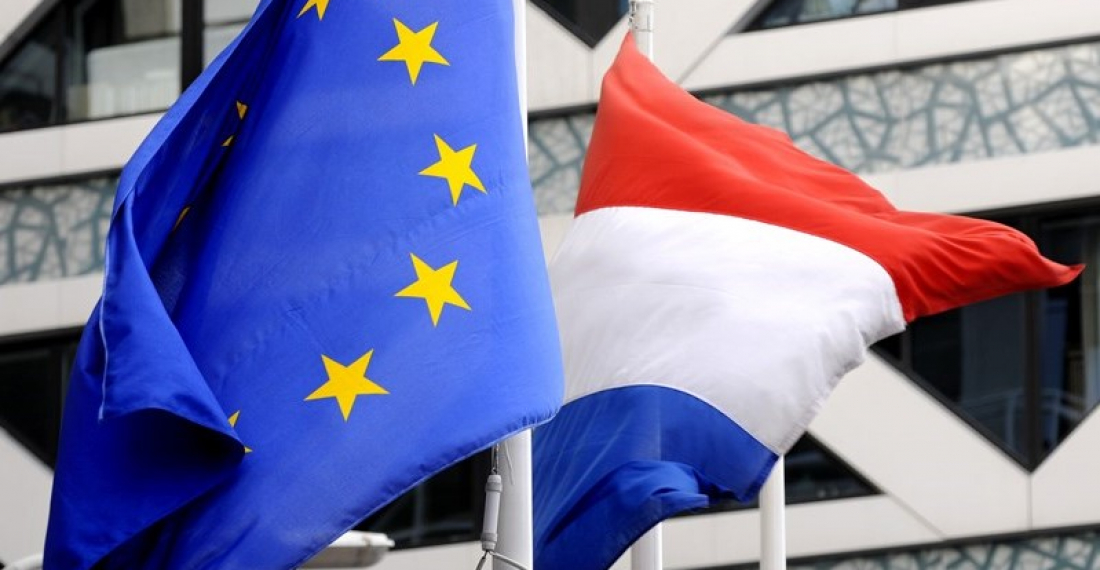
photo: Flag of the Netherlands and European Union. Hollandse Hoogte
The views expressed in opinion pieces and commentaries do not necessarily reflect the position of commonspace.eu or its partners.