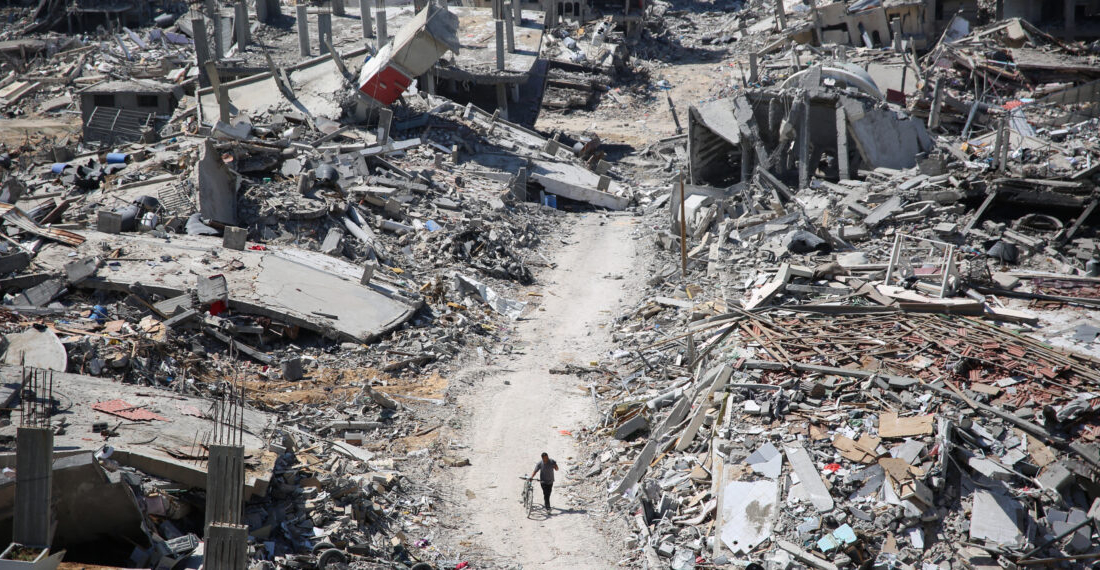
Since 7 October 2023, when Hamas killed 1,139 innocent civilians in Israel, the Israeli government has been conducting military operations in the Gaza Strip that have taken the lives of 43,552 Palestinians. As the death toll of Palestinians is increasing, the UN General Assembly (UNGA) has asked the International Court of Justice to give an advisory opinion on Israel’s military operations in Palestine. The International Court of Justice (ICJ) in The Hague issued an advisory opinion on 19th July 2024, stating that Israel’s continued presence in the Occupied Palestinian Territory is illegal under International Law. The ICJ also argued that states must not assist via financial, military or political aid to the Israeli government in maintaining its unlawful occupation (para. 273-279). It is important to note that although advisory opinions are not binding on states, they carry great legal weight by clarifying the application of international law and by having moral authority.
Despite this decision on 18 September 2024 during the UNGA vote reflecting the ICJ advisory opinion, only 13 EU members voted in favour while 12 EU members abstained with Hungary and the Czech Republic voting against. In addition, European countries such as the United Kingdom and Germany continue to send military aid to Israel. Germany, who is Israel’s second biggest military aid supplier, reiterated its support for Israel on 17 October 2024 in a speech by Chancellor Olaf Scholz who stated that “it is clear that supporting Israel also means that we are constantly ensuring Israel's defence capability, for example by supplying military goods or weapons”. The German government in the past 9 weeks has approved $33.7 million worth of military equipment to Israel. In addition, according to a report done on 3 October 2024 by the Stockholm International Peace Research Institute, the UK continues to supply Israel with F-35 fighter jets that have been used to target the Gaza Strip.
Other countries like Spain, Ireland, Norway and most recently France have called for a halt on military aid. Although stopping military aid is important, financial investment through trade with Israel also needs to stop as the Advisory Opinion emphasises in paragraph 278 (“ abstain from entering into economic or trade dealings with Israel concerning the Occupied Palestinian Territory”). Trade or investment spurs financial development facilitating Israel’s illegal occupation. Spain’s Prime Minister Pedro Sánchez has called on the European Union (EU) to review its trade agreement with Israel also known as the “EU-Israel Association Agreement” in a speech on 14 October 2024. Despite this, to this day, the EU does not have an agreement on trade sanctions due to opposition from countries like Germany, Austria, Hungary and the Czech Republic. These countries argue that the EU-Israel Association Agreement differentiates between products originating from Israel and those originating from settlements, granting preferential trade access to the former. However, according to a report done on 25 October 2024 by Human Rights Watch, differentiation is not enough; trade sanctions must be imposed on Israel to align with the advisory opinion of the ICJ.
The EU is neglecting its responsibility to uphold international law, a legal system that the union has championed in the past. This is problematic as it weakens the authority of international law. Moreover, it undermines the trust and legitimacy of the EU as a moral and just actor. As a result, other non-European countries might lose trust in the EU and be less likely to support its calls for unity, especially in matters like opposing Russia's war in Ukraine.
There is no global authority to implement international law, however all states, by being part of the UN, have a duty to respect and adhere to it. Although advisory opinions are not binding, states are expected to take these opinions seriously and implement policies accordingly as advisory opinions carry both legal and moral weight. The EU’s commitment to human rights, the rule of law, and international legal norms is central to its identity. As the EU holds an observer member with enhanced status at the UNGA, it must respect the principles of international law. Furthermore, the states that are part of the EU, like any other states have an obligation to follow international law. Therefore, to maintain its credibility and legitimacy, the EU must conform to the advisory opinion of the ICJ and implement policies that adhere to its legal judgements. This would involve halting military and financial aid, alongside implementing trade sanctions against Israel.