"Armenia has strong potential to become an exporter of renewable energy to the EU. The participation of Armenia in the Black Sea Energy submarine cable project will contribute to the country’s economic development," writes Benyamin Poghosyan in this op-ed for commonspace.eu. "It will boost regional economic cooperation, which is much needed to foster stability and security in the South Caucasus. It will strengthen the EU’s position and role in the region and is fully in line with overall EU strategy toward the South Caucasus."
After the end of the 2020 Nagorno-Karabakh War Armenia and Azerbaijan launched a negotiation process with the ultimate goal of signing a peace agreement. Until the end of 2021, Russia was the only mediator in the negotiations, with the European Union and the United States joining the process later.
The Armenia–Azerbaijan negotiations have had their ups and downs. The hopes for a peaceful solution were followed by escalations, including several acts of Azerbaijani aggression against Armenia in 2021 and 2022; in recent months the negotiations have stalled – the last meeting in the Brussels format took place on 31 August 2022, while the summit meeting of Armenian prime minister Pashinyan and Azerbaijani president Aliyev at the Munich Security Conference in February 2023 did not deliver any breakthroughs. Meanwhile, in parallel with political negotiations, discussions are underway in different Track 2 and Track 1.5 formats, focused on confidence-building measures, economic cooperation, and dialogue in education and culture.
The idea of using economic cooperation to contribute to the settlement of the Nagorno-Karabakh conflict is not new. Almost immediately after the May 1994 ceasefire agreement, the international community came up with projects to boost economic cooperation between Armenia and Azerbaijan as a way of supporting conflict resolution. The idea was simple: if Armenians and Azerbaijanis cooperated economically even on small-scale ventures, and received the benefits, this would create a more conducive environment for negotiations and contribute to confidence-building. However, Azerbaijan rejected any attempt at economic cooperation, arguing that economic contacts with Armenia or the self-proclaimed Nagorno-Karabakh Republic would foment conflict and perpetuate the status quo.
Discussions about economic cooperation should not be confined to potential bilateral ventures
After the 2020 Nagorno-Karabakh War, which has significantly changed the regional status quo, the idea of economic cooperation as a useful tool for building peace and stability resurfaced. Some initial attempts have been implemented to explore the potential of economic cooperation between Armenia and Azerbaijan in different areas, such as transport, energy, and water, while representatives of Azerbaijan and the self-proclaimed Nagorno-Karabakh Republic met to discuss the possible joint usage of the Sarsang water reservoir in Nagorno-Karabakh.
Discussions about economic cooperation should not be confined to potential bilateral ventures. Lasting peace and stability in the South Caucasus requires regional projects involving all three republics. Until now, Azerbaijan has done everything to exclude Armenia from regional projects, using this position as leverage to put pressure on Armenia. The Baku–Tbilisi–Ceyhan oil pipeline, the Baku–Tbilisi–Erzurum gas pipeline, and the Baku–Tbilisi–Kars railway are examples of a deliberate Azerbaijani policy of isolating Armenia from regional projects. The blockade imposed by Azerbaijan and Turkey was another attempt to exclude Armenia from regional cooperation.
However, this policy did not bring any benefits either to Azerbaijan or the region. Armenia managed to develop its economy despite the blockade, and currently Armenia’s GDP per capita is almost equal to that of Azerbaijan. And the isolation of Armenia did not force Armenia to make unilateral concessions before or after the 2020 Nagorno-Karabakh War. Nevertheless, the policy contributed to the creation of a fractured region, deepened tensions and controversies, and made any prospect of stability and security unrealistic.
The international community should not support this vision of isolated regional states in the South Caucasus, and instead should take steps to encourage economic projects that involve all three states. This approach would contribute to establishing an environment more conducive to successful Armenia–Azerbaijan negotiations, hopefully bringing the sides closer to a peace agreement.
Black Sea cable
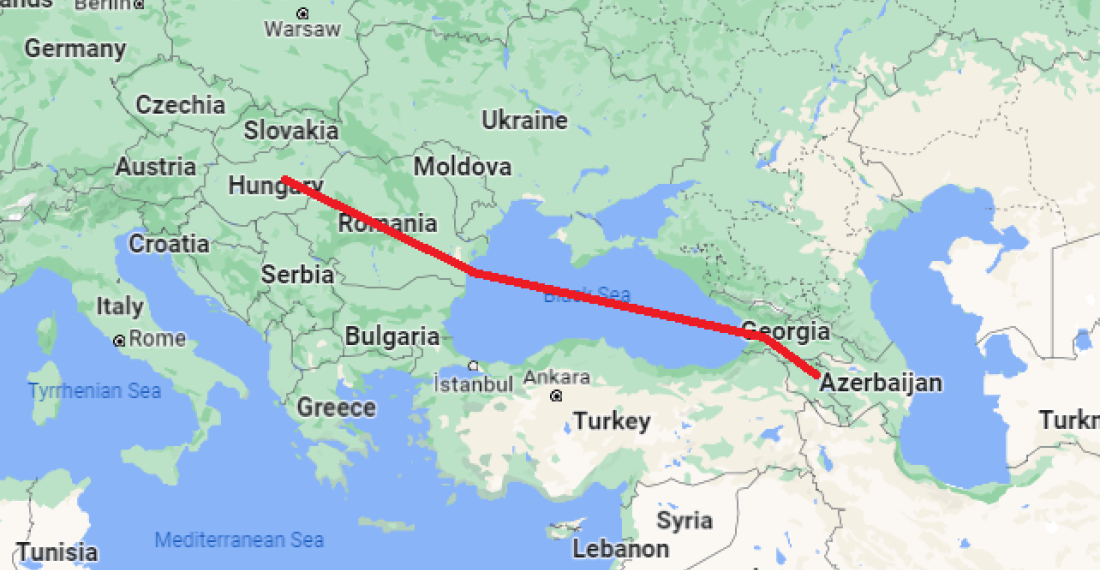
In this context, the project to develop the Black Sea Energy submarine cable may play a significant role. The 3GW high-voltage Black Sea submarine cable will be 1,195km long and is supposed to become operational in 2029. An 18-month feasibility study by CESI, an Italian consultancy, started in May 2022 and is expected to be completed in late 2023. The first official milestone followed in late 2022, with the leaders of Azerbaijan, Georgia, Romania, and Hungary signing an agreement in Bucharest on 17 December.
The project may be financed by the EU’s Global Gateway initiative, an international infrastructure development program poised to mobilize more than €300 billion over the four years to 2027. This project, for which the European Commission has earmarked €2.3 billion, will connect the electricity systems of Azerbaijan, Georgia, Romania, and Hungary and export electricity from renewable sources.
However, while Georgia’s electricity system is 80% hydropower, Azerbaijan’s electricity mix is nearly 95% fossil fuels. And there are a number of other concerns over the Black Sea cable, including the fact that getting the electricity to Hungary will likely require a new interconnector between Romania and Hungary to be licensed and integrated into the European network and some experts argue that the sums set aside for the project could have been spent on renewables production in Europe. However, if this project comes to fruition, the EU should emphasize the necessity of bringing Armenia in, and making it a true regional enterprise. Armenia was always an energy-exporting country, including in the Soviet era, given its nuclear power plant and hydropower resources.
The electricity currently generated in Armenia is mainly produced at three types of power plant: nuclear, hydro, and thermal. Some 39% is produced at the nuclear power plant, with 60% equally divided between hydro and thermal power plants. The government’s goal is to have 12 billion kWh of electricity by 2030, and at the same time to increase renewable energy production up to 15% by 2030.
Armenia has strong potential to become an exporter of renewable energy to the EU
Currently, two solar power plants are being constructed in Armenia, a 55MW capacity plant in Gegharquniq region and a 200MW plant in Aragatsotn, the second a joint $174 million project of the Armenian National Interest Fund and the Masdar company of Abu Dhabi. With these projects, the Government of the Republic of Armenia reaffirms its commitment to expand the renewable energy sector in Armenia, according to which it is planning to build solar power plants with a capacity of up to 1,000MW in coming years.
Armenia has strong potential to become an exporter of renewable energy to the EU. The participation of Armenia in the Black Sea Energy submarine cable project will contribute to the country’s economic development. It will boost regional economic cooperation, which is much needed to foster stability and security in the South Caucasus. It will strengthen the EU’s position and role in the region and is fully in line with overall EU strategy toward the South Caucasus.