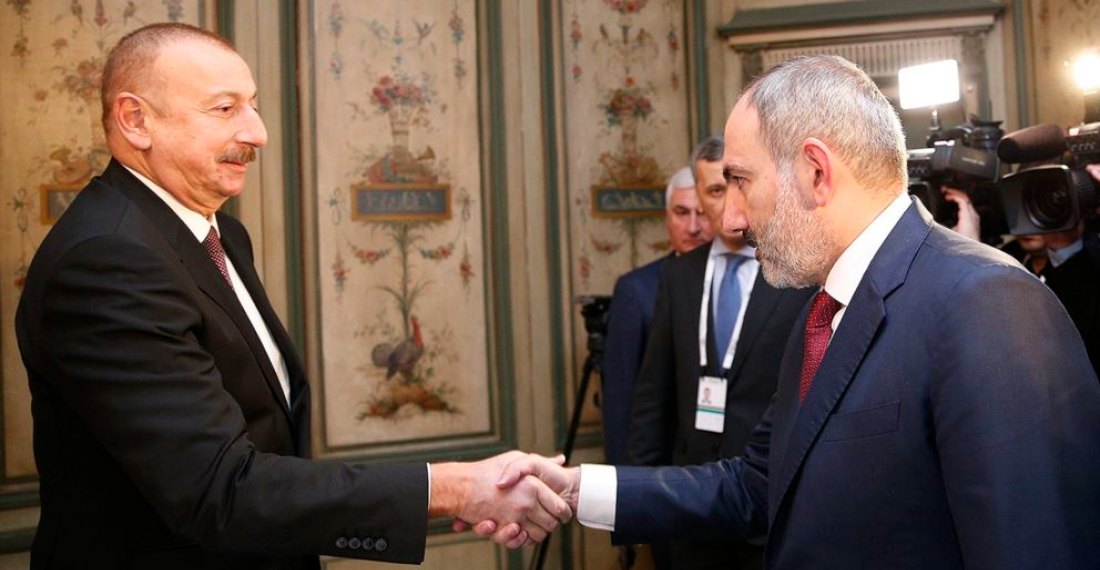
As recent statements from President Aliyev and Prime Minister Pashinyan demonstrate, "the two South Caucasian republics do not look entirely happy with the role of the mediators in their peace efforts," writes Vasif Huseynov for in this op-ed for commonspace.eu. "It is now clear that the success of these efforts may not depend solely on Baku and Yerevan. Devastating hostilities between the West and Russia and the jealous reaction of the Russian side to the growing role of the United States in the region seriously complicate the peace process," he adds.
In an international conference in Shusha, Azerbaijan, on 3 May, while the foreign ministers of Armenia and Azerbaijan were still deep in negotiations in Washington, President Ilham Aliyev of Azerbaijan made some statements about the format of the negotiations between the two countries and the role of mediators. In response to a question whether there are any external actors who might try to prevent a peace agreement between Baku and Yerevan, President Aliyev indirectly referred to the negative influence of some actors.
“I think that the best way… to come to an agreement is direct negotiations between Azerbaijan and Armenia without any mediator and without facilitator or spoiler,” he said. Pointing out the more supportive mediating role of Russia, the EU and United States, and criticizing the biased role of France, President Aliyev noted that “I think direct negotiations between the two countries will be more useful and helpful. I think that we need to go in that direction”, adding that “of course, if Armenia also is ready to do it”.
The Armenian Prime Minister Nikol Pashinyan has so far not publicly advocated a bilateral track of negotiations, but after the Washington meeting he was seen complaining about the security challenges posed by the deployment of the EU monitoring mission to Armenian territory this year.
“It does not provide any security guarantee, on the one hand, it can cause new challenges”, he said without elaborating which challenges he refers to. However, considering Russia’s reaction to this mission and its push for the deployment of the similar mission of the Collective Security Treaty Organization (CSTO) to the Armenia-Azerbaijan state border, one can infer what the Armenian premier is concerned about.
The Russia-West rivalries have negative implications for the Armenia-Azerbaijan peace process
These developments, and particularly the statement by President Aliyev, indicate that the widely shared perception amongst local experts about potentially negative implications of Russia-West rivalries and their parochial interests for the Armenia-Azerbaijan peace process may indeed reflect the reality of behind-the-doors negotiations.
In fact, this is not a secret anymore. The Kremlin has been traditionally unhappy with the “intervention” of the West in the Armenian-Azerbaijani peace process. For the Russian side, the mediating efforts of the EU and United States represent their attempt to encroach on Russia’s “sphere of influence” and elbow Russia out of this region. While the foreign ministers of Armenia and Azerbaijan were talking in Washington, Russia signaled that it would not support a peace deal that is not agreed upon with Moscow and not built on the basis of statements from the tripartite documents brokered by the Kremlin in 2020-2021.
In this context, the trilateral statements signed by the leaders of Russia, Armenia, and Azerbaijan on 10 November 2020, and on 11 January and 26 November 2021 are seen in Moscow as the major legal instruments to ensure Russia’s interests in a potential peace treaty. “So far, there has been no other legal framework that would contribute to the settlement [of the Armenia-Azerbaijan conflict]. Thus, these tripartite documents have absolutely no alternative,” the Kremlin spokesman said in reaction to the Washington meeting.
Moscow, apparently, feels itself cornered in the peace process between the two South Caucasian republics. On 23 April, despite earlier objections of the Russian side, Azerbaijan succeeded in installing a border crossing post at the starting point of the Lachin road at the Armenia-Azerbaijan border. Azerbaijani leaders had earlier made it clear that the border crossing point was supported by the EU and United States.
The border crossing post at the Lachin road is largely seen as a major blow to Russia’s influence in the region as it restored Azerbaijan’s control over movement between the Karabakh region and Armenia, limited Russia’s scope to manipulate this passage as a leverage against Azerbaijan, and as such constituted a major step towards the realisation of Baku’s demand of the withdrawal of the Russian peacekeeping mission in 2025. In parallel, the holding of four-day negotiations in Washington, the re-activation of the Brussels format of Aliyev-Pashinyan-Michel talks, and the announcement of already three EU-mediated meetings this year do not bode well for Russia’s role in the region.
The success of peace efforts does not depend on solely on Baku and Yerevan
Russia still does have some leverage over the region, however, and particularly over Armenia, which makes it so far an indispensable actor. This is the reason why both Baku and Yerevan seek to avoid provoking Russia and proceed with a balancing act between the rival mediators. The Moscow visit of the Armenian premier on 9 May and the planning of the new round of the foreign ministers’ meeting in Russia appear as the manifestation of these efforts.
As the aforementioned statement of President Aliyev and Pashinyan’s concerns about the EU monitoring mission demonstrated, the two South Caucasian republics do not look entirely happy with the role of the mediators in their peace efforts. It is now clear that the success of these efforts may not depend solely on Baku and Yerevan. Devastating hostilities between the West and Russia and the jealous reaction of the Russian side to the growing role of the United States in the region seriously complicate the peace process. Nevertheless, the latest dynamics in the process, increasingly frequent meetings and occasionally positive messages show goodwill of the sides and raise hope that this historic momentum will deliver a long-awaited peace treaty between Armenia and Azerbaijan.
source: Dr Vasif Huseynov, is a Senior Advisor at the Center of Analysis of International Relations (AIR Center) and Adjunct Lecturer at Khazar University in Baku, Azerbaijan.
photo: Munich Security Conference
The views expressed in opinion pieces and commentaries do not necessarily reflect the position of commonspace.eu or its partners