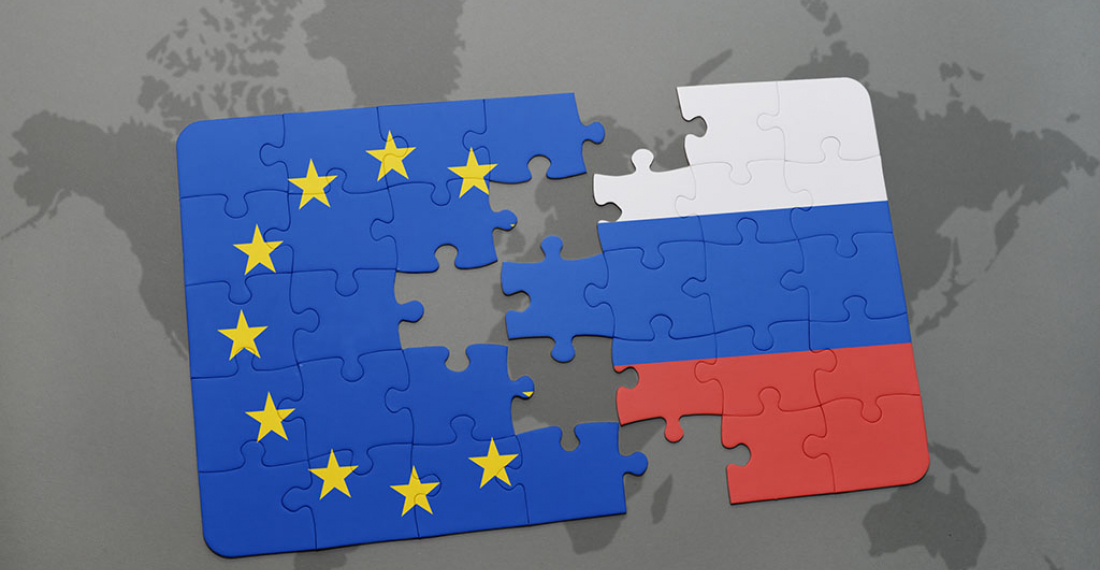
EU High Representative for Foreign and Security Policy, Josep Borrell, addressed EU-Russia relations when addressing the plenary session of the European Parliament on Tuesday (14 September).
Borrell reminded MEPs that Russia was the EU's biggest neighbour and it remains an important global actor. "Not from the economic point of view, the economics of Russia is more or less the same size as Italy. It is much bigger in surface, but economically speaking it is a medium-sized state. They have a lot of gas, and gas is becoming more and more expensive. This is good news for them and bad news for us. They have the atomic arm, they have an important army and they use it when they need it. In any case, Russia will not disappear. It will be there and this will not change overnight."
The following is the full text of his speech:
Mr President, Honourable Members of the European Parliament,
Allow me to congratulate the Rapporteur Andrius Kubilius and all the Members who have been working on this draft report, adopted with a large support in the Foreign Affairs Committee. I think that the report describes accurately where we stand in our relations with Russia, that are more difficult than ever. Building on the Joint Communication and the June conclusions of the European Council, although the debate in the European Council was mostly about “Summit yes” or “Summit no” in our relationship with Russia.
I think that the deliberate policy choices of the Russian government over the last years have been creating a negative spiral in our relations. The list of provocative actions by Russia is long and continues feeding a dynamic of escalation, which I regret. I have always been in favour of talking with everybody when we need to talk, but it has become difficult and I experienced that directly.
Our discussion today is very timely because we are going to have next week the UN General Assembly in New York, and it will maybe be an occasion to engage again in talks with the Russian representative.
Also there is the issue of the crackdown on Russian civil society and opposition. Ahead of this month's Duma elections, some of the priority actions that you identify in your report, the support to the civil society and their relentless efforts to defend democracy, remain as important as ever. One thing is the Russian regime, and another thing is the Russian people, and we have to be with the Russian people supporting their civil society.
On that, allow me to say that our unity should be our biggest asset in our relations with Russia. It is clear that Russia wants to divide us. They say that clearly, they do not care about the European Union, and prefer to avoid it. They want to talk with the member states directly, and not with all of them, only with the ones that matter. So yes, certainly, Russia wants to divide us, and in front of any attempt to divide us, what we have to do is try to remain united, which is – believe me - not always easy.
In any case Russia remains our largest neighbour and it remains an important global actor. Not from the economic point of view, the economics of Russia is more or less the same size as Italy. It is much bigger in surface, but economically speaking it is a medium-sized state. They have a lot of gas, and gas is becoming more and more expensive. This is good news for them and bad news for us. They have the atomic arm, they have an important army and they use it when they need it. In any case, Russia will not disappear. It will be there and this will not change overnight.
We should explore a path that helps us change the current dynamics gradually, into a less conflictual, more predictable and stable relationship. This is the work of diplomacy with whoever, to try to work for a less conflictual, more predictable and stable relationship on the issues’ in which we are interested in.
Let’s talk about Mr Navalny. As you know, I went to Russia to express directly in front of the Russian leadership our concern about the situation of Alexei Navalny when he was in front of the tribunal that condemned him. Since the assassination attempt of Mr Navalny we have held a number of discussions in the European Parliament, in the Foreign Affairs Council and in the European Council. But Mr Navalny remains in jail. So our collective ambition is not only to have a less conflictual relationship [with Russia], but also to continue defending the people like Mr Navalny. Don’t forget him, don’t forget the people who have been supporting him.
This has to be done building on the implementation of the five principles which have given us purpose and an approach in which our interests and values can be defended.
I want to remark here that the June Council Conclusions are very clear, including the full implementation of the Minsk agreements. In some days we will go to Kyiv to have the Association Agreement Council with Ukraine.
I would like to think of a renewed partnership with Russia, but today it is a distant prospect. In the present circumstances, to take the full potential of a close cooperation with Russia is not on our radar screen. It is a distant prospect.
We must therefore look at the state of EU-Russia relations in all their complexities and [propose] a realistic way forward.
With this in mind, the European Council tasked me, as HRVP, and the Commission to prepare concrete proposals on how take forward this multifaceted relationship – and we try to resume this in three words that we called “to push back, to constrain and to engage” - and I think that these three words summarise well how we have to develop our relationship with Russia, namely:
To present options for additional restrictive measures; to develop options for engagement on areas such as climate and the environment, and selected issues of foreign and security policy and multilateral issues like the JCPoA, where I have to recognise that Russia is playing a constructive role. On Syria and Libya. The Russians are very much present in Libya and more and more in the Central African Republic, which is worrying. To this list we should add Afghanistan, where there is a need for increased cooperation, including as regards the regional approach, after the take-over by the Taliban, and its consequences for regional and international security at large. Russia will also be affected by the new situation in Afghanistan and is not going to be in a “safe land” with respect to the risk of the spread of terrorism in the area.
Finally we have to put forward people-to-people contacts and support to civil society, human rights organisations and independent media. Such a thing exists in Russia, and we need to support them.
As you also rightly point out in your report, our reinforced cooperation with our Eastern Partners and support to democracy remain on top of the European Union’s interest. We cannot be an island of democracy in a world of autocracies. We cannot survive as democracy if we are surrounded and in the middle of a world that has a different political system. It is in our own interest that our system is shared by as many people and as many countries as possible.
This is what my services are trying to take forward. On that we are working. We stand ready to brief the European Parliament’s respective committees on all these issues.
Thank you very much for your work. Thank you very much for this report, which is a complementary work with the one that we are doing. Thank you Mr Rapporteur and to all MEPs that have been working with you on it.
You can also watch the speech of the High Representative on video here.
source: commonspace.eu with the press service of the European External Action Service, Brussels.