


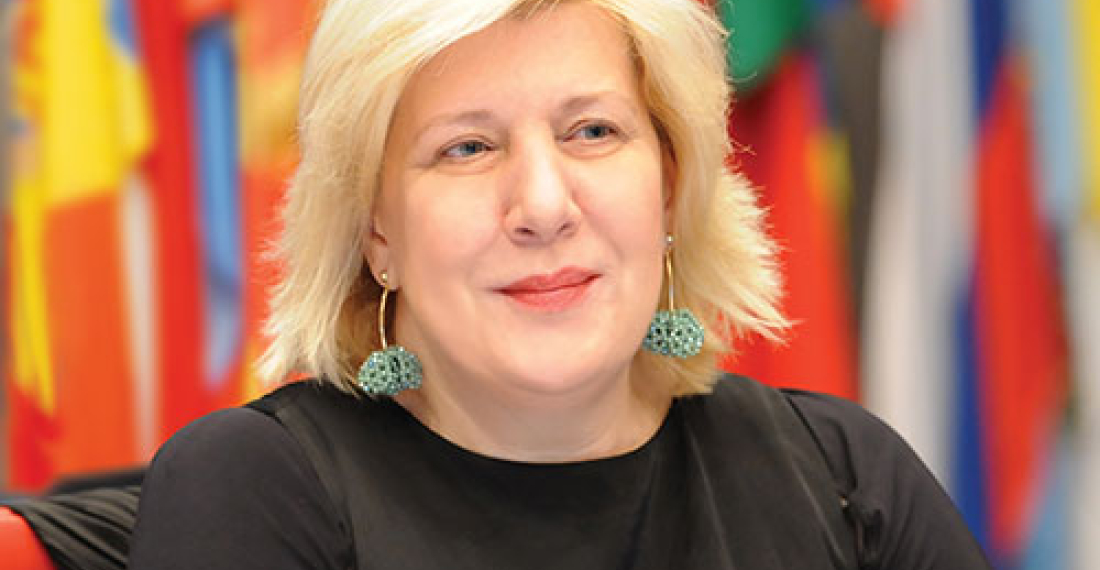
Dunya Mijatovic: "Entrenched harmful stereotypes and prejudice against LGBTI people still prevail in segments of Georgian society, including some politicians"

On March 27, the Council of Europe Commissioner for Human Rights, Dunja Mijatović, issued a statement calling on the Georgian government to “fully respect” its human rights obligations as a Council of Europe member state, “including with regard to the protection of the human rights of LGBTI people,” in response to the ruling party’s initiation of two draft constitutional laws on “family values and the protection of minors.”

The statement says:

“I am concerned about the present political discourse in Georgia, as illustrated by the announcement made by the Georgian Dream Party of their initiative to amend the Constitution and to adopt a new constitutional law on ‘Protection of Family Values and Underaged Persons’. It is reflective of entrenched harmful stereotypes and prejudice against LGBTI people which still prevail in segments of Georgian society, including some politicians, and is capable of having a strong, negative impact on the human rights, safety and well-being of LGBTI people and defenders of their rights. It also represents the political manipulation of LGBTI-phobia in the run-up to elections, which I have previously condemned, and which should have no place in a democratic society, based on the rule of law and respect for human rights of everyone.

Having noted once again that LGBTI people continue to be the target of hate crimes and pervasive discrimination in Georgia, as well as the regular occurrence of LGBTI people being denied their right to peaceful assembly, I have repeatedy called on the Georgian authorities to commit to a zero-tolerance policy and practice towards all forms of discrimination, and incitement to discrimination and violence, against LGBTI people. In recent months, I have followed the increasingly stigmatising rhetoric used by some politicians to undermine the legitimate work of human rights defenders and civil society in Georgia.

I therefore call on the Georgian authorities to fully respect their human rights obligations, as a member state of the Council of Europe, including with regard to protecting the human rights of LGBTI people and ensuring an enabling environment for the activities of civil society and human rights defenders. I urge all politicians in Georgia to resolutely denounce the use of LGBTI-phobia or any other discriminatory rhetoric in electoral campaigns.

I stand in solidarity with all those who advocate for and defend the human rights of every member of Georgian society, including LGBTI people, and who work for a peaceful country and society committed to equality and the human dignity of all.”
 source: commonspace.eu with Council of Europe
photo: Council of Europe Commissioner for Human Rights, Dunya Mijatović

Related articles

Editor's choice
News
Borrell tells the European Parliament that the situation in Afghanistan was critical, but the EU will remain engaged

Borrell tells the European Parliament that the situation in Afghanistan was critical, but the EU will remain engaged

Borrell underlined that the European Union will make every effort to support the peace process and to remain a committed partner to the Afghan people. "Of course, we will have to take into account the evolving situation, but disengagement is not an option.  We are clear on that: there is no alternative to a negotiated political settlement, through inclusive peace talks.
Editor's choice
News
Pope's visit to Türkiye and Lebanon has a strong ecumenical character, and places interreligious dialogue at its centre

Pope's visit to Türkiye and Lebanon has a strong ecumenical character, and places interreligious dialogue at its centre

Pope Leo XIV has begun the first overseas trip of his pontificate, a six-day visit to Türkiye and Lebanon, which started yesterday (27 November) and ends on Tuesday (2 December). According to Vatican Radio, the visit "carries a strong ecumenical character and places interreligious dialogue at its centre. It will also be a moment of closeness to Christian communities and local populations across the region".   During nearly a week in the region, Pope Leo XIV will meet civil and religious authorities, visit mosques and ancient churches, pray at Beirut’s port in memory of the victims of the 2020 explosion, and hold private meetings with Presidents Recep Tayyip Erdoğan and Joseph Aoun.   A highlight of the visit will be a visit to Nicaea, where the Pope will mark the anniversary of the Council of Nicaea. Christians of many traditions recognise the Council of Nicaea as a foundation of shared faith. One of the most anticipated moments will be the Pope’s encounter with Lebanese youth in Bkerké, at the Maronite Patriarchate, a meeting expected to carry strong messages of hope in the Jubilee Year. A central event will be the ecumenical celebration in İznik, where the Pope and Ecumenical Patriarch Bartholomew will walk together toward the ruins of the Basilica of St Neophytos. The prayer, held before icons of Christ and the Council, will conclude with the lighting of a candle—a symbolic gesture of unity. The journey will also highlight interreligious engagement.   Memorable moments are expected throughout the trip: a wreath at Atatürk’s mausoleum, prayer inside the Blue Mosque, Mass at Istanbul’s Volkswagen Arena, the planting of a cedar at the presidential palace in Beirut, and prayer at the tomb of St Charbel in Lebanon. The Vatican said that "Pope Leo XIV’s pilgrimage to Türkiye and Lebanon aims to offer a voice of peace, unity, and hope at the heart of the Middle East."

Popular

Editor's choice
News
Pope's visit to Türkiye and Lebanon has a strong ecumenical character, and places interreligious dialogue at its centre

Pope's visit to Türkiye and Lebanon has a strong ecumenical character, and places interreligious dialogue at its centre

Pope Leo XIV has begun the first overseas trip of his pontificate, a six-day visit to Türkiye and Lebanon, which started yesterday (27 November) and ends on Tuesday (2 December). According to Vatican Radio, the visit "carries a strong ecumenical character and places interreligious dialogue at its centre. It will also be a moment of closeness to Christian communities and local populations across the region".   During nearly a week in the region, Pope Leo XIV will meet civil and religious authorities, visit mosques and ancient churches, pray at Beirut’s port in memory of the victims of the 2020 explosion, and hold private meetings with Presidents Recep Tayyip Erdoğan and Joseph Aoun.   A highlight of the visit will be a visit to Nicaea, where the Pope will mark the anniversary of the Council of Nicaea. Christians of many traditions recognise the Council of Nicaea as a foundation of shared faith. One of the most anticipated moments will be the Pope’s encounter with Lebanese youth in Bkerké, at the Maronite Patriarchate, a meeting expected to carry strong messages of hope in the Jubilee Year. A central event will be the ecumenical celebration in İznik, where the Pope and Ecumenical Patriarch Bartholomew will walk together toward the ruins of the Basilica of St Neophytos. The prayer, held before icons of Christ and the Council, will conclude with the lighting of a candle—a symbolic gesture of unity. The journey will also highlight interreligious engagement.   Memorable moments are expected throughout the trip: a wreath at Atatürk’s mausoleum, prayer inside the Blue Mosque, Mass at Istanbul’s Volkswagen Arena, the planting of a cedar at the presidential palace in Beirut, and prayer at the tomb of St Charbel in Lebanon. The Vatican said that "Pope Leo XIV’s pilgrimage to Türkiye and Lebanon aims to offer a voice of peace, unity, and hope at the heart of the Middle East."

