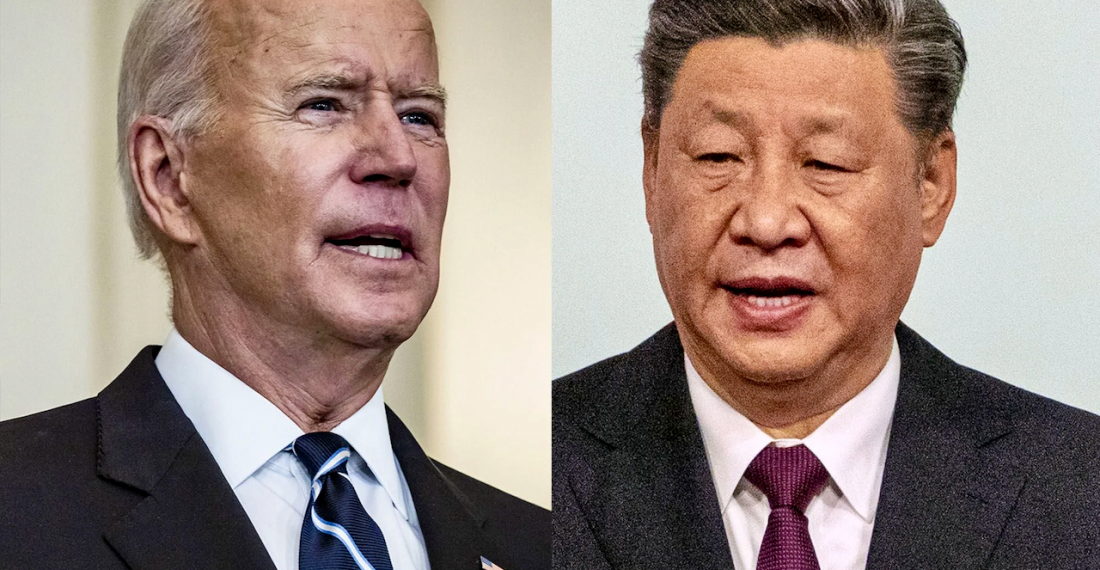
Xi warns Biden not to "play with fire" in relations with Taiwan

Chinese President, Xi Jinping, has warned his US counterpart, Joe Biden, in a telephone conversation that the United States must respect Beijing's 'One China' policy and "not play with fire” on the issue of Taiwan. This warning relates to a potential visit by the Speaker of the US House of Representatives, Nancy Pelosi, to Taiwan.

A visit by Pelosi would be a strong statement of support for Taiwan. Officially, Washington has no diplomatic ties with Taipei and the US follows Beijing's 'One China' policy. But under US legislation, the US is obliged to support democratically governed and Western-oriented Taiwan and help defend the island against a more assertive Beijing.

Xi is strongly opposed to such a visit to what he considers to be a Chinese province and he made this clear in the fifth telephone conversation between himself and Biden. 

Biden and Xi discussed geopolitical tensions and economic challenges at their first virtual meeting since March, the White House reported. China has not condemned Russia's invasion of Ukraine and this has become a further source of tension between Washington and Beijing.

According to the White House, the two presidents have instructed their staffs to arrange a follow-up to today's conversation. "Especially on topics such as climate change and public health”, the statement said.
 

source: commonspace.eu with the agencies
photo: US President Joe Biden of Chinese President Xi Jinping. Bloomberg

Related articles

Editor's choice
News
Mark Carney: "The world is in the midst of a rupture, not a transition"

Mark Carney: "The world is in the midst of a rupture, not a transition"

Canadian Prime Minister Mark Carney said the "old order is not coming back" and urged fellow middle powers to come together in a speech at the World Economic Forum in Davos, Switzerland. "Middle powers must act together because if we're not at the table, we're on the menu," Carney said on Tuesday, adding that he believed powerful nations were using economic coercion to get what they want. He also affirmed Canada's support for Greenland, Denmark and the Nato alliance, drawing applause. "Great powers" are often defined as countries with permanent seats on United Nations Security Council - China, France, Russia, the United Kingdom and the United States - which shows their economic and military dominance in the world. Middle powers, such as Canada, Australia, Argentina, South Korea and Brazil, are nations that still exert large influence in global politics, even though their economies are smaller. In his speech, Carney said the world is "in the midst of a rupture, not a transition". "Great powers have begun using economic integration as weapons, tariffs as leverage, financial infrastructure as coercion, supply chains as vulnerabilities to be exploited," he said. He also said "Canada was amongst the first to hear the wake-up call" that geography and historic alliances no longer guaranteed security or prosperity. As a member of the North Atlantic Treaty Organisation (Nato), Canada stands firmly with Greenland and Denmark and supports "their unique right to determine Greenland's future", Carney said in his speech. "Our commitment to Article Five is unwavering," the prime minister added, referring to a clause in the Nato agreement that states an attack against one member state is considered an attack on all. (read the full speech of the Canadian prime minister at Davos by clicking the picture).

Popular

Editor's choice
Interview
Thursday Interview: Murad Muradov

Thursday Interview: Murad Muradov

Today, commonspace.eu starts a new regular weekly series. THURSDAY INTERVIEW, conducted by Lauri Nikulainen, will host  persons who are thinkers, opinion shapers, and implementors in their countries and spheres. We start the series with an interview with Murad Muradov, a leading person in Azerbaijan's think tank community. He is also the first co-chair of the Action Committee for a new Armenian-Azerbaijani Dialogue. Last September he made history by being the first Azerbaijani civil society activist to visit Armenia after the 44 day war, and the start of the peace process. Speaking about this visit Murad Muradov said: "My experience was largely positive. My negative expectations luckily didn’t play out. The discussions were respectful, the panel format bringing together experts from Armenia, Azerbaijan, and Turkey was particularly valuable during the NATO Rose-Roth Seminar in Yerevan, and media coverage, while varied in tone, remained largely constructive. Some media outlets though attempted to represent me as more of a government mouthpiece than an independent expert, which was totally misleading.  Overall, I see these initiatives as important steps in rebuilding trust and normalising professional engagement. The fact that soon a larger Azerbaijani civil society visits to Armenia followed, reinforces the sense that this process is moving in the right direction." (click the image to read the interview in full)