Xi sets the tone, and Putin answers questions

Chinese President Xi chose Central Asia for his first foray overseas after a long hiatus due to the Covid pandemic, travelling to Kazakhstan, and then onwards to Samarkand to attend the meeting of the Shanghai Co-operation Organisation (SCO) and have various bilateral meetings.

Chinese protocol these days demand that all meetings with Xi are fully masked, and so attired delegations troded in to meet the Chinese leader: Azerbaijan President Ilham Aliyev was early in queue. There was Uzbekistan's president Miriyzoyev, who for good measure gave President Xi Uzbekistan's "Order of Friendship", and Belarus President Lukashenko.

But most interest was focused on when Putin's turn came. Increasingly the Russian leader is starting to look like the junior partner in the relationship with Xi. Certainly the official language was all proper and correct, but there was something in the body language that showed Putin's awkwardness at the new situation.

China is ready to work with Russia in extending strong support to each other on issues concerning their respective core interests, Chinese President Xi Jinping said during a meeting with his Russian counterpart, Vladimir Putin, here on Thursday.

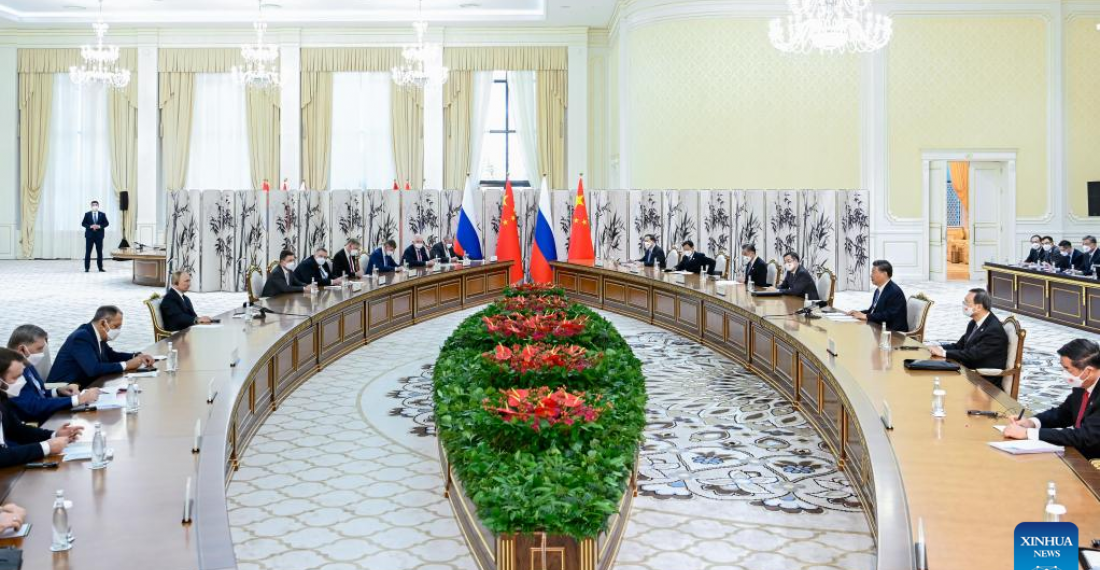
China's official Xinhua news agency reported that "Xi met with Putin at Forumlar Majmuasi Complex in Samarkand to exchange views on China-Russia relations and international and regional issues of shared interest.

"Since the beginning of this year, China and Russia have maintained effective strategic communication, Xi said. Bilateral cooperation in various fields has moved forward steadily, with activities of the Year of Sports Exchanges well underway, and a robust momentum in sub-national cooperation and people-to-people exchanges, he said. The two countries have maintained close coordination on the international stage to uphold basic norms of international relations, Xi said.

In the face of changes of the world, of the times and of history, China will work with Russia to fulfill their responsibilities as major countries and play a leading role in injecting stability into a world of change and disorder, Xi said.

He emphasized that China will work with Russia to deepen practical cooperation in trade, agriculture, connectivity and other areas..

Putin wished the 20th National Congress of the Communist Party of China (CPC) a full success and said he believes that under the leadership of President Xi, China will keep making new achievements in economic and social development.

Putin noted that the world is undergoing multiple changes, yet the only thing that remains unchanged is the friendship and mutual trust between Russia and China, and that the Russia-China comprehensive strategic partnership of coordination is as stable as mountains.

Both Russia and China stand for a more equitable and reasonable international order, setting a fine example in international relations, he said.

The Russian side is firmly committed to the one-China principle and condemns the provocative moves by individual countries on issues concerning China's core interests, he said.

Putin said Russia will consolidate and deepen bilateral and multilateral communication and collaboration with China, and expand cooperation in key areas such as economy, trade and energy.

“We highly value the balanced position of our Chinese friends when it comes to the Ukraine crisis,” Putin said in televised remarks to Xi. “We understand your questions and concern about this. During today’s meeting, we will, of course, explain our position.”

"Questions and concern" - not exactly enthusiastic support then by China for Putin's adventure in Ukraine.

The Shanghai Co-operation Organisation was initially set up with the aim of helping Russia manage China's engagement with Central Asia. It has grown into something different, as China becomes increasingly more assertive, and as its ambitions in Central Asia deepen. Russia on the other hand, has never been weaker in Central Asia, at least for the last one hundred years, than at present.

The price that Putin and Russia are paying for the Ukraine adventure is very high indeed.
source: commonspace.eu with agencies
photo: Russian and Chinese delegations meet on the margin of the summit of the Shanghai Co-operation Organisation in the Uzbek city of Samarkand (picture courtesy of the Xinhua news agency, Beijing).

Related articles

Editor's choice
News
Borrell tells the European Parliament that the situation in Afghanistan was critical, but the EU will remain engaged

Borrell tells the European Parliament that the situation in Afghanistan was critical, but the EU will remain engaged

Borrell underlined that the European Union will make every effort to support the peace process and to remain a committed partner to the Afghan people. "Of course, we will have to take into account the evolving situation, but disengagement is not an option.  We are clear on that: there is no alternative to a negotiated political settlement, through inclusive peace talks.
Editor's choice
News
NATO Chief says war is on Europe's doorstep, and warns against complacency

NATO Chief says war is on Europe's doorstep, and warns against complacency

Russia could attack a Nato country within the next five years, the Secretary General of NATO, Mark Rutte, said in a stark new warning. "Nato's own defences can hold for now," Rutte warned in Berlin, but conflict was "next door" to Europe and he feared "too many are quietly complacent, and too many don't feel the urgency, too many believe that time is on our side. "Russia is already escalating its covert campaign against our societies," Rutte said in a speech in Germany. "We must be prepared for the scale of war our grandparents or great-grandparents endured." Earlier this month, Russia's President Vladimir Putin said his country was not planning to go to war with Europe, but it was ready "right now" if Europe wanted to - or started a war. But similar reassurances were given by Moscow in 2022, just before 200,000 Russian troops crossed the border and invaded Ukraine. Putin has accused European countries of hindering US efforts to bring peace in Ukraine - a reference to the role Ukraine's European allies have recently played in trying to change a US peace plan to end the war, whose initial draft was seen as favouring Russia. But Putin was not sincere, Nato's secretary-general said in the German capital, Berlin. Supporting Ukraine, he added, was a guarantee for European security. "Just imagine if Putin got his way; Ukraine under the boot of Russian occupation, his forces pressing against a longer border with Nato, and the significantly increased risk of an armed attack against us." Russia's economy has been on a war footing for more than three years now - its factories churn out ever more supplies of drones, missiles and artillery shells. According to a recent report by the Kiel Institute for the World Economy, Russia has been producing each month around 150 tanks, 550 infantry fighting vehicles, 120 Lancet drones and more than 50 artillery pieces. The UK, and most of its Western allies, are simply not anywhere near this point. Analysts say it would take years for Western Europe's factories to come close to matching Russia's mass-production of weapons. "Allied defence spending and production must rise rapidly, our armed forces must have what they need to keep us safe," the Nato chief said.

Popular

Editor's choice
News
NATO Chief says war is on Europe's doorstep, and warns against complacency

NATO Chief says war is on Europe's doorstep, and warns against complacency

Russia could attack a Nato country within the next five years, the Secretary General of NATO, Mark Rutte, said in a stark new warning. "Nato's own defences can hold for now," Rutte warned in Berlin, but conflict was "next door" to Europe and he feared "too many are quietly complacent, and too many don't feel the urgency, too many believe that time is on our side. "Russia is already escalating its covert campaign against our societies," Rutte said in a speech in Germany. "We must be prepared for the scale of war our grandparents or great-grandparents endured." Earlier this month, Russia's President Vladimir Putin said his country was not planning to go to war with Europe, but it was ready "right now" if Europe wanted to - or started a war. But similar reassurances were given by Moscow in 2022, just before 200,000 Russian troops crossed the border and invaded Ukraine. Putin has accused European countries of hindering US efforts to bring peace in Ukraine - a reference to the role Ukraine's European allies have recently played in trying to change a US peace plan to end the war, whose initial draft was seen as favouring Russia. But Putin was not sincere, Nato's secretary-general said in the German capital, Berlin. Supporting Ukraine, he added, was a guarantee for European security. "Just imagine if Putin got his way; Ukraine under the boot of Russian occupation, his forces pressing against a longer border with Nato, and the significantly increased risk of an armed attack against us." Russia's economy has been on a war footing for more than three years now - its factories churn out ever more supplies of drones, missiles and artillery shells. According to a recent report by the Kiel Institute for the World Economy, Russia has been producing each month around 150 tanks, 550 infantry fighting vehicles, 120 Lancet drones and more than 50 artillery pieces. The UK, and most of its Western allies, are simply not anywhere near this point. Analysts say it would take years for Western Europe's factories to come close to matching Russia's mass-production of weapons. "Allied defence spending and production must rise rapidly, our armed forces must have what they need to keep us safe," the Nato chief said.