


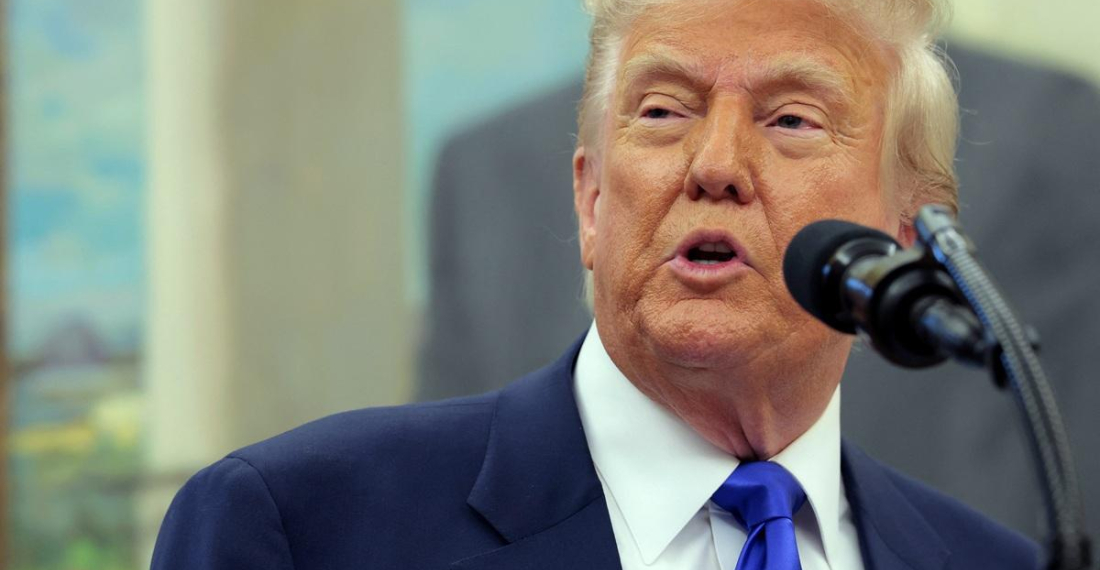
Trump recommends 50% tariff on the European Union, starting 1st June

US President Donald Trump on Friday said he is “recommending a straight 50% Tariff on the European Union” after complaining that trade negotiations have stalled. The steep new import duties would start on 1st June, Trump wrote on Truth Social. The EU “has been very difficult to deal with,” Trump wrote. “Our discussions with them are going nowhere!”

Trump’s announcement came less than 30 minutes after he threatened to impose a tariff of at least 25% on Apple if the company does not start manufacturing iPhones in the United States.

According to Reuters, stock futures sank immediately following Trump’s posts, which showed the president once again wielding the threat of massive import taxes in response to economic activity he disfavors.

Meanwhile, the Financial Times reported that U.S. Trade Representative Jamieson Greer is preparing to tell European Trade Commissioner Maros Sefcovic on Friday that a recent "explanatory note" shared by Brussels for the talks between the two sides falls short of U.S. expectations, the newspaper said, citing unnamed sources.

Reuters was unable to immediately verify the report. The Office of the United States Trade Representative did not respond to a Reuters request for comment outside regular business hours. "The priority for the EU is to seek a fair, balanced deal with the U.S., one that our massive trade and investment relationship deserves," Olof Gill, the European Commission spokesperson for trade, told Reuters in an email.

The European Union continues to actively engage with the U.S., with Commissioner Sefcovic due to speak to Greer on Friday, Gill added.

The FT reported that the European Union has been pushing for a jointly agreed framework text for the talks but the two sides remain too far apart.

The U.S. imposed 25% tariffs on EU cars, steel and aluminium in March and 20% tariffs on other EU goods in April. It then halved the 20% rate until July 8, setting a 90-day window for talks to reach a more comprehensive tariff deal.

In response, the 27-nation EU suspended its own plans to impose retaliatory tariffs on some U.S. goods and proposed zero duties for all industrial goods on both sides.

Source: commonspace.eu with agencies. Photo: AFP

Related articles

Editor's choice
News
Borrell tells the European Parliament that the situation in Afghanistan was critical, but the EU will remain engaged

Borrell tells the European Parliament that the situation in Afghanistan was critical, but the EU will remain engaged

Borrell underlined that the European Union will make every effort to support the peace process and to remain a committed partner to the Afghan people. "Of course, we will have to take into account the evolving situation, but disengagement is not an option.  We are clear on that: there is no alternative to a negotiated political settlement, through inclusive peace talks.
Editor's choice
News
Egypt rejects Israeli "offer" for an exit only Rafah checkpoint in Gaza

Egypt rejects Israeli "offer" for an exit only Rafah checkpoint in Gaza

Egypt has rejected an Israeli "offer" for opening for exit only the Rafah checkpoint in Gaza. According to the Egyptian State Information Service, Egyptian authorities refuted on Wednesday afternoon reports that Israel claims it will open the Rafah crossing, the only lifeline for Gaza to the outside world, but only for those wishing to leave the besieged coastal enclave.  Citing an Egyptian official, the service stated that ''any agreement to open the crossing will cover both entry and exit, in line with US President Donald Trump's plan for humanitarian and political arrangements following the ceasefire.'' Cairo reaffirmed its adherence to the plan and UN Security Council Resolution 2803, including the right of return for Palestinians and maintaining two-way operations at the crossing. Earlier in the day, Israel's Coordinator of Government Activities in the Territories (COGAT) announced that the Rafah crossing would reopen ''within the next few days,'' marking the first such move since February 2025. According to the statement, departures would require prior Israeli security approval and would follow mechanisms previously implemented under EU supervision. Notably, the statement made no mention of the entry of humanitarian aid, which continues to flow through the Kerem Shalom crossing. A Palestinian official also echoed the Egyptian denial of Israel's claim. The announced agreements stress that no Palestinians will be forced to leave Gaza. Those who choose to travel will have the right to return, while humanitarian aid will continue through UN agencies, the International Red Cross and Crescent, and other independent organisations. A European Union official, who requested anonymity and is familiar with the matter, told TNA that the EU has received no official notification from Israel regarding new arrangements, stressing that "no changes exist beyond the January agreements, and we await Israel's formal approval for crossing operations under the Trump plan. "Reopening the crossing will follow mechanisms jointly supervised by the EU and the Palestinian Authority to ensure oversight and transparency, according to the EU official.

Popular

Editor's choice
News
Egypt rejects Israeli "offer" for an exit only Rafah checkpoint in Gaza

Egypt rejects Israeli "offer" for an exit only Rafah checkpoint in Gaza

Egypt has rejected an Israeli "offer" for opening for exit only the Rafah checkpoint in Gaza. According to the Egyptian State Information Service, Egyptian authorities refuted on Wednesday afternoon reports that Israel claims it will open the Rafah crossing, the only lifeline for Gaza to the outside world, but only for those wishing to leave the besieged coastal enclave.  Citing an Egyptian official, the service stated that ''any agreement to open the crossing will cover both entry and exit, in line with US President Donald Trump's plan for humanitarian and political arrangements following the ceasefire.'' Cairo reaffirmed its adherence to the plan and UN Security Council Resolution 2803, including the right of return for Palestinians and maintaining two-way operations at the crossing. Earlier in the day, Israel's Coordinator of Government Activities in the Territories (COGAT) announced that the Rafah crossing would reopen ''within the next few days,'' marking the first such move since February 2025. According to the statement, departures would require prior Israeli security approval and would follow mechanisms previously implemented under EU supervision. Notably, the statement made no mention of the entry of humanitarian aid, which continues to flow through the Kerem Shalom crossing. A Palestinian official also echoed the Egyptian denial of Israel's claim. The announced agreements stress that no Palestinians will be forced to leave Gaza. Those who choose to travel will have the right to return, while humanitarian aid will continue through UN agencies, the International Red Cross and Crescent, and other independent organisations. A European Union official, who requested anonymity and is familiar with the matter, told TNA that the EU has received no official notification from Israel regarding new arrangements, stressing that "no changes exist beyond the January agreements, and we await Israel's formal approval for crossing operations under the Trump plan. "Reopening the crossing will follow mechanisms jointly supervised by the EU and the Palestinian Authority to ensure oversight and transparency, according to the EU official.

