In Tehran, at Friday prayers they hail Raisi's visit to Moscow

The high profile visit of the Iranian president, Ebrahim Raisi, to Moscow this week was also the focus of the traditional Friday Prayers in Tehran, the country's leading socio-political event of the week. 

"Today, science and economics have become a tool for colonization and plundering the nations of the world, the bullying powers use this tool to seize the wealth of other nations for their own benefit," Tehran's Provisional Friday Prayers leader Seyyed Mohammad Hassan Aboutorabi-Fard said during this week's Friday Prayers sermon in Tehran, as quoted by the Iranian Mher News Agency.

The interim Friday Prayers leader referred to the president Raisi's visit to Russia, which also coincided with the start combined naval exercises of Iran, Russia and China navies in northern Indian Oceans, and said: "These events signal important changes in the future of the region and the world."

 He added that Asia is the birthplace of divine religions. "[Iranian]Army and IRGC naval exercises with Chinese and Russian navies in the Indian Ocean could play an important role in enhancing regional security," he said on the combined naval drill that kicked off earlier today.

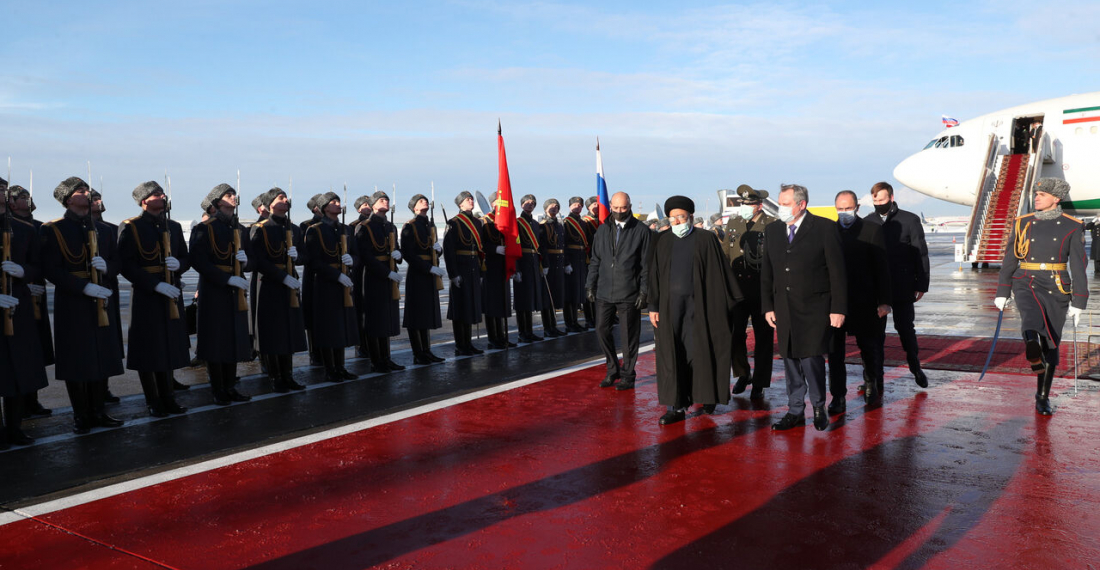
Russia this week rolled out the red carpet for President Raisi. His visit included a rare invitation to address the State Duma, as well as a long meeting with president Putin.

Welcoming Raisi to Moscow on Wednesday (19 January) Russian president Vladimir Putin hailed the co-operation between the two countries:

In the international arena, we cooperate very closely. I'm not talking about the fact that thanks to our efforts, to a large extent, we managed to help the Syrian Government overcome the threats associated with international terrorism. Now, of course, both you and us are concerned about the situation that is developing in Afghanistan. I would like to discuss all these issues with you, to know your position on these problems.

On a temporary basis, on the basis of a temporary agreement, relations between Iran and the Eurasian Economic Community are developing, and we are actively working to create a long-term basis, a free trade zone between Iran and our association. Iran is also actively working as an observer in the Shanghai Cooperation Organisation."

On his part Raisi also highly evaluated the level of current Russian-Iranian relations:

"As for relations with our friendly Russian Federation, we want these relations to be stable and comprehensive. We can develop our relations in the field of economy, trade, politics, culture and all those areas in a bilateral format between our countries that are beneficial to our two countries, as well as our two peoples. So in all these areas we can develop and expand our bilateral cooperation.

We in the Islamic Republic of Iran have no restrictions on the development and expansion of relations with our friendly country, Russia, and these relations will be strategic. Therefore, these relationships will not be short-term or positional - they will be permanent and strategic.

I would like to say that in the current, very exceptional conditions, when there is a confrontation with the unilateral actions of the West, including the United States, we can create synergy in our interaction.

We have been resisting the Americans for more than 40 years, and we will never stop the progress and development of the country because of sanctions or because of threats. We are now, of course, making efforts to ensure that the sanctions are lifted. But all these mechanisms that we are working on, in the end, we want them to end with the elimination of certain restrictions.

We have a document on strategic cooperation between our two countries, which can determine the prospect for at least 20 years ahead, or at least clarify the prospect. Therefore, here we handed this document over to our Russian colleagues. In any case, we believe that this document will, of course, determine the long-term strategic interaction between the Islamic Republic of Iran and the Russian Federation.

Our trade and economic ties in the current situation do not cause us satisfaction. Of course, we can raise the level of our trade and economic cooperation by several times, and we are making efforts to raise the level of our trade and economic cooperation, investment in trade, in the economy, we are making efforts to ensure that the level of our trade and economic cooperation , as well as investment cooperation at times enhance.

I would like to say that I hope that during our visit what our colleagues agreed on together with your colleagues, these agreements will be further developed. You, too, Your Excellency, with your positive view of our interaction will help to ensure that our agreements are translated into practice, and I, too, in the Islamic Republic of Iran intend to focus on our colleagues so that our interaction and cooperation will receive further executive and practical development. and that our interaction, of course, would bring appropriate fruits and results."
source: commonspace.eu with Mher News Agency (Tehran) IRNA (Tehran) and the press service of the president of Russia.
photo: Iranian president Ebrahim Raisi arriving in Moscow on an official visit on 18 January 2022 (picture courtesy of Islamic Republic News Agency, Tehran).

Related articles

Editor's choice
News
Council of Europe launches new International Claims Commission for Ukraine

Council of Europe launches new International Claims Commission for Ukraine

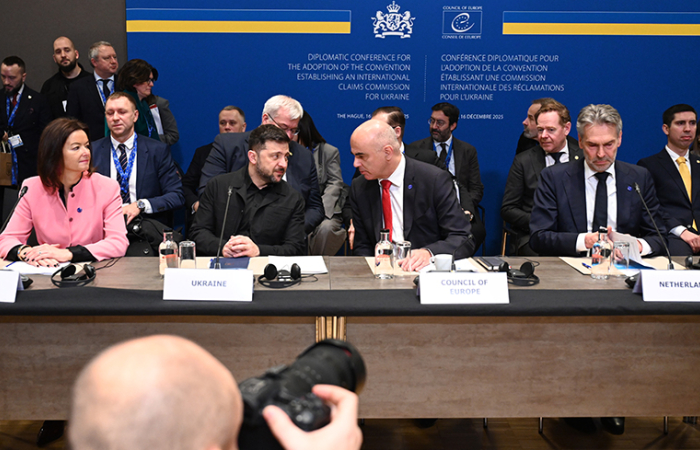
Thirty-four countries and the European Union have signed a new convention establishing an International Claims Commission for Ukraine at a diplomatic conference co-hosted by the 46-nation Council of Europe and the Netherlands in the Hague. The diplomatic conference was attended by leaders and high-level representatives from over 50 states, including the President of Ukraine, Volodymyr Zelenskyy, the President of the Republic of Moldova, Maia Sandu, and the Prime Minister of the Netherlands, Dick Schoof.  “Today marks a major step forward in ensuring accountability for Ukraine. The International Claims Commission represents justice and hope for tens of thousands of victims—our determination that those who have suffered will not be forgotten. I call for quick ratifications so we can get the commission rapidly up and running for the people of Ukraine,” said Council of Europe Secretary General Alain Berset. Ukrainian President Volodymyr Zelenskyy said: “We expect that every mechanism for compensation from the Register of Damage and Claims Commission to the actual payments – will start working and receive strong and sufficient international support, so that people can truly feel that any kind of damage caused by the war can be compensated. This war, and Russia’s responsibility for it, MUST become a clear example – so that others learn not to choose aggression.” “Accountability is about creating the conditions for peace that endures. And therefore, accountability is a condition of security – today and for the future. But accountability is not only about Ukraine. And it is not only about one aggressor and one victim. Accountability is about Europe. About every country in Europe. It is about whether Europe, as a whole, is willing to defend its peace,” said Maia Sandu, President of the Republic of Moldova, which currently holds the Presidency of the Council of Europe’s Committee of Ministers. The Prime Minister of the Netherlands, Dick Schoof, said: “Every day Russia is deliberately bombarding homes, destroying businesses and damaging infrastructure in Ukraine. Russia must compensate Ukraine for the damage caused. That is why we have launched the International Claims Commission for Ukraine and we are honoured to host it.” The International Claims Commission will be the second part of a comprehensive compensation mechanism related to Russia’s war of aggression, building on the existing Register of Damage for Ukraine. The claims commission will be established within the framework of the Council of Europe and will also be open to other countries. The Register of Damage for Ukraine, created in 2023, collects and records compensation claims submitted by individuals, organisations and public bodies in Ukraine. Forty-four states and the European Union have so far joined the Register, which has already received 86,000 claims. The International Claims Commission will review, assess and decide upon claims submitted to the Register of Damage for Ukraine and determine the amount of compensation, if any, which is due in each case. The convention establishing the commission will enter into force once it has been ratified by 25 signatories, as long as sufficient funds have been secured to support its initial work.

Popular

Editor's choice
News
Council of Europe launches new International Claims Commission for Ukraine

Council of Europe launches new International Claims Commission for Ukraine

Thirty-four countries and the European Union have signed a new convention establishing an International Claims Commission for Ukraine at a diplomatic conference co-hosted by the 46-nation Council of Europe and the Netherlands in the Hague. The diplomatic conference was attended by leaders and high-level representatives from over 50 states, including the President of Ukraine, Volodymyr Zelenskyy, the President of the Republic of Moldova, Maia Sandu, and the Prime Minister of the Netherlands, Dick Schoof.  “Today marks a major step forward in ensuring accountability for Ukraine. The International Claims Commission represents justice and hope for tens of thousands of victims—our determination that those who have suffered will not be forgotten. I call for quick ratifications so we can get the commission rapidly up and running for the people of Ukraine,” said Council of Europe Secretary General Alain Berset. Ukrainian President Volodymyr Zelenskyy said: “We expect that every mechanism for compensation from the Register of Damage and Claims Commission to the actual payments – will start working and receive strong and sufficient international support, so that people can truly feel that any kind of damage caused by the war can be compensated. This war, and Russia’s responsibility for it, MUST become a clear example – so that others learn not to choose aggression.” “Accountability is about creating the conditions for peace that endures. And therefore, accountability is a condition of security – today and for the future. But accountability is not only about Ukraine. And it is not only about one aggressor and one victim. Accountability is about Europe. About every country in Europe. It is about whether Europe, as a whole, is willing to defend its peace,” said Maia Sandu, President of the Republic of Moldova, which currently holds the Presidency of the Council of Europe’s Committee of Ministers. The Prime Minister of the Netherlands, Dick Schoof, said: “Every day Russia is deliberately bombarding homes, destroying businesses and damaging infrastructure in Ukraine. Russia must compensate Ukraine for the damage caused. That is why we have launched the International Claims Commission for Ukraine and we are honoured to host it.” The International Claims Commission will be the second part of a comprehensive compensation mechanism related to Russia’s war of aggression, building on the existing Register of Damage for Ukraine. The claims commission will be established within the framework of the Council of Europe and will also be open to other countries. The Register of Damage for Ukraine, created in 2023, collects and records compensation claims submitted by individuals, organisations and public bodies in Ukraine. Forty-four states and the European Union have so far joined the Register, which has already received 86,000 claims. The International Claims Commission will review, assess and decide upon claims submitted to the Register of Damage for Ukraine and determine the amount of compensation, if any, which is due in each case. The convention establishing the commission will enter into force once it has been ratified by 25 signatories, as long as sufficient funds have been secured to support its initial work.