Just over a week after two anti-Kremlin Russian paramilitary groups fighting on the side of Ukraine launched a cross-border raid into Russia's Belgorod Oblast, the same two groups - the Freedom of Russia Legion (LSR) and the nationalist Russian Volunteer Corps (RVC) - have claimed another raid into Russian territory on Thursday (1 June), this time towards the town of Shebekino.
The first incursion came on 22 and 23 May, when the LSR and RVC reportedly took control of several settlements close to the border, exposing the Kremlin’s inability to protect its own borders amid its ongoing invasion of Ukraine.
Early on Thursday morning (1 June), the LSR and RVC posted videos on Telegram announcing that they had begun another raid into Russian territory, and were advancing towards the town of Shebekino. It is impossible to verify where these videos were taken.
Heavy battles have been reported in Novaya Tavolzhanka, south-west of Shebekino. The RVC said that they could not organise the evacuation of civilians from border settlements, accusing Russia of shelling the area.
By mid-morning on Thursday, in a video posted on Telegram, Gladkov announced that eight people had been injured, but reported no casualties. In the video, he said that “the enemy was not and is not on the territory of Belgorod Oblast [...] but there is massive shelling”.
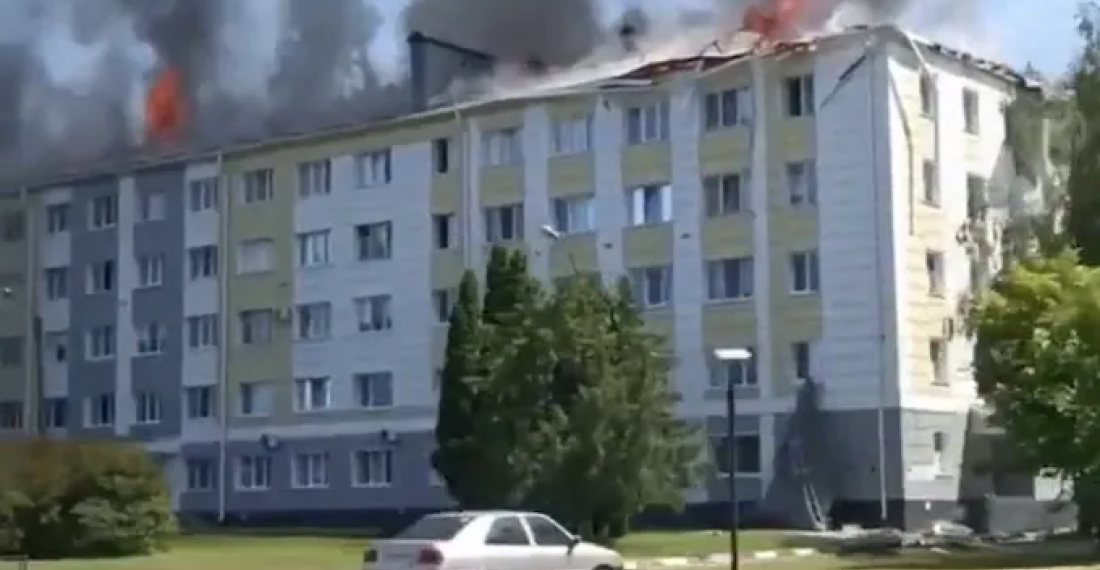
Later, Gladkov also said that a dormitory building in Shebekino was on fire, and that the town administration building had also been hit. One building, the roof of which was filmed being on fire, can be geolocated to Ulitsa Lenina 58, indeed a few metres from the town administration building. Clouds of smoke have been filmed rising above Shebekino, and Russian media has reported heavy shelling.
Early Thursday afternoon, the Russian Ministry of Defence issued a statement on Telegram claiming that the insurgents had been driven back having suffered “significant losses”, with state-run RIA Novosti reporting that Russian forces had “thwarted an attempted invasion by Ukrainian militants in Shebekino”.
Around the same time, however, the RVC released a video claiming that its forward units were “already fighting on the outskirts of Shebekino”, around the villages of Novaya Tavolzhanka and Titovka.
There have been reports of long lines forming at petrol stations near Shebekino as Russians attempt to flee.
1 June incursion follows several days of shelling in Shebekino, Russia blames Ukraine
The events on 1 June come after several days and nights of reported shelling in Shebekino, which Russia has blamed on Ukraine.
On Saturday night (27 May), governor Gladkov announced on Telegram that he had witnessed shelling in the town, which lies some 4km away from the Ukrainian border.
“I could get to Shebekino myself only on the second attempt,” he said. “On the first one, when I entered the city, it was under attack. I couldn't even get out of the car. Shells exploded on a nearby street.” Gladkov said the city had been shelled five times during that day, resulting in one death and three injuries.
Further shelling of Shebekino was reported by Gladkov on Tuesday and Wednesday (30-31 May). The governor claimed damage to a small number of apartment buildings, homes, a school, administrative buildings, and an industrial plant. As the shelling has reportedly continued, small numbers of casualties have been recorded. Speaking in a live broadcast on Wednesday, Gladkov said that “the situation in Shebekino is not getting better.”
Then, overnight on Thursday (1 June), Gladkov announced another night of shelling on Shebekino. Accusing the Armed Forces of Ukraine of shelling the city, he said the attack lasted for more than an hour.
It was around the same time as this that the LSR and RVC released their videos on Thursday claiming a new raid into Russia.
source: commonspace.eu with agencies
photo: Twitter