Putin signs new doctrine for the Russian Navy

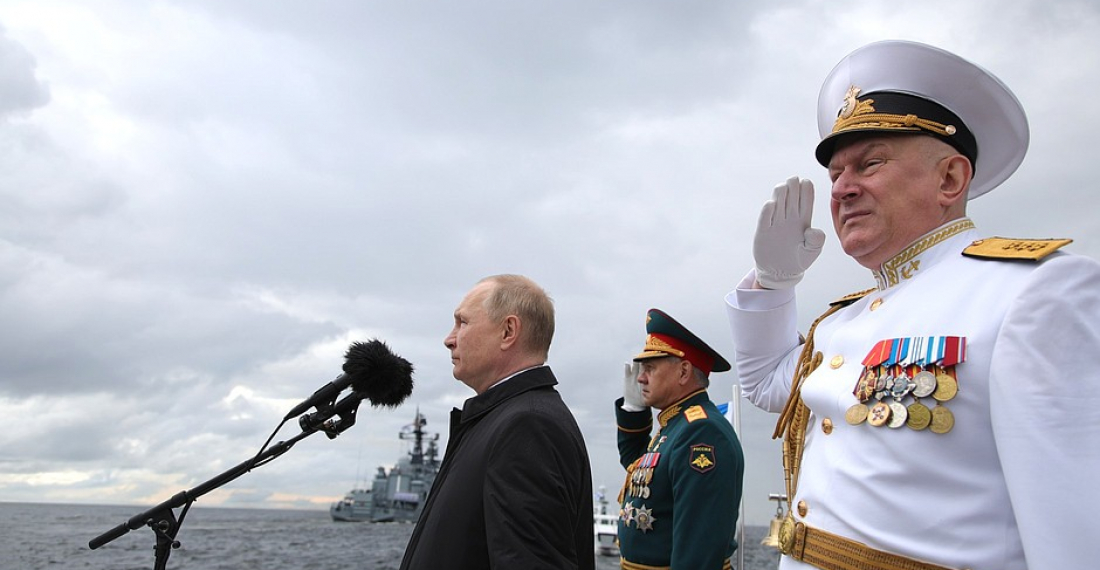
Russian president Vladimir Putin has signed the new doctrine of the Russian Navy. The Doctrine outlines the boundaries and areas of the country’s national interests, Putin said before reviewing ships at the annual Main Naval Parade in St. Petersburg on Sunday (31 July).

"Russia’s new Maritime Doctrine has been approved. We openly designated the boundaries and areas of Russia’s national interests, both economic and vital strategic areas. First of all, these are our Arctic waters, the waters of the Black, Okhotsk and Bering Seas, the Baltic and Kuril straits. We will firmly provide for their protection by all means," Putin stressed.

Putin said, "the Navy’s capabilities are a key word here." "It is capable of swiftly counteracting all those who will venture to encroach on our sovereignty and freedom and accomplishes strategic tasks successfully and with honour on our country’s frontiers and in any part of the World Ocean," he said.

The latest developments require Russia’s adequate and decisive actions, the Russian president added.

"The present-day conditions require that we take adequate, prompt and decisive actions. I am certain that the current generation of sailors and officers is the Fatherland’s reliable and enduring support. For all of us, the Motherland is a sacred notion and its protection is the lofty duty and the essence of life for each of us," Putin emphasized.

The delivery of the cutting-edge Tsirkon hypersonic missile systems to the Russian Armed Forces will begin in the coming months and the frigate Admiral Gorshkov will be the first carrier of these formidable weapons,  Putin said, emphasising that the Russian Navy is constantly improving its armaments.

"It will suffice to mention the latest and world’s unrivaled Tsirkon hypersonic missile systems, for which no obstacles exist," the Russian leader stressed. "Their delivery to the Russian Armed Forces will begin in the coming months. The frigate Admiral Gorshkov will be the first to assume combat alert with these formidable weapons on board. The area of the operation of this warship outfitted with the Tsirkon hypersonic missiles will be chosen proceeding from the interests of ensuring Russia’s security," Putin said.

The new Doctrine of the Russian Navy

The new Doctrine of the Russian Navy has now been posted on the web portal of the Russian government.

"The major challenges and threats to the national security and the sustainable development of the Russian Federation related to the World Ocean are: the US strategic course towards dominance in the World Ocean and its global influence on international processes, including those related to the use of transportation lanes and energy resources of the World Ocean," the document says.

The new doctrine also identifies the expansion of the NATO military infrastructure to the Russian borders and the growing number of the military bloc’s drills in the seas adjacent to Russian territory as major security threats.

The new doctrine points to the attempts by the United States and its allies to limit Russia’s access to the World Ocean’s resources and vitally important sea transportation lanes and the US desire to achieve the overwhelming supremacy of its Navy.

Russia’s new Maritime Doctrine stipulates stepping up activities in the Arctic, the document suggests.

"The new doctrine envisages "diversifying and stepping up maritime activity on the Spitsbergen, Franz Josef Land and Novaya Zemlya archipelagoes and Wrangel Island," the document says.

Russia will be ramping up the Navy’s operational capabilities to ensure national security and protect its interests in the World Ocean, as follows from the new Maritime Doctrine.

"The strategic goals of the national maritime policy are as follows: raising the Navy’s operational (combat) capabilities for ensuring national security of the Russian Federation and protecting its national interests in the World Ocean," the document says.

Another strategic objective is to raise the efficiency of defending and protecting the state maritime borders of the Russian Federation, the document says.

Russia’s new Maritime Doctrine stipulates developing the shipbuilding industry in the Far East, in particular, for building aircraft carriers, as follows from the document.

"Developing a modern, hi-tech shipbuilding industry in the Far East designed for building large-tonnage vessels (in particular, for the Arctic’s development) and advanced aircraft carriers for the Navy," the document reads.

NATO’s expansion to Russian borders is unacceptable in Moscow’s relations with the military bloc, as follows from the new Maritime Doctrine.

"NATO’s plans of moving its military infrastructure close to the Russian borders and the alliance’s attempts to assume global functions continue to be unacceptable for the Russian Federation and remain a determining factor in its relations with NATO," the document reads.

As the doctrine specifies, Russia’s national maritime policy in the Atlantic region is shaped taking into account the existence of NATO whose activity "is aimed at direct confrontation with the Russian Federation and its allies."

Source: commonspace.eu with TASS news agency (Moscow) and other media outlets
 

Related articles

Editor's choice
News
Key European countries back Denmark in the face of Trump's continuing insistence on taking over Greenland

Key European countries back Denmark in the face of Trump's continuing insistence on taking over Greenland

 Six major European countries have declared their support to Denmark following renewed insistence by the US that it must have control over Greenland. "Greenland belongs to its people, and only Denmark and Greenland can decide on matters concerning their relations," said the leaders of the UK, France, Germany, Italy, Poland, and Spain, in a joint statement, issued on Tuesday (6 January), together with Denmark. On Sunday, Donald Trump said the US "needed" Greenland - a semi-autonomous region of fellow Nato member Denmark - for security reasons. He has refused to rule out the use of force to take control of the territory, and Danish Prime Minister Mette Frederiksen warned on Monday that an attack by the US would spell the end of Nato. The issue of Greenland's future resurfaced in the wake of the US military intervention in Venezuela, during which elite troops went in to seize the country's President Nicolás Maduro and take him to face drugs and weapons charges in New York. Following the raid, Trump said the US would "run" Venezuela for an unspecified period of time. He also said the US was returning to an 1823 policy of US supremacy in its sphere of influence in the Western hemisphere - and he warned a number of countries the US could turn its attention to them. The US military raid in Venezuela has reignited fears that the US may consider using force to secure control of Greenland. A day after the raid, Katie Miller - the wife of one of Trump's senior aides - posted on social media a map of Greenland in the colours of the American flag, alongside the word "SOON". On Monday, her husband Stephen Miller said it was "the formal position of the US government that Greenland should be part of the US". In an interview with CNN, he also said the US "is the power of Nato. For the US to secure the Arctic region, to protect and defend Nato and Nato interests, obviously Greenland should be part of the US." Asked repeatedly whether the US would rule out using force to annex it, Miller responded: "Nobody's going to fight the US over the future of Greenland." Stressing they were as keen as the US in Arctic security, the seven European signatories of Tuesday's joint statement said this must be achieved by Nato allies, including the US "collectively" - whilst "upholding the principles of the UN Charter, including sovereignty, territorial integrity and the inviolability of borders". Greenland's Prime Minister Jens-Frederik Nielsen welcomed the statement and called for "respectful dialogue". "The dialogue must take place with respect for the fact that Greenland's status is rooted in international law and the principle of territorial integrity," Nielsen said. Trump has claimed that making Greenland part of the US would serve American security interests due to its strategic location and its abundance of minerals critical to high-tech sectors. Greenland, which has a population of 57,000 people, has had extensive self-government since 1979, though defence and foreign policy remain in Danish hands. While most Greenlanders favour eventual independence from Denmark, opinion polls show overwhelming opposition to becoming part of the US.
Editor's choice
News
Donald Tusk: "One for all, and all for one! Otherwise we are finished."

Donald Tusk: "One for all, and all for one! Otherwise we are finished."

Europe is rattled by events in Venezuela, and there are serious concerns that US disregard for international law may have consequences close to home.  The BBC diplomatic correspondent, James Landale, said, the question is how Europe may respond in the longer term to America's military operation in Venezuela. Will it provide a catalyst for the continent to take greater responsibility for its own security in the face of so much instability from what many see as an unreliable ally? Polish prime minister, Donald Tusk, appears to have answered the question, saying on social media: "No-one will take seriously a weak and divided Europe: neither enemy nor ally. It is already clear now. "We must finally believe in our own strength, we must continue to arm ourselves, we must stay united like never before. One for all, and all for one. Otherwise, we are finished." The US seizing of Venezuela's leader has faced strong criticism from both America's friends and foes at an emergency meeting of the United Nations Security Council, held on Monday, 5 January. Many member states agreed with the US that Nicolás Maduro had been an illegitimate and repressive leader. But many also condemned the US military action as a breach of international law and the UN Charter, and they demanded a democratic transition that reflected the will of the Venezuelan people. (click the image to read the full article).

Popular

Editor's choice
News
Key European countries back Denmark in the face of Trump's continuing insistence on taking over Greenland

Key European countries back Denmark in the face of Trump's continuing insistence on taking over Greenland

 Six major European countries have declared their support to Denmark following renewed insistence by the US that it must have control over Greenland. "Greenland belongs to its people, and only Denmark and Greenland can decide on matters concerning their relations," said the leaders of the UK, France, Germany, Italy, Poland, and Spain, in a joint statement, issued on Tuesday (6 January), together with Denmark. On Sunday, Donald Trump said the US "needed" Greenland - a semi-autonomous region of fellow Nato member Denmark - for security reasons. He has refused to rule out the use of force to take control of the territory, and Danish Prime Minister Mette Frederiksen warned on Monday that an attack by the US would spell the end of Nato. The issue of Greenland's future resurfaced in the wake of the US military intervention in Venezuela, during which elite troops went in to seize the country's President Nicolás Maduro and take him to face drugs and weapons charges in New York. Following the raid, Trump said the US would "run" Venezuela for an unspecified period of time. He also said the US was returning to an 1823 policy of US supremacy in its sphere of influence in the Western hemisphere - and he warned a number of countries the US could turn its attention to them. The US military raid in Venezuela has reignited fears that the US may consider using force to secure control of Greenland. A day after the raid, Katie Miller - the wife of one of Trump's senior aides - posted on social media a map of Greenland in the colours of the American flag, alongside the word "SOON". On Monday, her husband Stephen Miller said it was "the formal position of the US government that Greenland should be part of the US". In an interview with CNN, he also said the US "is the power of Nato. For the US to secure the Arctic region, to protect and defend Nato and Nato interests, obviously Greenland should be part of the US." Asked repeatedly whether the US would rule out using force to annex it, Miller responded: "Nobody's going to fight the US over the future of Greenland." Stressing they were as keen as the US in Arctic security, the seven European signatories of Tuesday's joint statement said this must be achieved by Nato allies, including the US "collectively" - whilst "upholding the principles of the UN Charter, including sovereignty, territorial integrity and the inviolability of borders". Greenland's Prime Minister Jens-Frederik Nielsen welcomed the statement and called for "respectful dialogue". "The dialogue must take place with respect for the fact that Greenland's status is rooted in international law and the principle of territorial integrity," Nielsen said. Trump has claimed that making Greenland part of the US would serve American security interests due to its strategic location and its abundance of minerals critical to high-tech sectors. Greenland, which has a population of 57,000 people, has had extensive self-government since 1979, though defence and foreign policy remain in Danish hands. While most Greenlanders favour eventual independence from Denmark, opinion polls show overwhelming opposition to becoming part of the US.