


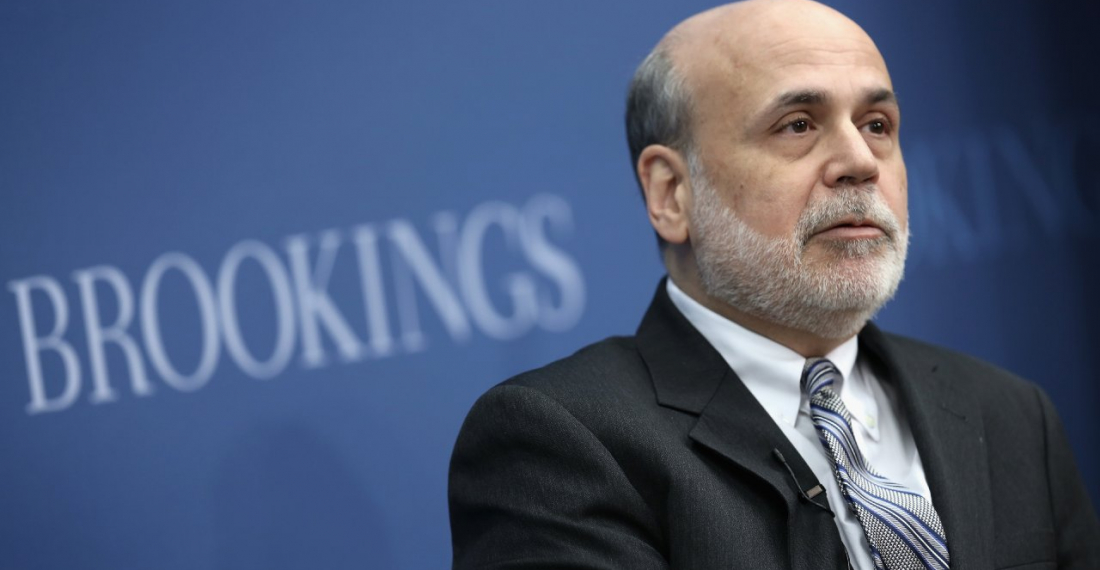
Nobel Prize in Economic Sciences awarded to Ben Bernanke, Douglas Diamond and Philip Dybvig for their research on banks and financial crises

Former 14th chairman of the Federal Reserve System (FED), Ben Bernanke, has been awarded the Nobel Prize in Economic Sciences for his research on the stability of the financial system. He shares the prize with Douglas Diamond and Philip Dybvig. The news was announced in Stockholm on Monday (10 October).

As former chairman of the US central bank, Bernanke played a pivotal role in combating the financial crisis in 2007-2008. Bernanke, now associated with the Brookings Institution think tank for domestic economic policy, demonstrated in a 1983 paper how a 'run' on banks, in which worried depositors withdraw their money en masse, could cause banks to fail and plunge the economy into depression. Banks were thus at the root of the 1930s' Great Depression.

Last year, the Nobel Prize in Economic Sciences was shared by David Card, Joshua Angrist and Guido Imbens. Card received the prize for his contribution to labour economics, Angrist and Imbens were awarded for their research on causal relationships.

source: commonspace.eu with agencies
p
hoto: Former US central bank chairman Ben Bernanke. AFP


Related articles

Popular

Editor's choice
Interview
Thursday Interview: Murad Muradov

Thursday Interview: Murad Muradov

Today, commonspace.eu starts a new regular weekly series. THURSDAY INTERVIEW, conducted by Lauri Nikulainen, will host  persons who are thinkers, opinion shapers, and implementors in their countries and spheres. We start the series with an interview with Murad Muradov, a leading person in Azerbaijan's think tank community. He is also the first co-chair of the Action Committee for a new Armenian-Azerbaijani Dialogue. Last September he made history by being the first Azerbaijani civil society activist to visit Armenia after the 44 day war, and the start of the peace process. Speaking about this visit Murad Muradov said: "My experience was largely positive. My negative expectations luckily didn’t play out. The discussions were respectful, the panel format bringing together experts from Armenia, Azerbaijan, and Turkey was particularly valuable during the NATO Rose-Roth Seminar in Yerevan, and media coverage, while varied in tone, remained largely constructive. Some media outlets though attempted to represent me as more of a government mouthpiece than an independent expert, which was totally misleading.  Overall, I see these initiatives as important steps in rebuilding trust and normalising professional engagement. The fact that soon a larger Azerbaijani civil society visits to Armenia followed, reinforces the sense that this process is moving in the right direction." (click the image to read the interview in full)

