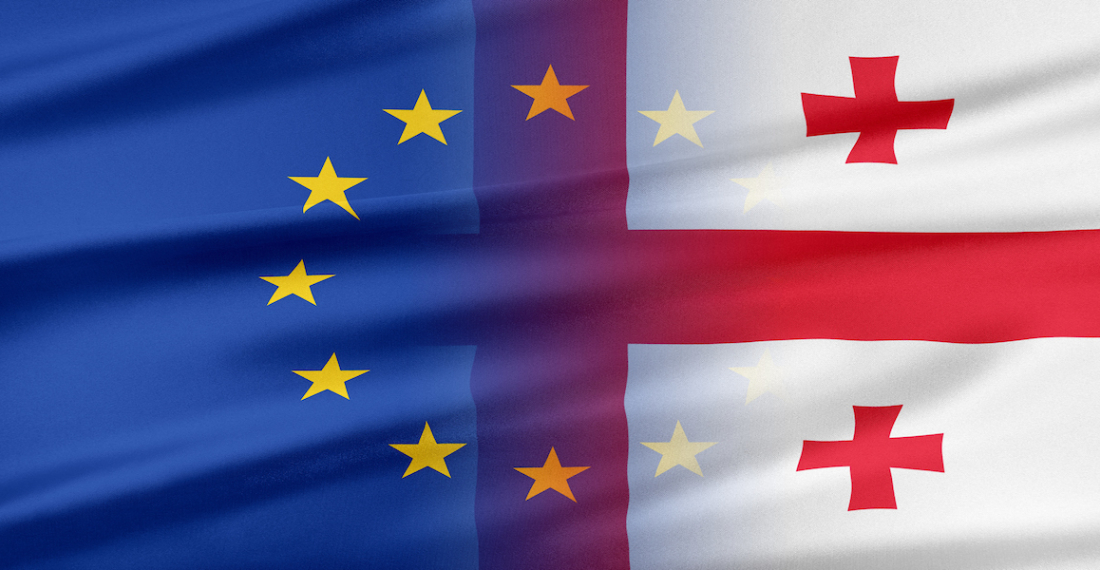
Seven Members of the European Parliament (MEPs) have published a joint statement in response to Georgian politicians' inability to reach an agreement to resolve the country's political crisis under the mediation of the President of the European Council’s Personal Envoy, Christian Danielsson. Danielsson was in Tbilisi this week for the second round of negotiations with the government and opposition, to whom he presented an EU-drafted document presenting a way out of the crisis for all parties. He emerged in the early hours of Wednesday morning (31 March), after an eight-hour meeting with the leaders of the government and opposition, admitting that he was “sad to report that none of the political parties could agree to this solution in whole”.
In their statement, the co-signatories from across party lines deplored Georgia’s rejection of the proposal and announced consequences in terms of EU-Georgia relations. The MEPs noted that following this refusal by both sides to compromise, “Georgia’s leaders should not expect a return to business as usual from the European Union”. They warned that the European Parliament would call for “disbursements of and an increase in conditionality linked to EU Macro Financial Assistance and budget support programmes”. They finished by asserting:
"We call on Georgia’s leaders to take action immediately. The future of EU-Georgia relations is at stake."
Georgia has been in a political crisis since October last year when opposition parties alleged that the parliamentary elections had been rigged – a claim not supported by international observers – boycotting parliament. The crisis further erupted in Feburary when Nika Melia, the leader of the United National Movement (UNM - the largest opposition party), was arrested for inciting violence during anti-government protests in 2019 – charges that his supporters allege are politically motivated. The stumbling blocks in the EU-mediation process were the two issues that have been at the centre of the dispute from the beginning, namely the opposition demands for early elections and the release of opposition leaders who are in prison.
The full statement can be read here:
“We are deeply disappointed with the political leaders in Georgia for their inability to reach an agreement last Tuesday despite the best efforts deployed by the European Union to help put an end to the current political crisis. Both the ruling and the main opposition parties taking part in the discussions are to be blamed for this outcome and a special responsibility lies with the party in government.
We reiterate our strong support to Christian Danielsson’s tireless work and welcome the publication of the proposal he made to the political parties, which further increased the transparency of the mediation process. It is essential to rebuild confidence between political party actors. The content of this proposal is indeed the right way ahead for Georgia: ambitious electoral and judicial reforms, meaningful sharing of responsibilities in the Georgian Parliament and, most importantly, a solution on future elections and on two cases of politicised justice. This solution is politically balanced and respects both the rule of law and the international assessment of the 2020 elections. We also welcome the idea of a Jean-Monnet Dialogue process supported by the European Parliament, when the political situation allows.
Following the refusal from the political parties to compromise, Georgia’s leaders should not expect a return to business as usual from the European Union. The European Parliament in particular will call for consequences in terms of EU financial assistance, including both a suspension of further disbursements of and an increase in conditionality linked to EU Macro Financial Assistance and budget support programmes.
In the meantime, the adoption of ongoing electoral and judicial reforms in the Georgian Parliament requires broad political support and the need to fully implement the recommendations of OSCE/ODIHR and the Council of Europe’s Venice Commission. These reforms are key to rebuild trust. We call on the ruling party to ensure a genuinely inclusive process to avoid the further undermining of both future elections and the judiciary, as well as unnecessarily closing the door to a possible agreement in the future.
We call on Georgia’s leaders to take action immediately. The future of EU-Georgia relations is at stake.”
The statement is co-signed by:
David McAllister (EPP, Germany), Chair of the Committee on Foreign Affairs and the Co-Chair of the Democracy Support and Election Coordination Group;
Marina Kaljurand (S&D, Estonia), Chair of the Delegation for Relations with the South Caucasus;
Andrius Kubilius (EPP, Lithuania), Chair of the Delegation to the Euronest Parliamentary Assembly;
Viola von Cramon-Taubadel (The Greens/EFA, Germany), lead member of the Democracy Support and Election Coordination Group for Georgia;
Sven Mikser (S&D, Estonia), European Parliament’s Standing Rapporteur on Georgia;
Michael Gahler (EPP, Germany), European Parliament’s Standing Rapporteur on Ukraine;
Petras Auštrevičius (Renew Europe, Lithuania), European Parliament’s Standing Rapporteur on Belarus.