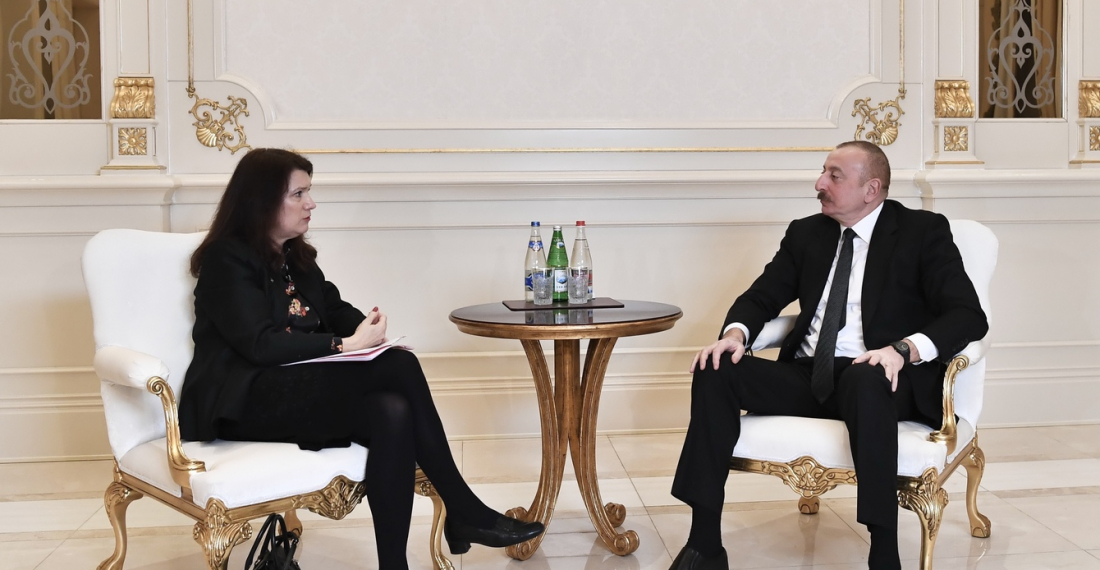
The current Chairperson-in-office of the Organisation for Security and Co-operation in Europe, Swedish Foreign Minister Ann Linde, on Sunday (14 March) met in Baku with Azerbaijani President Ilham Aliyev to discuss the situation in the South Caucasus following the 44-day Karabakh war.
Linde later tweeted:
Pleased to speak with Azerbaijani 🇦🇿President @presidentaz. Constructive discussions on @OSCE-related matters & regional developments. Emphasized important role of #OSCE and Minsk Group Co-Chairs in resolving outstanding issues. #OSCE2021SWE pic.twitter.com/5qG43jkYX6
— Ann Linde (@AnnLinde) March 14, 2021
According to the website of the Azerbaijani president, Ilham Aliyev told Linde that "the conflict is already in the history and we need to look to the future. And we discussed today with you our views how to build the future. We think four months which passed after war already demonstrate the will of both sides to turn the page and to concentrate on the future. This is very important."
The president added,
"As far as we are concerned, we already started the rehabilitation of the liberated territories. The program of reconstruction already is being implemented. A lot is to be done, because everything is destroyed on the liberated territories-the cities, the villages, the cultural monuments, all infrastructure. So there will be really a very big scope of work. It’s more than 10 thousand square kilometers of totally destroyed area. We already started the process of negotiations on the opening of communications between Armenia and Azerbaijan. That was part of the statement which was signed on November 10. Negotiations already had several rounds, different levels and I think that this particular issue can be a starting point for completely turning the page of war and leaving it to the history. Because opening of communications will be in the benefit of all the regional countries. We will create new opportunities, bring new dynamics to regional cooperation. And it can bring after many other areas of potential cooperation. I already publicly spoke that Azerbaijan is ready for that. We have completed our task, we liberated the territories, implemented the resolutions of Security Council of United Nations and decisions of OSCE. So now, we need to concentrate on future."