


EU tiptoes into Belarus crisis

EU Council president Charles Michel spoke to president Putin on Thursday (20 August), informing him of EU's position on the ongoing crisis in Belarus, agreed yesterday by the leaders of the 27 member states.

Michel tweeted 


The EU leaders on Wednesday agreed on a strategy for dealing with the crisis in Belarus, which tried to balance a firm message to the Belarusian authorities with a way forward through dialogue. A statement issued afterwards made it clear that the EU considered the 9 August elections "were neither free nor fair, therefore we do not recognise the results".The statement adds:

"The people of Belarus have a right to determine their future. The members of the European Council express their clear solidarity with the people of Belarus in their desire to exercise their fundamental democratic rights.

The members of the European Council condemn the disproportionate and unacceptable violence displayed by the state authorities against peaceful protesters. Violence must be avoided and all those unlawfully detained must be immediately and unconditionally released. Civil society and opposition actors engaged in discussions of political transition must be protected from arbitrary arrests and violence. The EU expects a complete and transparent investigation into all alleged abuses.

The EU will shortly impose sanctions against a substantial number of individuals responsible for violence, repression and the falsification of election results.

Progress made in the past years in the relationship between the EU and Belarus is at risk. Any further deterioration of the situation will impact on our relationship and have negative consequences.

We call on the Belarusian authorities to find a way out of the crisis through an end to violence, de-escalation, and an inclusive national dialogue. Only a peaceful and democratic process, underpinned by independent and free media and a strong civil society, can provide sustainable solutions. All parties, including third states, should support such a process.

We will continue to follow the situation closely and stand ready to contribute to efforts to peacefully end the crisis. The EU fully supports OSCE proposals for dialogue in Belarus and is ready to provide assistance to further them"

In Minsk however, Belarus president Alexander Lukashenko appeared defiant, ordering a clampdown on protestors, and re-appointing his Ministers to their position, after they had resigned as was required by law after the 9 August election.

A re-run of the election appears to be the only way out of the current crisis, but Lukashenko appears to be adamant in resisting this request.

Commonspace.eu political editor said in a comment that the European Union is being very careful how it is dealing with the crisis - rather than barging in it is trying to tip toe softly into engaging with what is a complicated situation. It is also trying to find a way of working with Russia on the crisis, rather than confronting or opposing Russia. It seems that president Putin is also not keen on dramatic confrontations. The problem is that Brussels and Moscow have high stakes in Belarus, but their capacity to influence events is limited. The Belarusian leader, Alexander Lukashenko is stubborn and has a fixed view of the world, and of the place of Belarus in it, which colours a lot of his decision making. He will continue trying to play Moscow against Brussels and Washington. But the the strength of the opposition to him inside the country is now so high that plastering over the cracks is no longer a viable option for him either. Change is coming to Belarus, but quite what kind of change, and how it will happen, remains to be seen."

source: commonspace.eu with agencies

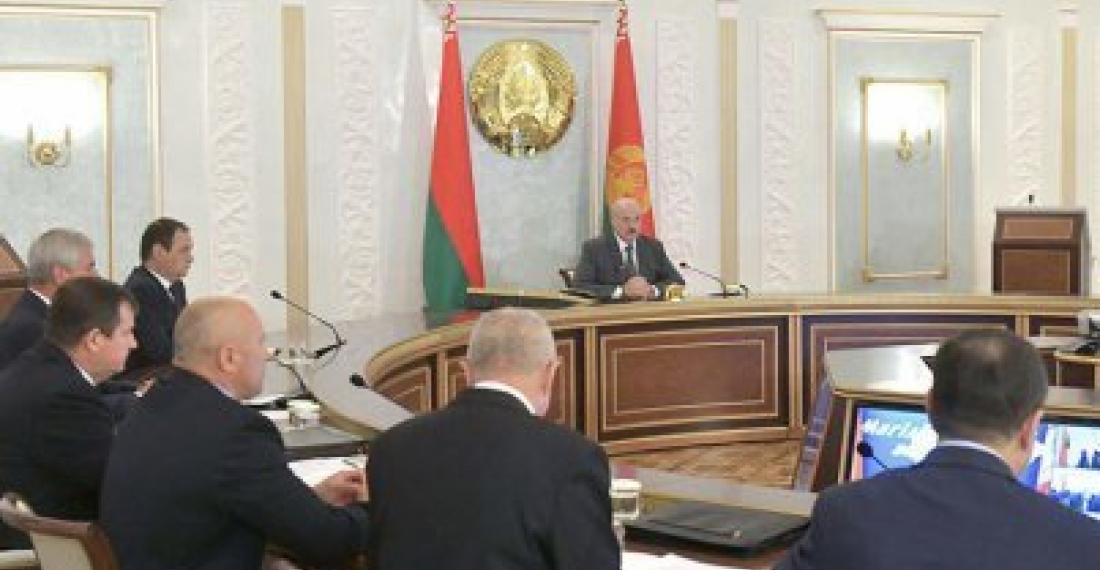
photo: Belarus President Alexandor Lukashenko addressing his National Security Council on Wednesday, 19 August 2020. (picture courtesy of Belta News Agency, Minsk.)

Related articles

Editor's choice
News
Borrell tells the European Parliament that the situation in Afghanistan was critical, but the EU will remain engaged

Borrell tells the European Parliament that the situation in Afghanistan was critical, but the EU will remain engaged

Borrell underlined that the European Union will make every effort to support the peace process and to remain a committed partner to the Afghan people. "Of course, we will have to take into account the evolving situation, but disengagement is not an option.  We are clear on that: there is no alternative to a negotiated political settlement, through inclusive peace talks.
Editor's choice
News
Egypt rejects Israeli "offer" for an exit only Rafah checkpoint in Gaza

Egypt rejects Israeli "offer" for an exit only Rafah checkpoint in Gaza

Egypt has rejected an Israeli "offer" for opening for exit only the Rafah checkpoint in Gaza. According to the Egyptian State Information Service, Egyptian authorities refuted on Wednesday afternoon reports that Israel claims it will open the Rafah crossing, the only lifeline for Gaza to the outside world, but only for those wishing to leave the besieged coastal enclave.  Citing an Egyptian official, the service stated that ''any agreement to open the crossing will cover both entry and exit, in line with US President Donald Trump's plan for humanitarian and political arrangements following the ceasefire.'' Cairo reaffirmed its adherence to the plan and UN Security Council Resolution 2803, including the right of return for Palestinians and maintaining two-way operations at the crossing. Earlier in the day, Israel's Coordinator of Government Activities in the Territories (COGAT) announced that the Rafah crossing would reopen ''within the next few days,'' marking the first such move since February 2025. According to the statement, departures would require prior Israeli security approval and would follow mechanisms previously implemented under EU supervision. Notably, the statement made no mention of the entry of humanitarian aid, which continues to flow through the Kerem Shalom crossing. A Palestinian official also echoed the Egyptian denial of Israel's claim. The announced agreements stress that no Palestinians will be forced to leave Gaza. Those who choose to travel will have the right to return, while humanitarian aid will continue through UN agencies, the International Red Cross and Crescent, and other independent organisations. A European Union official, who requested anonymity and is familiar with the matter, told TNA that the EU has received no official notification from Israel regarding new arrangements, stressing that "no changes exist beyond the January agreements, and we await Israel's formal approval for crossing operations under the Trump plan. "Reopening the crossing will follow mechanisms jointly supervised by the EU and the Palestinian Authority to ensure oversight and transparency, according to the EU official.

Popular

Editor's choice
News
Egypt rejects Israeli "offer" for an exit only Rafah checkpoint in Gaza

Egypt rejects Israeli "offer" for an exit only Rafah checkpoint in Gaza

Egypt has rejected an Israeli "offer" for opening for exit only the Rafah checkpoint in Gaza. According to the Egyptian State Information Service, Egyptian authorities refuted on Wednesday afternoon reports that Israel claims it will open the Rafah crossing, the only lifeline for Gaza to the outside world, but only for those wishing to leave the besieged coastal enclave.  Citing an Egyptian official, the service stated that ''any agreement to open the crossing will cover both entry and exit, in line with US President Donald Trump's plan for humanitarian and political arrangements following the ceasefire.'' Cairo reaffirmed its adherence to the plan and UN Security Council Resolution 2803, including the right of return for Palestinians and maintaining two-way operations at the crossing. Earlier in the day, Israel's Coordinator of Government Activities in the Territories (COGAT) announced that the Rafah crossing would reopen ''within the next few days,'' marking the first such move since February 2025. According to the statement, departures would require prior Israeli security approval and would follow mechanisms previously implemented under EU supervision. Notably, the statement made no mention of the entry of humanitarian aid, which continues to flow through the Kerem Shalom crossing. A Palestinian official also echoed the Egyptian denial of Israel's claim. The announced agreements stress that no Palestinians will be forced to leave Gaza. Those who choose to travel will have the right to return, while humanitarian aid will continue through UN agencies, the International Red Cross and Crescent, and other independent organisations. A European Union official, who requested anonymity and is familiar with the matter, told TNA that the EU has received no official notification from Israel regarding new arrangements, stressing that "no changes exist beyond the January agreements, and we await Israel's formal approval for crossing operations under the Trump plan. "Reopening the crossing will follow mechanisms jointly supervised by the EU and the Palestinian Authority to ensure oversight and transparency, according to the EU official.

