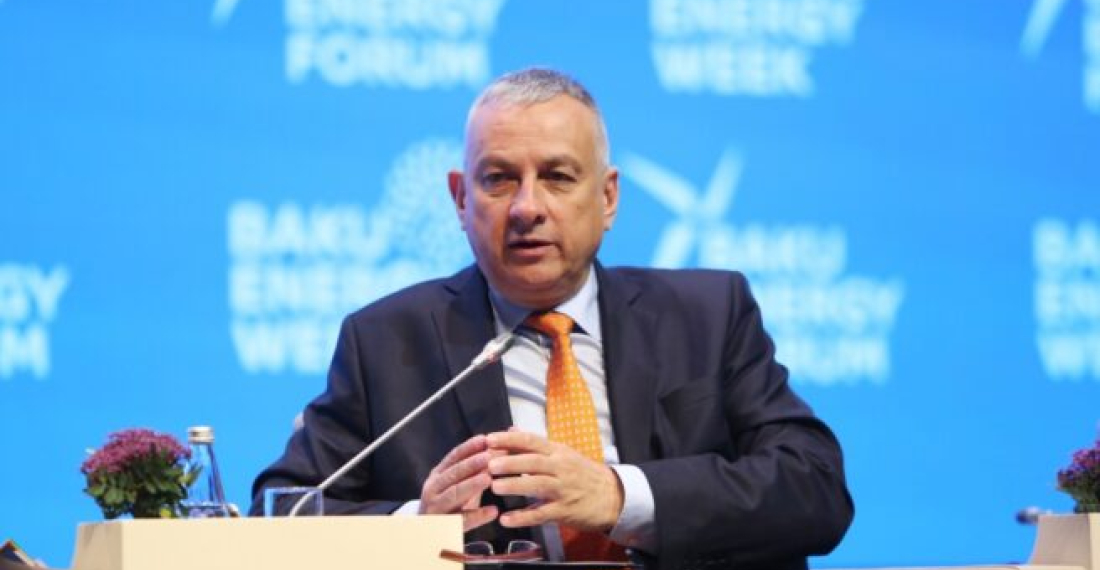
EU Commissioner Síkela visits Central Asia to promote development projects in the region

Between 12 and 18 March, European Commissioner for International Partnerships Jozef Síkela will visit the five Central Asian countries to strengthen the EU-Central Asia partnership ahead of the EU-Central Asia Summit and scale up Global Gateway, the EU’s investment strategy to boost jobs and sustainable economic growth. 

In a statement Commissioner Síkela said: “Central Asia is an important partner for the European Union, and our cooperation offers a great potential for the future. More than ever, current global challenges emphasise the need for solid partnerships and that is exactly what I aim to strengthen during my mission. My goal is to focus on key Global Gateway projects, which the EU and Central Asian partners are advancing together to create quality jobs, unlock new business opportunities, and improve essential services—from education to modern infrastructure."

Commissioner Síkela, aims to use the visit to Central Asia to advance the development of the Trans-Caspian International Transport Route. On X, the Commissioner said:  "Trade between Europe and Asia is growing fast. But to make it stable and efficient, we are developing the Trans-Caspian Transport Corridor — a fast, secure route connecting Europe and Asia in 15 days or less, and an alternative to Russian and Red Sea routes. I will visit Turkmenbashi Port in Turkmenistan, the gateway to this corridor. But most of my meetings in all five countries will focus on making this project a reality".

During his visit, Síkela will meet with officials from the five Central Asian countries to promote economic collaboration under the EU's Global Gateway Strategy. He highlighted that the region has a 340 billion euro economy, growing at an average rate of 5 percent annually, with vast untapped potential for further cooperation.

The Commissioner’s visit will focus on the main Global Gateway priority areas in Central Asia:

  • transport, with a particular emphasis on the development of the Trans-Caspian Transport Corridor to reduce travel times and boost trade;
  • critical raw materials, to promote best practices, new jobs and economic resilience;
  • digital connectivity, to bridge the digital gap and boost access to secure high-speed internet;
  • the water, energy & climate sector, including the flagship project to support the construction of resilient infrastructure, to promote access to reliable, affordable and clean energy.

During the visit, Commissioner will sign several contracts linked to the above four key priority areas.

The Commissioner will kick off the visit in Turkmenistan, where he will meet government leaders as well as private sector representatives. The Commissioner will also visit the Turkmenbashi port, a strategic point for the development of the Trans-Caspian Transport Corridor.

In Kazakhstan, the Commissioner will meet high-level government representatives, participate in ceremony to sign bilateral and regional agreements in the field of transport and critical raw materials, press conference as well as engage with Kazakh and EU businesses. 

In Tajikistan, the Commissioner will attend several meetings with government leaders. This will be followed by a signing ceremony of important projects to support the green energy transition and the local cotton value chain. The next day, the Commissioner will visit the landmark Rogun Hydropower Plant for future support.

In Kyrgyzstan, the Commissioner will meet senior government representatives and participate in ceremonies to sign projects on water, energy, transport and human development. He will also discuss investment opportunities with the World Bank, Asian Development Bank, and European Bank for Reconstruction and Development in the country. One of the topics will be potential support to the construction of the Kambarata-1 hydropower plant. In addition, the Commissioner will engage with youth representatives and the UN.

The Commissioner will conclude his visit in Uzbekistan, meeting with high-level government representatives. He will travel to the Almalyk Mining and Metallurgical Complex and also exchange with Uzbek and European businesses. The next day, he will attend the signing ceremony of regional projects in the field of digital connectivity.

The visit will be conducted in the Team Europe spirit: EU financing institutions, the European Investment Bank, and European Bank for Reconstruction and Development, as well as the EU private sector and Member States present in the region will take part in different parts of the mission. The upcoming first-ever EU-Central Asia Summit early April as well as the Global Gateway Forum in June will further build on the commitment of the EU and Central Asia to delivering lasting impact.

Global Gateway is the EU's positive offer to reduce the worldwide investment disparity and boost smart, clean and secure connections in digital, energy and transport sectors, and to strengthen health, education and research systems. As a strategy it embodies a Team Europe approach that brings together the European Union, EU Member States, and European development finance institutions. Together, we aim to mobilise up to €300 billion in public and private investments from 2021 to 2027, creating essential links rather than dependencies, and closing the global investment gap.
Source: commonspace.eu with agencies. Photo: EU commissioner Jozef Síkela Photo credit - AFP

Related articles

Editor's choice
News
Borrell tells the European Parliament that the situation in Afghanistan was critical, but the EU will remain engaged

Borrell tells the European Parliament that the situation in Afghanistan was critical, but the EU will remain engaged

Borrell underlined that the European Union will make every effort to support the peace process and to remain a committed partner to the Afghan people. "Of course, we will have to take into account the evolving situation, but disengagement is not an option.  We are clear on that: there is no alternative to a negotiated political settlement, through inclusive peace talks.
Editor's choice
News
NATO Chief says war is on Europe's doorstep, and warns against complacency

NATO Chief says war is on Europe's doorstep, and warns against complacency

Russia could attack a Nato country within the next five years, the Secretary General of NATO, Mark Rutte, said in a stark new warning. "Nato's own defences can hold for now," Rutte warned in Berlin, but conflict was "next door" to Europe and he feared "too many are quietly complacent, and too many don't feel the urgency, too many believe that time is on our side. "Russia is already escalating its covert campaign against our societies," Rutte said in a speech in Germany. "We must be prepared for the scale of war our grandparents or great-grandparents endured." Earlier this month, Russia's President Vladimir Putin said his country was not planning to go to war with Europe, but it was ready "right now" if Europe wanted to - or started a war. But similar reassurances were given by Moscow in 2022, just before 200,000 Russian troops crossed the border and invaded Ukraine. Putin has accused European countries of hindering US efforts to bring peace in Ukraine - a reference to the role Ukraine's European allies have recently played in trying to change a US peace plan to end the war, whose initial draft was seen as favouring Russia. But Putin was not sincere, Nato's secretary-general said in the German capital, Berlin. Supporting Ukraine, he added, was a guarantee for European security. "Just imagine if Putin got his way; Ukraine under the boot of Russian occupation, his forces pressing against a longer border with Nato, and the significantly increased risk of an armed attack against us." Russia's economy has been on a war footing for more than three years now - its factories churn out ever more supplies of drones, missiles and artillery shells. According to a recent report by the Kiel Institute for the World Economy, Russia has been producing each month around 150 tanks, 550 infantry fighting vehicles, 120 Lancet drones and more than 50 artillery pieces. The UK, and most of its Western allies, are simply not anywhere near this point. Analysts say it would take years for Western Europe's factories to come close to matching Russia's mass-production of weapons. "Allied defence spending and production must rise rapidly, our armed forces must have what they need to keep us safe," the Nato chief said.

Popular

Editor's choice
News
NATO Chief says war is on Europe's doorstep, and warns against complacency

NATO Chief says war is on Europe's doorstep, and warns against complacency

Russia could attack a Nato country within the next five years, the Secretary General of NATO, Mark Rutte, said in a stark new warning. "Nato's own defences can hold for now," Rutte warned in Berlin, but conflict was "next door" to Europe and he feared "too many are quietly complacent, and too many don't feel the urgency, too many believe that time is on our side. "Russia is already escalating its covert campaign against our societies," Rutte said in a speech in Germany. "We must be prepared for the scale of war our grandparents or great-grandparents endured." Earlier this month, Russia's President Vladimir Putin said his country was not planning to go to war with Europe, but it was ready "right now" if Europe wanted to - or started a war. But similar reassurances were given by Moscow in 2022, just before 200,000 Russian troops crossed the border and invaded Ukraine. Putin has accused European countries of hindering US efforts to bring peace in Ukraine - a reference to the role Ukraine's European allies have recently played in trying to change a US peace plan to end the war, whose initial draft was seen as favouring Russia. But Putin was not sincere, Nato's secretary-general said in the German capital, Berlin. Supporting Ukraine, he added, was a guarantee for European security. "Just imagine if Putin got his way; Ukraine under the boot of Russian occupation, his forces pressing against a longer border with Nato, and the significantly increased risk of an armed attack against us." Russia's economy has been on a war footing for more than three years now - its factories churn out ever more supplies of drones, missiles and artillery shells. According to a recent report by the Kiel Institute for the World Economy, Russia has been producing each month around 150 tanks, 550 infantry fighting vehicles, 120 Lancet drones and more than 50 artillery pieces. The UK, and most of its Western allies, are simply not anywhere near this point. Analysts say it would take years for Western Europe's factories to come close to matching Russia's mass-production of weapons. "Allied defence spending and production must rise rapidly, our armed forces must have what they need to keep us safe," the Nato chief said.