


EU announces €250 million financial package to Moldova to tackle energy crisis

The European Union has pledged Moldova another €250 million in financial aid to deal with the acute energy crisis.

The pro-European government in Chisinau fears that Russia could turn off the gas supply to Moldova at any moment, leaving it cold and without power.

Moldova is very dependent on Russian gas and Ukrainian electricity. Russia is using the gas tap to put pressure on the EU candidate country. The Russian military have also badly damaged Ukraine's electricity infrastructure, which also has repercussions for Moldova.

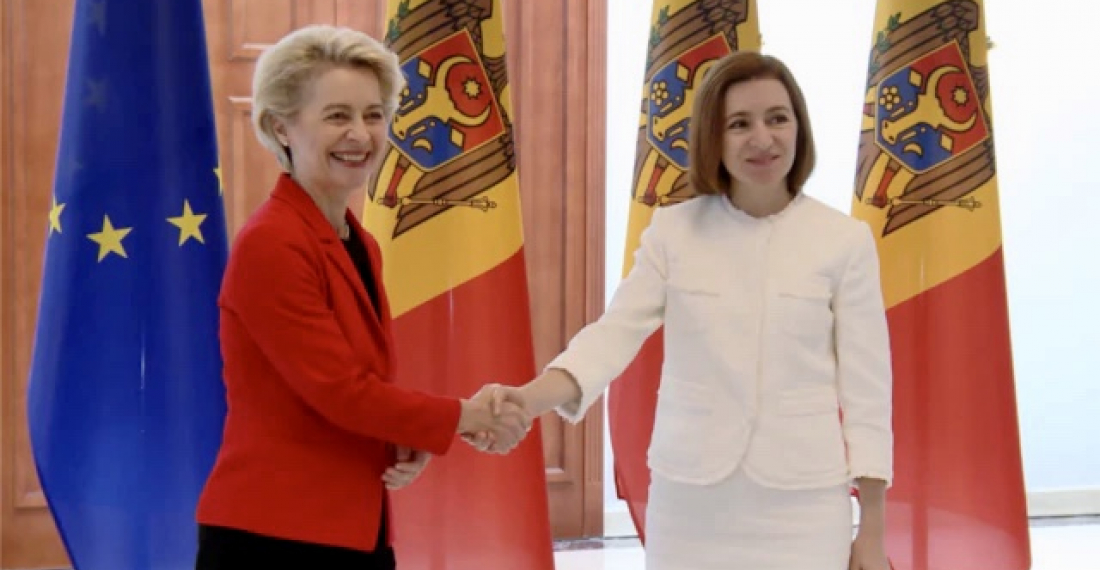
The government in Chisinau can expect 100 million euros plus a soft loan of another 100 million in January, European Commission President Ursula von der Leyen announced at a joint conference with Moldovan President Maia Sandu in Moldova's capital on Thursday (10 November). 

"Moldova is part of our European family. And family must stick together when the times are getting tough and difficult," she said.

This financial package is intended "to meet the need for gas supplies," she said on a visit to the Moldovan capital. Another 50 million in budget support intended for "the most vulnerable citizens" will also follow.
 

source: commonspace.eu with agencies
photo: European Commission President Ursula von der Leyen with Moldovan President Maia Sandu in Chisinau on 10 November 2022. RFE/RL

Related articles

Popular

Editor's choice
Interview
Thursday Interview: Murad Muradov

Thursday Interview: Murad Muradov

Today, commonspace.eu starts a new regular weekly series. THURSDAY INTERVIEW, conducted by Lauri Nikulainen, will host  persons who are thinkers, opinion shapers, and implementors in their countries and spheres. We start the series with an interview with Murad Muradov, a leading person in Azerbaijan's think tank community. He is also the first co-chair of the Action Committee for a new Armenian-Azerbaijani Dialogue. Last September he made history by being the first Azerbaijani civil society activist to visit Armenia after the 44 day war, and the start of the peace process. Speaking about this visit Murad Muradov said: "My experience was largely positive. My negative expectations luckily didn’t play out. The discussions were respectful, the panel format bringing together experts from Armenia, Azerbaijan, and Turkey was particularly valuable during the NATO Rose-Roth Seminar in Yerevan, and media coverage, while varied in tone, remained largely constructive. Some media outlets though attempted to represent me as more of a government mouthpiece than an independent expert, which was totally misleading.  Overall, I see these initiatives as important steps in rebuilding trust and normalising professional engagement. The fact that soon a larger Azerbaijani civil society visits to Armenia followed, reinforces the sense that this process is moving in the right direction." (click the image to read the interview in full)

