


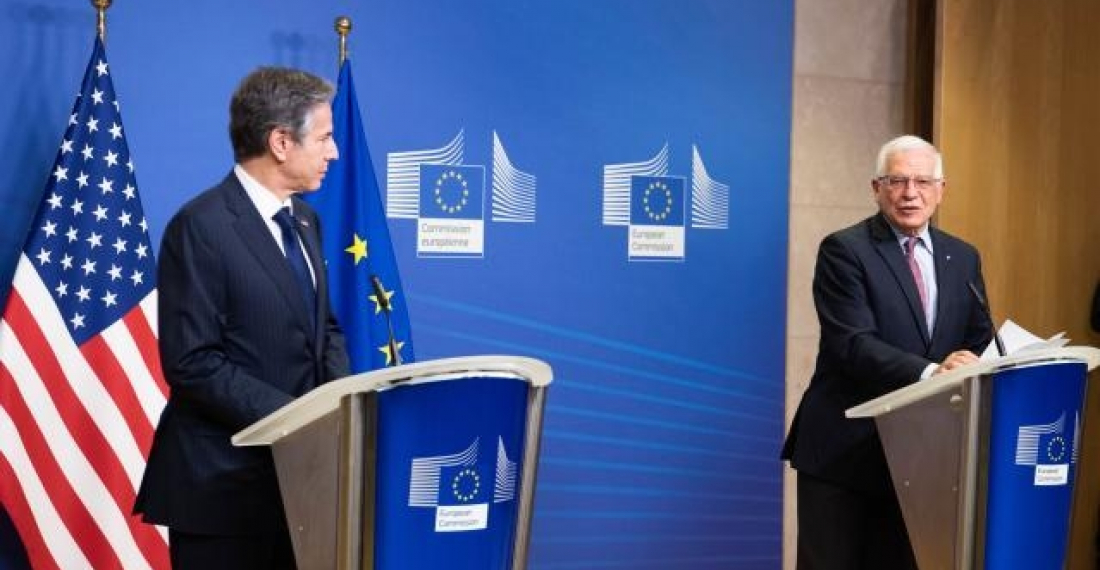
EU and US agree on joint measures related to several global issues

The European Union and the United States have agreed on a number of joint measures after a meeting in Brussels on Wednesday of their two most senior diplomats. EU High Representative Josep Borrell and US Secretary of State Antony Blinken discussed ways to strengthen the EU-US relationship and co-ordinate responses to prioritise foreign policy, security, and economic issues. They also committed to co-operate in the face of global challenges, including addressing the global climate crisis, bringing an end to the COVID-19 pandemic, facilitating a sustainable economic recovery, and defending democratic values and fundamental freedoms including within multilateral structures.

China and Russia were high on the agenda. 

On China, the two sides "decided to re-launch the bilateral dialogue on China, as a forum to discuss the full range of related challenges and opportunities. They acknowledged a shared understanding that relations with China are multifaceted, comprising elements of co-operation, competition, and systemic rivalry."

High Representative Borrell and Secretary Blinken noted their determination to further address, in a co-ordinated manner, Russia's challenging behaviour, including its ongoing aggression against Ukraine and Georgia; hybrid threats, such as disinformation; interference in electoral processes; malicious cyber activities; and military posturing.  Both sides also decided to co-ordinate their response to the shrinking space in Russia for independent political voices, civil society and media freedom and the dwindling respect for human rights and the rule of law. At the same time, both sides declared that they are ready to engage with Russia on issues of common interest and to encourage Russia to abandon confrontational approaches.

They also decided to continue close co-operation to encourage comprehensive reforms in the EU Eastern neighbourhood, including South Caucasus countries.

Over the last week there has been a flurry of activity as EU and US diplomats moved fast to re-establish the traditional bond in the transatlantic relationship, which had all but disappeared during the time of the Trump administration.


Source: commonspace.eu with the press service of the European External Action Service (Brussels)
Photo: EU High Representative Josep Borrell and US Secretary of State, Antony Blinken at their meeting in Brussels on 24 March 2021 (picture courtesy of the press service of the European Union).

 

Related articles

Editor's choice
News
Borrell tells the European Parliament that the situation in Afghanistan was critical, but the EU will remain engaged

Borrell tells the European Parliament that the situation in Afghanistan was critical, but the EU will remain engaged

Borrell underlined that the European Union will make every effort to support the peace process and to remain a committed partner to the Afghan people. "Of course, we will have to take into account the evolving situation, but disengagement is not an option.  We are clear on that: there is no alternative to a negotiated political settlement, through inclusive peace talks.
Editor's choice
News
NATO Chief says war is on Europe's doorstep, and warns against complacency

NATO Chief says war is on Europe's doorstep, and warns against complacency

Russia could attack a Nato country within the next five years, the Secretary General of NATO, Mark Rutte, said in a stark new warning. "Nato's own defences can hold for now," Rutte warned in Berlin, but conflict was "next door" to Europe and he feared "too many are quietly complacent, and too many don't feel the urgency, too many believe that time is on our side. "Russia is already escalating its covert campaign against our societies," Rutte said in a speech in Germany. "We must be prepared for the scale of war our grandparents or great-grandparents endured." Earlier this month, Russia's President Vladimir Putin said his country was not planning to go to war with Europe, but it was ready "right now" if Europe wanted to - or started a war. But similar reassurances were given by Moscow in 2022, just before 200,000 Russian troops crossed the border and invaded Ukraine. Putin has accused European countries of hindering US efforts to bring peace in Ukraine - a reference to the role Ukraine's European allies have recently played in trying to change a US peace plan to end the war, whose initial draft was seen as favouring Russia. But Putin was not sincere, Nato's secretary-general said in the German capital, Berlin. Supporting Ukraine, he added, was a guarantee for European security. "Just imagine if Putin got his way; Ukraine under the boot of Russian occupation, his forces pressing against a longer border with Nato, and the significantly increased risk of an armed attack against us." Russia's economy has been on a war footing for more than three years now - its factories churn out ever more supplies of drones, missiles and artillery shells. According to a recent report by the Kiel Institute for the World Economy, Russia has been producing each month around 150 tanks, 550 infantry fighting vehicles, 120 Lancet drones and more than 50 artillery pieces. The UK, and most of its Western allies, are simply not anywhere near this point. Analysts say it would take years for Western Europe's factories to come close to matching Russia's mass-production of weapons. "Allied defence spending and production must rise rapidly, our armed forces must have what they need to keep us safe," the Nato chief said.

Popular

Editor's choice
News
NATO Chief says war is on Europe's doorstep, and warns against complacency

NATO Chief says war is on Europe's doorstep, and warns against complacency

Russia could attack a Nato country within the next five years, the Secretary General of NATO, Mark Rutte, said in a stark new warning. "Nato's own defences can hold for now," Rutte warned in Berlin, but conflict was "next door" to Europe and he feared "too many are quietly complacent, and too many don't feel the urgency, too many believe that time is on our side. "Russia is already escalating its covert campaign against our societies," Rutte said in a speech in Germany. "We must be prepared for the scale of war our grandparents or great-grandparents endured." Earlier this month, Russia's President Vladimir Putin said his country was not planning to go to war with Europe, but it was ready "right now" if Europe wanted to - or started a war. But similar reassurances were given by Moscow in 2022, just before 200,000 Russian troops crossed the border and invaded Ukraine. Putin has accused European countries of hindering US efforts to bring peace in Ukraine - a reference to the role Ukraine's European allies have recently played in trying to change a US peace plan to end the war, whose initial draft was seen as favouring Russia. But Putin was not sincere, Nato's secretary-general said in the German capital, Berlin. Supporting Ukraine, he added, was a guarantee for European security. "Just imagine if Putin got his way; Ukraine under the boot of Russian occupation, his forces pressing against a longer border with Nato, and the significantly increased risk of an armed attack against us." Russia's economy has been on a war footing for more than three years now - its factories churn out ever more supplies of drones, missiles and artillery shells. According to a recent report by the Kiel Institute for the World Economy, Russia has been producing each month around 150 tanks, 550 infantry fighting vehicles, 120 Lancet drones and more than 50 artillery pieces. The UK, and most of its Western allies, are simply not anywhere near this point. Analysts say it would take years for Western Europe's factories to come close to matching Russia's mass-production of weapons. "Allied defence spending and production must rise rapidly, our armed forces must have what they need to keep us safe," the Nato chief said.

