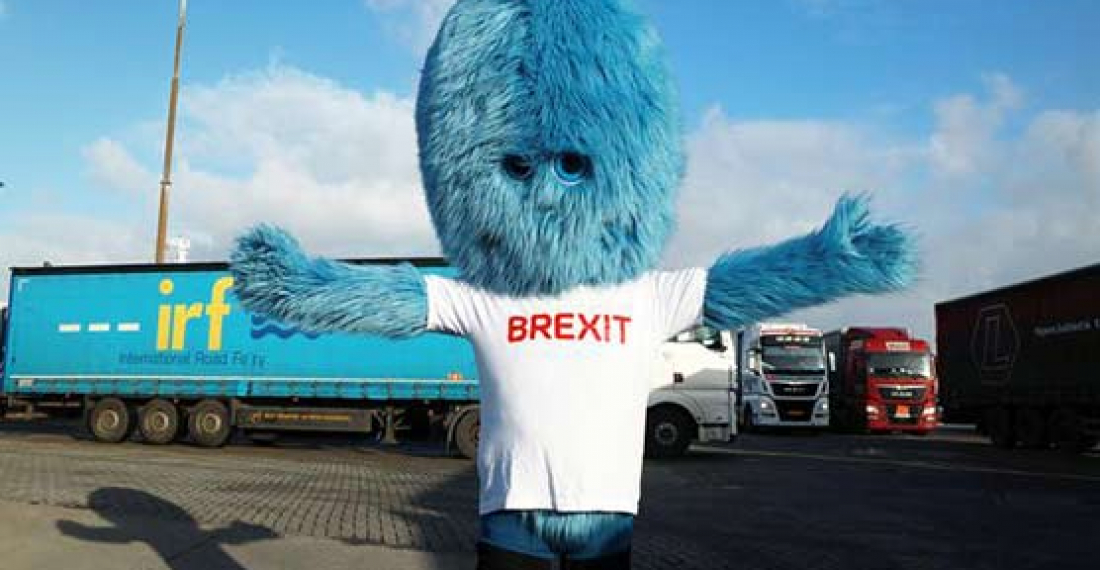
Dutch authorities unleashed a beastly blue mascot on Tuesday (1 December) to warn that the end of the Brexit transition period in one month’s time poses a monster of a problem for port users. In its first public appearance, the “Brexit Monster” posed for the media at the port of Rotterdam while customs officials handed out “Get ready” flyers to lorry drivers.
The muppet’s message: from 1 January drivers will be denied entry to ferries to Britain and stranded in a huge lorry park if they have not completed new customs procedures.
While the clock is ticking for Britain and the EU to reach a deal on post-transition trade ties, officials said the new controls are coming anyway.
The Brexit monster is far from scary, merely a man dressed up in blue furry headwear, with the same fur on his arms and shoes, who is rolled out from time to time to remind people about the serious side of Brexit.
The Netherlands, one of Britain's closest trading partners, brought out the monster this time due to concerns the coronavirus pandemic has reduced awareness around Britain's departure.
Although Britain technically left the union at the start of 2020, there has been a one-year grace period before the introduction of traffic controls now set to begin. There will continue to be no border and custom controls between the other 27 members of the European Union.
Around 3000 trucks going to or coming from Britain pass through the port of Rotterdam daily, A spokesman said the port expects 100-200 won't have their documents in order in the first week. The port has fenced off areas as overflow zones for drivers who don't have paperwork ready.
The Netherlands, the euro zone’s fifth-largest economy and world’s fifth-largest exporter, expects to incur €2.3 billion ($3.7 billion) in direct costs by 2023 as a result of Britain's departure from the European Union.
“A deal or no deal is not of importance when it’s about the port operations,” Mark Dijk, Brexit coordinator for the Port of Rotterdam, told AFP. “Because from the 1st of January, you need to have all the custom formalities in place. If you don’t have those formalities in place, you can’t go to the UK.”
Some 88% of drivers using the port have signed up to a special database so far, leaving 12 percent at risk of being stuck in the 700-space lorry park.
Europe’s largest seaport handles up to 4,000 trucks a day going to and from Britain, a major trading partner for the Netherlands.
‘Monster has had some impact’
The monster — in reality a man dressed in a furry blue suit with staring eyes and a white t-shirt saying “Brexit” — was unveiled by the Dutch government last year to symbolise difficulties caused by Britain’s EU exit.
The beast has since become a cult figure in the Netherlands and Britain, appearing in short videos in which it variously gets in the way of traders, lorry drivers and the Dutch foreign minister.
On Tuesday, with a minder helping it from falling over in strong winds, the monster handed a leaflet to a government minister for the cameras, before pretending to give directions to lorries being unloaded from a huge ferry.
“Within all the producers and manufacturers who are in The Netherlands, then the Brexit monster has had some impact,” said port official Dijk.
“Everyone knows it at least.”
Port authorities hope the “Brexit action day” will push the remaining lorry companies and drivers to sign up now and avoid trouble later.
“Of course, there will be some hiccups in the beginning of January. There will be some traffic jams, there will be probably some very disappointed truckers who can’t enter the terminal, and we think also that’s terrible,” said Dijk.
But he added that he hoped they would be “fully prepared” within six to eight weeks of the transition ending “and then the trade with the UK — at least from Rotterdam to the UK — will be “as smooth as it was before.”
source: commonspace.eu with Reuters, AFP, Sydney Morning Herald and Euractiv
photo: The Brexit Monster at Rotterdam Port on 1 December 2020