


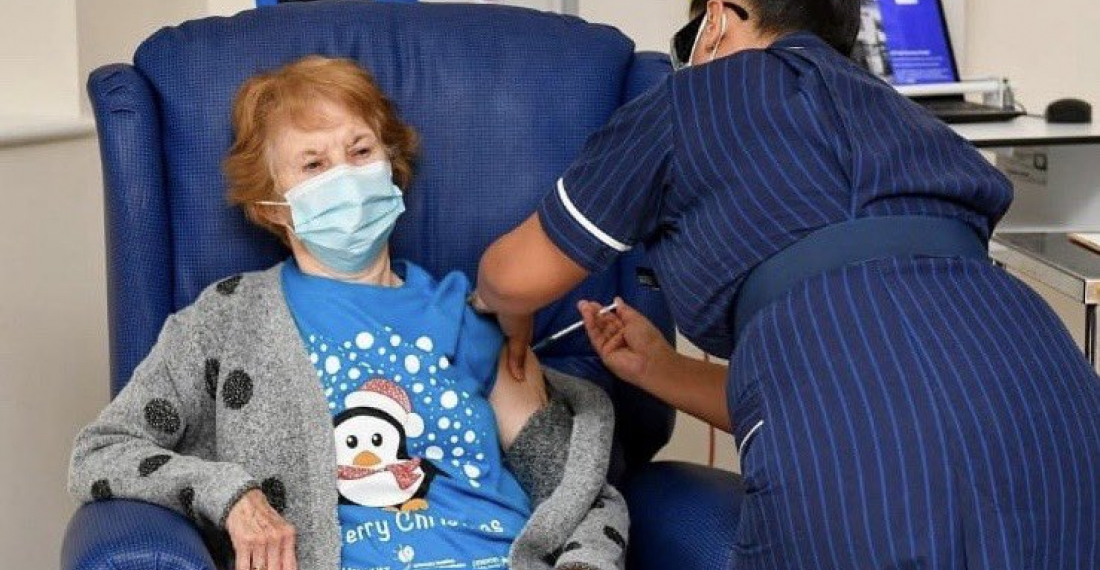
British woman is first to receive COVID-19 vaccine

A British woman was the first ever person in the world to receive Pfizer-BioNTech coronavirus vaccine outside clinical trials. She was vaccinated this morning in the UK, kicking off a nationwide rollout of inoculations. Tuesday has been dubbed "V-Day" — a nod to triumphs in the Second World War.

Margaret Keenan received the first of two planned jabs of the vaccine at Coventry Hospital outside Birmingham. 

"I feel so privileged to be the first person vaccinated against COVID-19.... It’s the best early birthday present I could wish for because it means I can finally look forward to spending time with my family and friends in the New Year after being on my own for most of the year.”

British Health Secretary Matt Hancock and Stephen Powis, medical director for England’s National Health Service (NHS), both told national media they found it emotional watching footage of Keenan receiving her initial dose.

The U.K. began vaccinating members of its general population through the NHS less than a week after becoming the first country to approve the shot developed by Pfizer and BioNTech.

Other nations that are set to approve the vaccine in the coming days, including Canada and the United States. 

The U.K. is one of the hard-hit countries with the pandemic. There are 61,000 COVID-19 related deaths — more than any other country has reported in Europe. The U.K. has more than 1.7 million cases to date.


Source: commonspace.eu with Global News (Vancouver). 
Photo: Margaret Keenan receiving her first dose of vaccine (Twitter: @donnamgriffiths). 
 

Related articles

Editor's choice
News
Borrell tells the European Parliament that the situation in Afghanistan was critical, but the EU will remain engaged

Borrell tells the European Parliament that the situation in Afghanistan was critical, but the EU will remain engaged

Borrell underlined that the European Union will make every effort to support the peace process and to remain a committed partner to the Afghan people. "Of course, we will have to take into account the evolving situation, but disengagement is not an option.  We are clear on that: there is no alternative to a negotiated political settlement, through inclusive peace talks.
Editor's choice
News
Egypt rejects Israeli "offer" for an exit only Rafah checkpoint in Gaza

Egypt rejects Israeli "offer" for an exit only Rafah checkpoint in Gaza

Egypt has rejected an Israeli "offer" for opening for exit only the Rafah checkpoint in Gaza. According to the Egyptian State Information Service, Egyptian authorities refuted on Wednesday afternoon reports that Israel claims it will open the Rafah crossing, the only lifeline for Gaza to the outside world, but only for those wishing to leave the besieged coastal enclave.  Citing an Egyptian official, the service stated that ''any agreement to open the crossing will cover both entry and exit, in line with US President Donald Trump's plan for humanitarian and political arrangements following the ceasefire.'' Cairo reaffirmed its adherence to the plan and UN Security Council Resolution 2803, including the right of return for Palestinians and maintaining two-way operations at the crossing. Earlier in the day, Israel's Coordinator of Government Activities in the Territories (COGAT) announced that the Rafah crossing would reopen ''within the next few days,'' marking the first such move since February 2025. According to the statement, departures would require prior Israeli security approval and would follow mechanisms previously implemented under EU supervision. Notably, the statement made no mention of the entry of humanitarian aid, which continues to flow through the Kerem Shalom crossing. A Palestinian official also echoed the Egyptian denial of Israel's claim. The announced agreements stress that no Palestinians will be forced to leave Gaza. Those who choose to travel will have the right to return, while humanitarian aid will continue through UN agencies, the International Red Cross and Crescent, and other independent organisations. A European Union official, who requested anonymity and is familiar with the matter, told TNA that the EU has received no official notification from Israel regarding new arrangements, stressing that "no changes exist beyond the January agreements, and we await Israel's formal approval for crossing operations under the Trump plan. "Reopening the crossing will follow mechanisms jointly supervised by the EU and the Palestinian Authority to ensure oversight and transparency, according to the EU official.

Popular

Editor's choice
News
Egypt rejects Israeli "offer" for an exit only Rafah checkpoint in Gaza

Egypt rejects Israeli "offer" for an exit only Rafah checkpoint in Gaza

Egypt has rejected an Israeli "offer" for opening for exit only the Rafah checkpoint in Gaza. According to the Egyptian State Information Service, Egyptian authorities refuted on Wednesday afternoon reports that Israel claims it will open the Rafah crossing, the only lifeline for Gaza to the outside world, but only for those wishing to leave the besieged coastal enclave.  Citing an Egyptian official, the service stated that ''any agreement to open the crossing will cover both entry and exit, in line with US President Donald Trump's plan for humanitarian and political arrangements following the ceasefire.'' Cairo reaffirmed its adherence to the plan and UN Security Council Resolution 2803, including the right of return for Palestinians and maintaining two-way operations at the crossing. Earlier in the day, Israel's Coordinator of Government Activities in the Territories (COGAT) announced that the Rafah crossing would reopen ''within the next few days,'' marking the first such move since February 2025. According to the statement, departures would require prior Israeli security approval and would follow mechanisms previously implemented under EU supervision. Notably, the statement made no mention of the entry of humanitarian aid, which continues to flow through the Kerem Shalom crossing. A Palestinian official also echoed the Egyptian denial of Israel's claim. The announced agreements stress that no Palestinians will be forced to leave Gaza. Those who choose to travel will have the right to return, while humanitarian aid will continue through UN agencies, the International Red Cross and Crescent, and other independent organisations. A European Union official, who requested anonymity and is familiar with the matter, told TNA that the EU has received no official notification from Israel regarding new arrangements, stressing that "no changes exist beyond the January agreements, and we await Israel's formal approval for crossing operations under the Trump plan. "Reopening the crossing will follow mechanisms jointly supervised by the EU and the Palestinian Authority to ensure oversight and transparency, according to the EU official.


