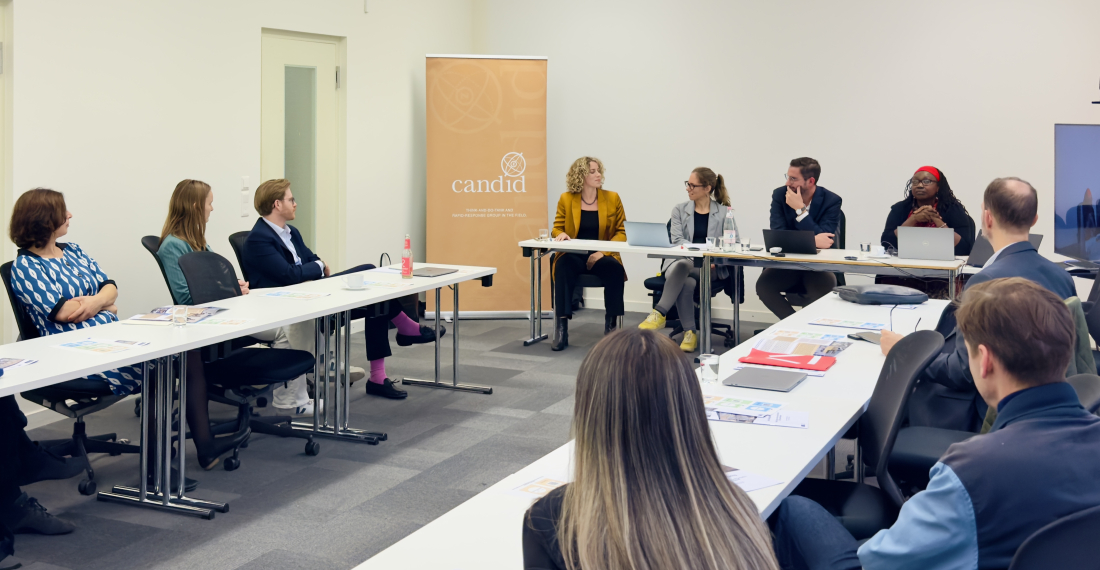
The Bonn Contact Group on Climate, Peace and Security ahead of COP29, held its final report presentation on 9 October at the Hertie School in Berlin, Germany. The meeting was attended by representatives of Berlin-based civil society organisations, policymakers, academics and international organisations. The meeting focused on three critical reports examining the intersections of climate change with water scarcity, land degradation and food insecurity. The event was organised by LINKS Europe in collaboration with the Restart Initiative and the Candid Foundation.
In her opening remarks, Isabelle McRae, Director of the Restart Initiative, explained the origins of the Bonn Contact Group and its aim to bring the nexus of conflict, peace and climate change onto the climate change agenda for COP29, mentioning the group's Bonn workshop on 3 May 2024 and commissioned reports. She also discussed integrated approaches to addressing climate change, food, water and land degradation issues, emphasising the importance of conflict sensitivity and cross-border cooperation.
During the event, Dr Amanda Woomer presented online the first report, "The Climate Change, Food Insecurity, and Conflict Nexus", which examines how climate-related disruptions to food systems exacerbate conflict in vulnerable regions. The second report, "Ripples of Discord: Addressing Water Conflicts in the Anthropocene", authored by Dr Tobias Zumbrägel and Dr Johanna Höhl, examines rising tensions over water resources in an increasingly unpredictable climate. The third and final report, "Land Degradation: The 'Double Exposure' of ERW Contamination and Climate Change", was presented by Dr Sarah Njeri and Dr Christina Greene, who highlighted the compounded risks posed by climate change and explosive remnants of war (ERW) on degraded land.
The presentations were followed by a panel discussion and an engaging Q&A session, where participants exchanged views on how to address these intertwined challenges ahead of COP29. The discussion concluded with suggestions for addressing environmental challenges. On this occasion, LINKS Europe proposed the establishment of an International Solidarity Fund for the South Caucaus region, with an office in Baku, Azerbaijan. This initiative would aim to provide general assistance to countries and communities affected by the double impact of conflict and climate change. This fund should be substantial, in the order of $100 million, and available to all countries in the region facing a common problem.
For those interested, the three reports presented during the event are available for download:
- The Climate Change, Food Insecurity, and Conflict Nexus
- Ripples of Discord: Addressing Water Conflicts in the Anthropocene
- Land Degradation: The ‘Double Exposure’ of ERW Contamination and Climate Change