


NATO-RUSSIA COUNCIL AGREES WORKPLAN FOR 2012

NATO and Russia have agreed to deepen the co-operation between them in future years and approved their work plan for 2012. The decisions were taken by the 29 Chiefs of Defence Staff of NATO countries and Russia meeting in the format of the NATO-Russia Council in Brussels yesterday.

NATO and Russia currently focus on six agreed areas of cooperation: Logistics, Combating Terrorism, Search and Rescue at Sea, Counter Piracy, Military Academic Exchanges and Theatre Missile Defence/ Missile Defence.

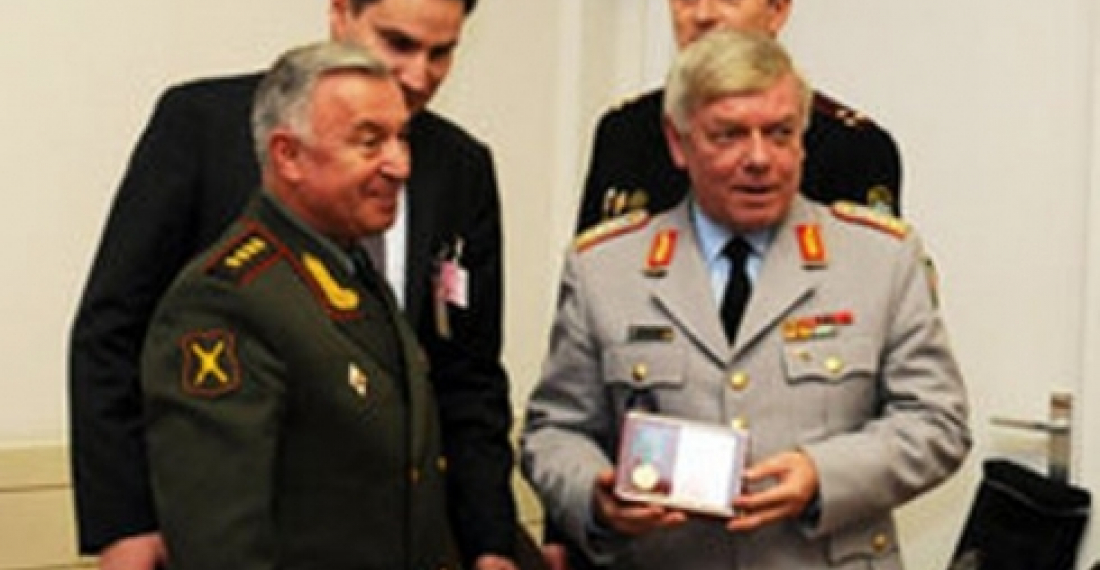
After the meeting, the Chief of the Russian Defence Staff, General Nikolay E Makarov handed medals to a number of NATO senior officers. Speaking at the ceremony Makarov said that "our cooperation with NATO is expanding, in particular, in the spheres of fighting against sea piracy and terrorism." Makarov praised the NATO officers for making the Russia-NATO co-operation real.

The NATO-Russia Council was established at the NATO-Russia Summit in Rome on 28 May 2002. In accordance with the Rome declaration, NATO member states and Russia work as equal partners in areas of common interest in the framework of the NRC, which provides a mechanism for consultation consensus-building, cooperation, joint decision and joint action on a wide spectrum of security issues in the Euro-Atlantic region. The members of the NRC, acting in their national capacities and in a manner consistent with their respective collective commitments and obligations, take joint decisions and bear equal responsibility, individually and jointly for their implementation.

Since the NRC's establishment, it has evolved into a productive mechanism for consultation, consensus-building, cooperation, joint decision and joint action. As an example, more than 25 working groups and committees have been created to develop cooperation on terrorism, proliferation, peacekeeping, theatre missile defence, airspace management, civil emergencies, defence reform, logistics, scientific cooperation for peace and security.

source: commonspace.eu with Itar-Tass and www.nato.int

picture: General Nikolai Makarov, Chief og the Russian General Staff presenting a medal to Lieutenant General Jürgen Bornemann, NATO Director General of the International Military Staff following a meeting of the NATO-Russia Council at NATO Headquarters in brussels on 18 January 2012 (picture courtesy of NATO)


Related articles

Editor's choice
News
Aden under curfew, as problem in Yemen's south deepens

Aden under curfew, as problem in Yemen's south deepens

The port city of Aden, in Yemen's south, has been put under curfew, as the rift in the country between  the Saudi led coalition which  backs Yemen's presidential governing council, and the southern forces led by the Southern Transitional Council (STC), deepens. Abdul Rahman al-Mahrami, a member of the Yemeni Presidential Governing Council and commander of the al-Amalik brigades, has ordered a curfew in the temporary capital, Aden, "to maintain security". "A curfew has been imposed throughout Aden Governorate from 9:00 p.m. to 6:00 a.m., in accordance with the instructions of Commander Abdul Rahman al-Mahrami, a member of the Presidential Management Council," the statement said. It states that only security and military personnel, as well as medical and technical teams with approved permits, will be allowed to move in the area during these hours. Yemen's presidential council, which is backed by Saudi Arabia and which already is in a struggle with the Houthi Movement in the north of the country who also occupy the capital Sanaa, two days ago issued an order for the arrest of the head of the Southern Transitional Council (STC),, Aidarous al Zubaidi. The STC have wide support among people in the South, and advocate that South Yemen restores its independence. The coalition warned of further escalation in Aden, long regarded as an STC stronghold, as the Presidential Leadership Council (PLC) chief accused STC leader Aidarous Al Zubaidi of “high treason” and announced the revocation of his membership in the governing body. The moves mark a sharp escalation in tensions within the anti-Houthi camp, despite National Shield Forces, rivals of the STC and former allies, having recently retaken control of Hadhramaut and Mahra from southern fighters. The STC’s takeover of the two regions last month angered Saudi Arabia and contributed to igniting the current internal conflict. (click the picture to read more)

Popular

Editor's choice
News
Aden under curfew, as problem in Yemen's south deepens

Aden under curfew, as problem in Yemen's south deepens

The port city of Aden, in Yemen's south, has been put under curfew, as the rift in the country between  the Saudi led coalition which  backs Yemen's presidential governing council, and the southern forces led by the Southern Transitional Council (STC), deepens. Abdul Rahman al-Mahrami, a member of the Yemeni Presidential Governing Council and commander of the al-Amalik brigades, has ordered a curfew in the temporary capital, Aden, "to maintain security". "A curfew has been imposed throughout Aden Governorate from 9:00 p.m. to 6:00 a.m., in accordance with the instructions of Commander Abdul Rahman al-Mahrami, a member of the Presidential Management Council," the statement said. It states that only security and military personnel, as well as medical and technical teams with approved permits, will be allowed to move in the area during these hours. Yemen's presidential council, which is backed by Saudi Arabia and which already is in a struggle with the Houthi Movement in the north of the country who also occupy the capital Sanaa, two days ago issued an order for the arrest of the head of the Southern Transitional Council (STC),, Aidarous al Zubaidi. The STC have wide support among people in the South, and advocate that South Yemen restores its independence. The coalition warned of further escalation in Aden, long regarded as an STC stronghold, as the Presidential Leadership Council (PLC) chief accused STC leader Aidarous Al Zubaidi of “high treason” and announced the revocation of his membership in the governing body. The moves mark a sharp escalation in tensions within the anti-Houthi camp, despite National Shield Forces, rivals of the STC and former allies, having recently retaken control of Hadhramaut and Mahra from southern fighters. The STC’s takeover of the two regions last month angered Saudi Arabia and contributed to igniting the current internal conflict. (click the picture to read more)

