Unconventional diplomacy, such as Track II activities and public diplomacy initiatives, is as old as diplomacy itself. It is thought some Athenians tried it in 432 BC in an effort to prevent the Peloponnesian War. Alas they did not succeed. The record of Track II and public diplomacy practices are as chequered as that of diplomacy itself. However, just as diplomacy remains an essential tool in international affairs, so track II initiatives and public diplomacy are increasingly necessary to support and compliment traditional diplomacy.
Nowhere more so than in the Caucasus. The Nagorno-Karabakh conflict is one of Europe's most dangerous unresolved conflicts. Efforts to resolve it - spearheaded by France, Russia and the United States - the three co-chair countries of the OSCE Minsk Group mandated by the international community to lead these efforts - have so far failed. The mood veers from moments of high tension and violence - the latest big outbreak of violence happened in April 2016, to moments of euphoria about the prospects of peace - such as before the Kazan summit in 2011 and in the immediate aftermath of the change of government in Yerevan in 2018. The sharp swings of the pendulum are partly caused by the volatility on this issue existing in Armenian and Azerbaijani public opinion. An astonishing amount of fake news now pollutes the information sphere, making the challenge even bigger.
There have been attempts at engaging Track II and public diplomacy initiatives in support of a Karabakh conflict settlement since 1994, and some good work has been done. These efforts however have never been properly supported by the sides in the conflict, who often see them as a distraction. Unfortunately the international mediators have also shown lack of enthusiasm in engaging with track II efforts. It should be evident to all concerned that this must change. There is a hope that it may.
In an op-ed on this website on 21 March, Azerbaijani analyst Ahmad Alili wrote: It is very important to bring "Track 1" and "Track 2" closer to each other, so there is less room for 'wrong' interpretations and misunderstanding. The conflicting parties tend to interpret the existing documents on a diplomatic resolution of the Nagorno-Karabakh conflict in a way benefiting them most. Hence, each party developed its own interpretation of the existing situation, which are mutually contradictory. "Track 1" and "Track 2" contacts could lead to shrinking the gap of misunderstanding and help to bring the public expectations to an adequate level."
Recent statements from the official negotiation process speak about the need to prepare the populations for peace. As one Armenian analyst, Richard Giragosian, wrote on this website on 4 March, "it is not only the public that need to be prepared for peace, but the politicians too", so there is much more work to be done.
Read it: It is not only the public that needs to be prepared for peace, but the politicians too
Track 2 diplomacy is also needed to mitigate the gender deficit in the track 1 process. Since the 1994 cease fire, none of the negotiators or mediators in the Karabakh peace process has been a woman. This reinforces the widely held misconception in the region that women are consumers of security, rather than stakeholders.
There are therefore plenty of reasons why public diplomacy and track II initiatives must now be accepted as a necessity, and their importance and contribution recognised.
EPNK - a unique European partnership
A lot of the public diplomacy initiatives supporting a peaceful resolution of the Nagorno-Karabakh conflict since 2010 have been in the framework of the EPNK programme, a unique European Union initiative that supports work by European civil society, working with stakeholders in the region. It's third phase has just come to an end, and some activists from across the conflict divide will gather today in Brussels to speak about their experience.
People working on the EPNK programme are often under fire from both sides of the conflict divide, yet they have persevered in their work, challenging some of the war rhetoric and nationalistic narratives that dominate the discourse around the conflict. They have provided alternative sources for information, they have generated new ideas, and they have created safe spaces where people from across the conflict divide could discuss delicate issues. They have knocked at the door of the track 1 peace process, and even though that door is far from being wide open, one can sense that it is now slightly ajar.
Two examples of good work done through the epnk initiative are the Dialogue through Film series run by Conciliation Resources which has harnessed artistic talent in a series of films that gave voice to people impacted by the conflict. These films have been cleverly used to instil public debate, although attempts to air them on mainstream TV stations have not yet succeeded.
Another example, is the work done by LINKS to promote confidence-building measures. The report prepared by a working group of Armenian and Azerbaijani experts published on 13 December 2018 offers an interesting perspective of what can be done in this field and when.
There are dozens of other examples of similarly good work from the activities of these two organisations and the three other international partners of EPNK: International Alert, Crisis Management Initiative and Kvinna till Kvinna. A complimentary programme, run by the Eurasia Peace Foundation in Baku and Yerevan, provides support, mainly to local NGOs to implement other initiatives.
The European Union should be congratulated for having the foresight and the will to launch the EPNK programme in 2010, and to sustain it since, despite the efforts of some to undermine it. The programme compliments perfectly the efforts of the EUSR for the South Caucasus, and is a good example of unconventional diplomacy supporting and complimenting diplomacy in pursuance of a good cause. This work should continue; the instruments to achieve it need to be sharpened and the many lessons learnt from the experience of the last years need to be factored in to make any future action more efficient and more effective.
Source: This editorial was prepared by the editorial team of commonspace.eu. Commonspace.eu was an activity of LINKS (DAR) in the framework of EPNK 3 between 1 May 2016- 30 April 2019.
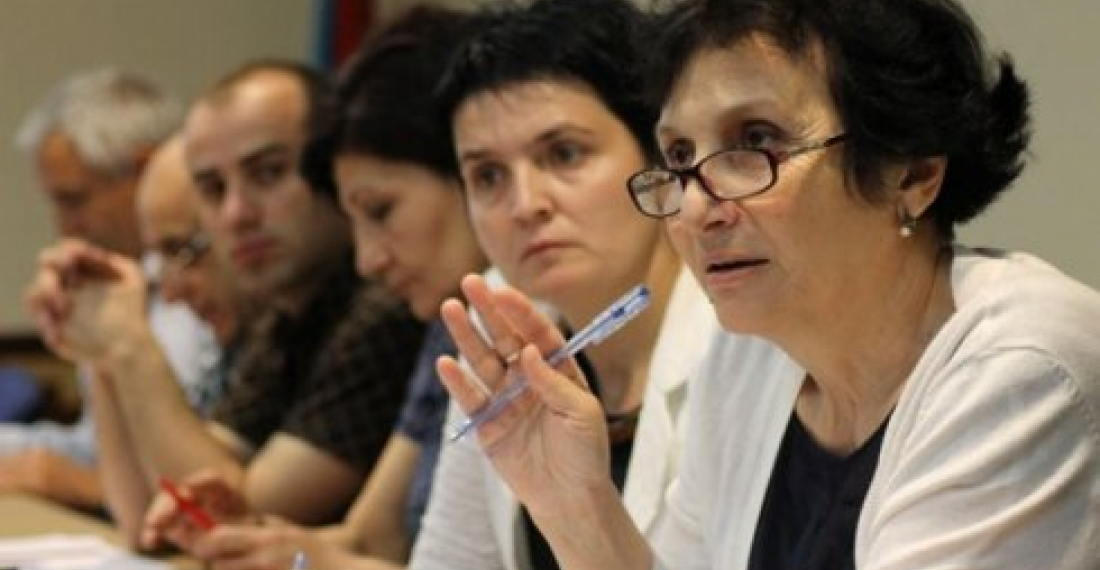
Photo: Civil society activists discuss peace in the Caucasus (archive picture)