


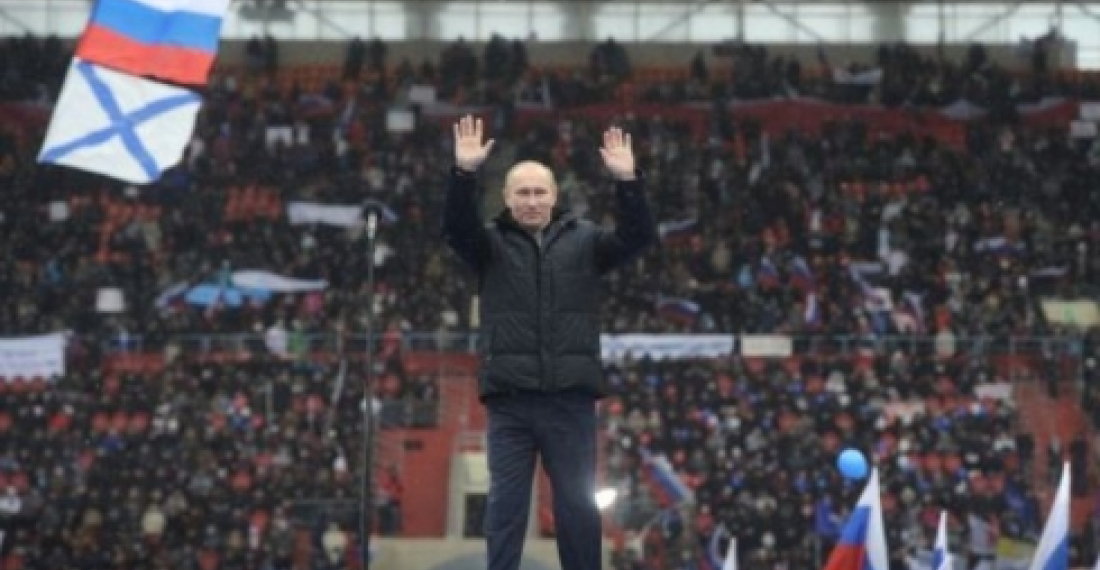
"We will die defending Moscow like our brothers died". Quoting Lermontov Putin told cheering supporters of " a new battle for Russia".

Just days before the forthcoming Presidential Election Russian Prime Minister Vladimir Putin yesterday addressed tens of thousands of supporters at the Luzhniki Stadium in Moscow and promised to fight for Russia in the face of unspecified foreign enemies. "We are the defenders of the fatherland!" Putin told a crowd of an estimated 130,000 supporters at the Luzhniki rally. The pro-Putin gathering was the latest in a series of public demonstrations organised by both pro and anti Putin forces which for the first time since the collapse of the USSR has seen mass scale public political events in Russia.

In a further bid to attract the nationalist vote, which is considered to be a decisive factor in the elections on 4 March, Putin recalled the Battle of Borodino, which marked the beginning of the end of Napoleon's 1812 campaign in Russia. "We will die defending Moscow, like our brothers died," he said, reciting a poem by Mikhail Lermontov. He added, "The battle for Russia continues, and we will win!"

Commonspace political editor said in a comment "The use of nationalist rhetoric has been one of the main features of this election campaign in Russia and reflects the current mood of the country. All the candidates are making this the centrepiece of their campaign. Putin was initially well liked by nationalists but in the four years that he has been out of the presidency he lost some of the sparkle that was associated with him when he was President. Dimitri Medvedev never had the support of nationalists in the same way and this may be one of the main reasons that it is Putin and not Medvedev that is candidate in this election representing the interests of the Kremlin."

source: commonspace.eu with Moscow Times and RIA Novosti

picture: Vladimir Putin addressing the crowds at the Luzhniki Stadium in Moscow on 23 February 2012 (courtesy of RIA Novosti)


Related articles

Editor's choice
News
Georgian Patriarch buried amid scenes of nation-wide grief

Georgian Patriarch buried amid scenes of nation-wide grief

Catholicos-Patriarch of All Georgia, Ilia II, was was buried in Tbilisi on Sunday (22 March) amid expressions and scenes of nation-wide grief. Crowds filled the Holy Trinity Cathedral, and the route to the Sioni Cathedral where he will be buried, many shouting "We love you, Patriarch".  The service was led by Ecumenical Patriarch, His Holiness Bartholomew I, together with Metropolitan Shio and members of the Holy Synod of the Georgian Church. Soldiers lined the route from Trinity Cathedral to Sion Cathedral, but tens of thousands of people were also present Ilia II died on March 17. Since March 18, his body has been laying in state in the Trinity Cathedral where thousands of citizens paid tribute. During these days, the flow of people who wanted to say goodbye to the Patriarch flowed to the cathedral continuously, 24 hours a day. Citizens often had to stand in a queue for several hours to enter the cathedral.   Read the Obituary of Ilia II,  written by Dennis Sammut at  Read the Obituary of Ilia II,  written by Dennis Sammut here  Read the Obituary of Ilia II,  written by Dennis Sammut here   https://www.commonspace.eu/node/13740

Popular

Editor's choice
Interview
Thursday Interview: Murad Muradov

Thursday Interview: Murad Muradov

Today, commonspace.eu starts a new regular weekly series. THURSDAY INTERVIEW, conducted by Lauri Nikulainen, will host  persons who are thinkers, opinion shapers, and implementors in their countries and spheres. We start the series with an interview with Murad Muradov, a leading person in Azerbaijan's think tank community. He is also the first co-chair of the Action Committee for a new Armenian-Azerbaijani Dialogue. Last September he made history by being the first Azerbaijani civil society activist to visit Armenia after the 44 day war, and the start of the peace process. Speaking about this visit Murad Muradov said: "My experience was largely positive. My negative expectations luckily didn’t play out. The discussions were respectful, the panel format bringing together experts from Armenia, Azerbaijan, and Turkey was particularly valuable during the NATO Rose-Roth Seminar in Yerevan, and media coverage, while varied in tone, remained largely constructive. Some media outlets though attempted to represent me as more of a government mouthpiece than an independent expert, which was totally misleading.  Overall, I see these initiatives as important steps in rebuilding trust and normalising professional engagement. The fact that soon a larger Azerbaijani civil society visits to Armenia followed, reinforces the sense that this process is moving in the right direction." (click the image to read the interview in full)

