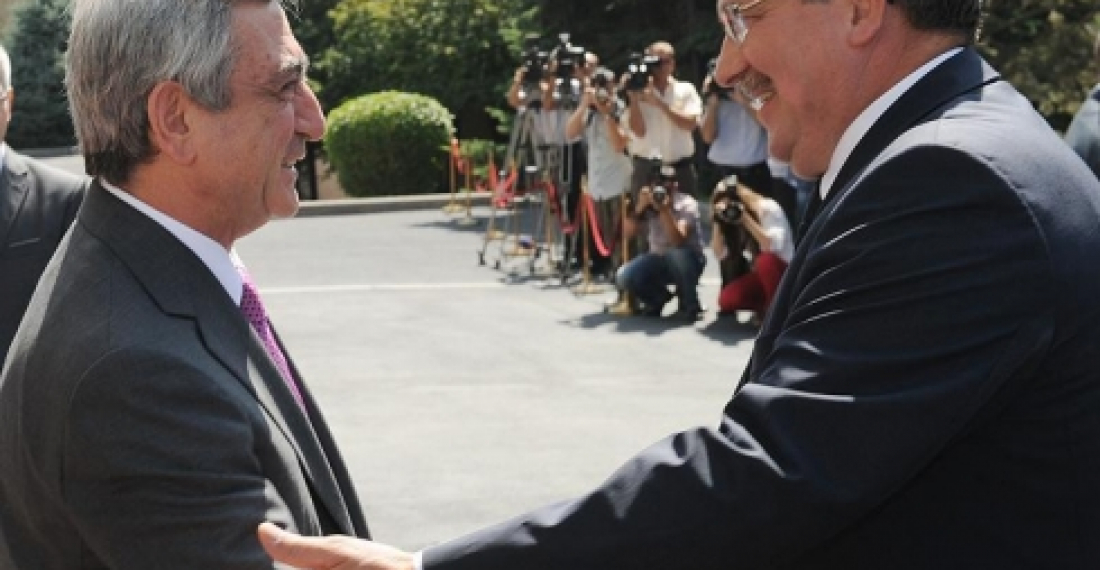
The visit of the President of Poland, Bronislaw Komorowski to Azerbaijan, Georgia and Armenia was meant to send several signals.
Poland is sending a clear message that as one of the largest members of the European Union it is determined to leave its mark on the EU foreign policy. The Caucasus, together with Eastern Europe, are Poland's prioirty areas in this regard. The visit by the Polish President to the three South Caucasus countries within days of his country assuming the EU Presidency was an expression of both the interest of Poland in the region and an expression of support for its future. Nowadays, in the debating chambers of Brussels the now not so new EU member states of Eastern and Central Europe take the lead whenever there is a discussion on the South Caucasus, and Poland is usually in the forefront.
Warsaw is also sending a message to Russia that a belt of countries running from the Baltic Sea to the Caspian Sea is emerging - areas that were traditionally in Russia's sphere of influence, but who today pursue their own very disticnt and independent forieign policy.
The first stop of the Polish leader was in Azerbaijan, important for Poland both politically and economically.
In Baku the Polish and Azerbaijani leaders reviewed a whole range of issues and signed agreements on foreign policy, culture, economy and science were signed between Polish and Azeri ministries in the presence of Komorowski and Aliyev. The documents signed included a 2011-2013 cultural partnership agreement, a veterinary partnership agreement and an agreement for non-visa traffic for diplomatic passport holders.

"Poland remains highly interested in the construction of transfer systems which would help Poland solve its energy problems, but first and foremost they would be important solutions for the whole EU" said Komorowski at a joint press conference with the president of Azerbaijan.He emphasised that this pertained both to the gas pipeline and "to an old project, funds for which have been already granted from the EU – the Odessa-Brody-Płock-Gdańsk pipeline". Komorowski assured that the project had not been abandoned.
"Poland is very interested in the progress of Azerbaijan talks with EU institutions regarding prospects for association and inclusion in an area governed by uniform economic rules," the Polish president added.
From Baku the Polish president travelled to Batumi where he met President Saakashvili and other Georgian officials. Georgia strikes a cord with Polish sensibilities because is perceived as having stood up to Russia. Yet Poland also recently has been trying to manage its relations with Russia better and president Kormorowski is likely to have advised his Georgian colleague to do the same.

Before leaving for Yerevan the Polish President also met with civil society representatives and visit the EU Monitoring Mission (EUMM) headquarters in Tbilisi, which is now headed by a Polish General.
The polish leader also visited Armenia, the state in the South caucasus with the closest relations with Russia. Despite this Komorowski was keen to express full support for Armenia's further integration with European institutions and to praise Armenia's efforts at economic reform.

In the South Caucasus the Polish president extended invitations to the presidents of the three countries to participate in the EU Eastern Partnership Summit which will be held in Poland in September. This summit, held under polish chairmanship is likely to provide an important opportunity for the EU to showcase the qualitative improvement in the relations with its neighbours to the East.
A group of Polish businessmen accompanies the President on his trip and business forums were held in the three countries. Poland is keen to develop trade with the region, to engage with Azerbaijan on energy issues and generally to see its presence in the region increased.
All in all this has been a very successful visit and one that is likely to bear useful results in the months and years ahead, not only for Poland but also for the region and for the EU in general.
prepared by the commonspace.eu newsroom with additional reporting from the website of the president of Poland. Pictures courtesy of the press Service of the president of Poland and the Press Service of the president of Armenia
(c) commonspace.eu