


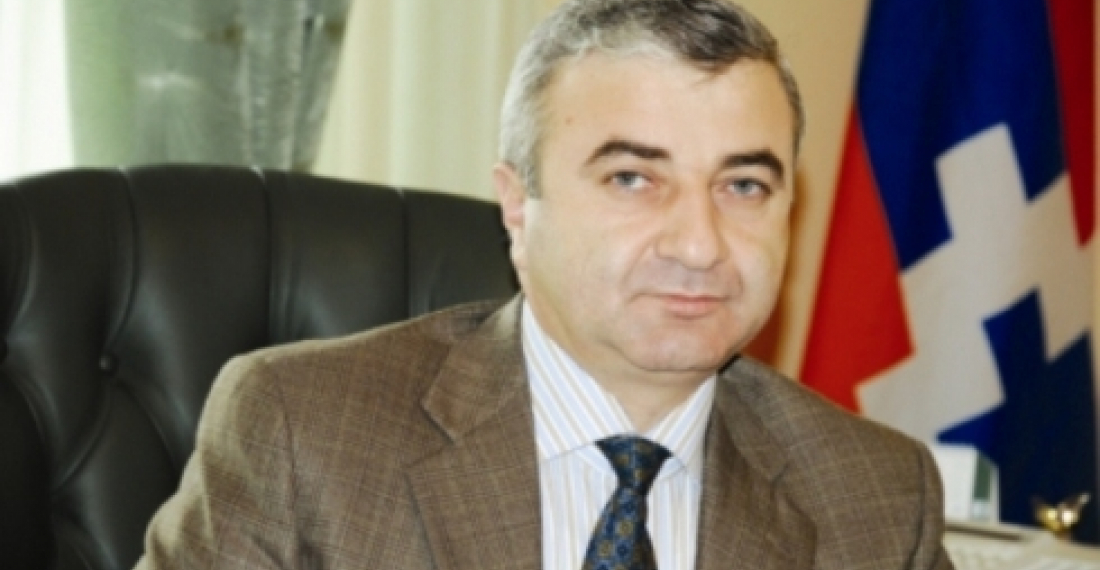
"The people of Karabakh are determined to carry on". The Speaker of Parliament of the self declared Nagorno-Karabakh Republic is in the UK.

The Speaker of Parliament of the self declared Nagorno-Karabakh Republic, who is currently in Britain as a guest of the British-Armenian Parliamentary Group, on Wednesday (13 June) addressed a group of academics and students from Oxford University at an event organised by the Oxford Armenia Society held at Manchester-Harris College.

Ashot Ghoulian told his audience that over the last twenty years the people of Karabakh had succeeded in rehabilitating their homeland following the conflict. Many reforms had also been implemented, and the basis established for a democratic state. "The people of Karabakh are determined to carry on despite all adversity", Ghoulian said.

Speaking about the insistence of the Karabakh authorities to be represented in the peace process, Ghoulian said that there was no other conflict situation where the main component was not part of the peace process. He said that Karabakh's absence has allowed Azerbaijan to distort the way in which the conflict is presented. The main issue, which is the future of Karabakh, was being marginalised. Instead Azerbaijan was depicting Armenia as the aggressor. Ghoulian insisted that the people of Karabakh must be allowed to determine their own future.

Speaking about the economy Ghoulian said that in recent years Karabakh had identified mining as a source of economic development. It was estimated that there were gold and copper depositis that could last for thirty years. He said that Karabakh at the moment recieves around 40% of its annual budget in the form of loans from Armenia. The figure used to be higher but has now gone down because Karabakh can now generate its own revenues. The loans are paid back from import taxes which Armenia collects on Karabakh's behalf. The authorities in Karabakh have now declared agriculture, ecotourism and the construction of small hydro electric stations as priorities in the economic development of the territory in the immediate future.

Asked about international recognition of the Nagorno-Karabakh Republic Ghoulian said that he regreted no country had recognised NKR as yet. He referred to other partly recognised entities such as Kosovo and Abkhazia and said that their international recognition came as a result of political manoevering. "The day will come when this manoevering will work in favour of Karabakh as well", Ghoulian said. He added that he did not wish Karabakh to be recognised in this way.

Ghoulian said that Karabakh can be a viable state, but that the Karabakh conflict exists, and it poses a threat to regional security. He condemned what he called "Azerbaijani provocations" in the first days of June which had left many young soldiers dead. He mentioned that a number of British NGOs have been trying to deal with the issue of mistrust between the sides through the development of confidence-building measures.

source: commonspace.eu

picture: Ashout Ghoulian, Speaker of Parliament fo the self declared nagorno-Karabakh Republic (archive picture).
Related articles

Editor's choice
News
Council of Europe launches new International Claims Commission for Ukraine

Council of Europe launches new International Claims Commission for Ukraine

Thirty-four countries and the European Union have signed a new convention establishing an International Claims Commission for Ukraine at a diplomatic conference co-hosted by the 46-nation Council of Europe and the Netherlands in the Hague. The diplomatic conference was attended by leaders and high-level representatives from over 50 states, including the President of Ukraine, Volodymyr Zelenskyy, the President of the Republic of Moldova, Maia Sandu, and the Prime Minister of the Netherlands, Dick Schoof.  “Today marks a major step forward in ensuring accountability for Ukraine. The International Claims Commission represents justice and hope for tens of thousands of victims—our determination that those who have suffered will not be forgotten. I call for quick ratifications so we can get the commission rapidly up and running for the people of Ukraine,” said Council of Europe Secretary General Alain Berset. Ukrainian President Volodymyr Zelenskyy said: “We expect that every mechanism for compensation from the Register of Damage and Claims Commission to the actual payments – will start working and receive strong and sufficient international support, so that people can truly feel that any kind of damage caused by the war can be compensated. This war, and Russia’s responsibility for it, MUST become a clear example – so that others learn not to choose aggression.” “Accountability is about creating the conditions for peace that endures. And therefore, accountability is a condition of security – today and for the future. But accountability is not only about Ukraine. And it is not only about one aggressor and one victim. Accountability is about Europe. About every country in Europe. It is about whether Europe, as a whole, is willing to defend its peace,” said Maia Sandu, President of the Republic of Moldova, which currently holds the Presidency of the Council of Europe’s Committee of Ministers. The Prime Minister of the Netherlands, Dick Schoof, said: “Every day Russia is deliberately bombarding homes, destroying businesses and damaging infrastructure in Ukraine. Russia must compensate Ukraine for the damage caused. That is why we have launched the International Claims Commission for Ukraine and we are honoured to host it.” The International Claims Commission will be the second part of a comprehensive compensation mechanism related to Russia’s war of aggression, building on the existing Register of Damage for Ukraine. The claims commission will be established within the framework of the Council of Europe and will also be open to other countries. The Register of Damage for Ukraine, created in 2023, collects and records compensation claims submitted by individuals, organisations and public bodies in Ukraine. Forty-four states and the European Union have so far joined the Register, which has already received 86,000 claims. The International Claims Commission will review, assess and decide upon claims submitted to the Register of Damage for Ukraine and determine the amount of compensation, if any, which is due in each case. The convention establishing the commission will enter into force once it has been ratified by 25 signatories, as long as sufficient funds have been secured to support its initial work.

Popular

Editor's choice
News
Council of Europe launches new International Claims Commission for Ukraine

Council of Europe launches new International Claims Commission for Ukraine

Thirty-four countries and the European Union have signed a new convention establishing an International Claims Commission for Ukraine at a diplomatic conference co-hosted by the 46-nation Council of Europe and the Netherlands in the Hague. The diplomatic conference was attended by leaders and high-level representatives from over 50 states, including the President of Ukraine, Volodymyr Zelenskyy, the President of the Republic of Moldova, Maia Sandu, and the Prime Minister of the Netherlands, Dick Schoof.  “Today marks a major step forward in ensuring accountability for Ukraine. The International Claims Commission represents justice and hope for tens of thousands of victims—our determination that those who have suffered will not be forgotten. I call for quick ratifications so we can get the commission rapidly up and running for the people of Ukraine,” said Council of Europe Secretary General Alain Berset. Ukrainian President Volodymyr Zelenskyy said: “We expect that every mechanism for compensation from the Register of Damage and Claims Commission to the actual payments – will start working and receive strong and sufficient international support, so that people can truly feel that any kind of damage caused by the war can be compensated. This war, and Russia’s responsibility for it, MUST become a clear example – so that others learn not to choose aggression.” “Accountability is about creating the conditions for peace that endures. And therefore, accountability is a condition of security – today and for the future. But accountability is not only about Ukraine. And it is not only about one aggressor and one victim. Accountability is about Europe. About every country in Europe. It is about whether Europe, as a whole, is willing to defend its peace,” said Maia Sandu, President of the Republic of Moldova, which currently holds the Presidency of the Council of Europe’s Committee of Ministers. The Prime Minister of the Netherlands, Dick Schoof, said: “Every day Russia is deliberately bombarding homes, destroying businesses and damaging infrastructure in Ukraine. Russia must compensate Ukraine for the damage caused. That is why we have launched the International Claims Commission for Ukraine and we are honoured to host it.” The International Claims Commission will be the second part of a comprehensive compensation mechanism related to Russia’s war of aggression, building on the existing Register of Damage for Ukraine. The claims commission will be established within the framework of the Council of Europe and will also be open to other countries. The Register of Damage for Ukraine, created in 2023, collects and records compensation claims submitted by individuals, organisations and public bodies in Ukraine. Forty-four states and the European Union have so far joined the Register, which has already received 86,000 claims. The International Claims Commission will review, assess and decide upon claims submitted to the Register of Damage for Ukraine and determine the amount of compensation, if any, which is due in each case. The convention establishing the commission will enter into force once it has been ratified by 25 signatories, as long as sufficient funds have been secured to support its initial work.

