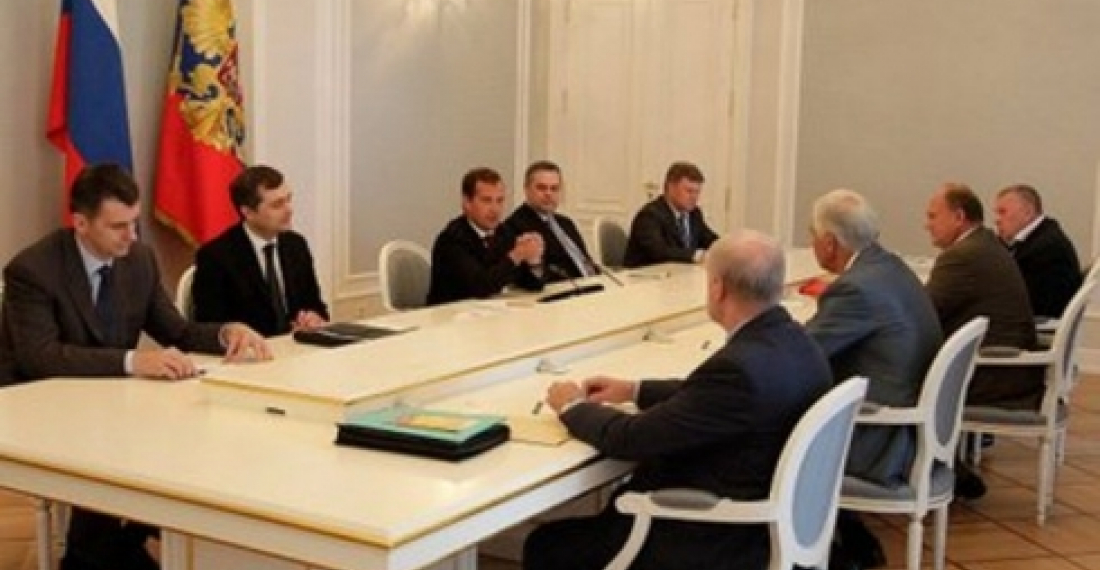
Russia will hold Parliamentary elections on 4 December. The elections for the State Duma were announced today at a meeting in Sochi between President Medvedev and leaders of the seven political parties registered.
Addressing the political leaders Medvedev warned against provocations during the election campaign, and said that everybody should know how to lose as well as to win. Medvedev also had a tough message for those who may want to use the campaign as an excuse for inciting racial hatred, and said that race hate slogans ahead of the vote should be "prevented at all costs." He warned of dire consequences facing anyone trying to sabotage the elections. Many people of Caucasian origin have in recent times complained of harrassment because of their ethnicity, and extreme right wing groups have used ocassions such as football matches as an excuse to unleash violence against people from the North Caucasus, Armenians, Azerbaijanis or Georgians. The Russian leadership is concerned that if ethnicity becomes an issue during the campaign it may further inflame problems that already exist, especially in big cities like Moscow and St Petersburg.
Russia will also hold presidential elections in March next year, though the date has not yet been announced.
Commonspace.eu political editor commented that the two elections will have important implications for Russia's neighbours. With regards to the Caucasus, the opening of the election season may see the Russian President dedicate less time to the Karabakh conflict resolution process than he has done so far and Medvedev would want to avoid failures, such as the one in Kazan last June prior the election.
The Russian leadership is likely also to keep a steady course in the next months with regards to its relations with Georgia and its policy in the North Caucasus. It is however likely that both issues will be revisited as soon as the elections are out of the way, since many close the Russian leadership think that the status quo on both issues is far from ideal. Whilst it is unlikely that the elections will create any major upheavel in the tightly managed Russian political system, the question of whether Prime Minister Putin will try to come back as President continues to excite foreign observers, although ironically less so the Russians themselves.
source: commonspace.eu
photo: courtesy of the Press and Information Service of the President of Russia.