


Could this be a model for Karabakh? An agreement between Serbia and Kosovo can offer lessons for the situation in Karabakh.

Serbia has taken a step forward on the road to EU membership by striking a deal with Kosovo to deepen co-operation with its former province, whose independence it does not recognise. The agreement reached yesterday in Brussels comes one week before European leaders decide at a summit in Brussels whether to grant Serbia the status of being a candidate to join the EU.

This would enable Belgrade to begin formal accession talks. Although the leaders delayed a decision last December after violence at the north Kosovan border, the situation is calmer now. Serbia was expelled from Kosovo by Nato forces in 1999 after a civil war in which some 10,000 people were killed.

The new deal sets out how Serbia and Kosovo will manage their border. It gives Kosovo the right to participate in all regional meetings and sign agreements on its own account, a role previously taken by the UN mission in Kosovo. The designation for such engagements will be Kosovo* . The asterisk refers to a footnote saying this is without prejudice to positions on status and is in line with UN resolutions and court opinions.

These agreements are a major step forward, said EU foreign policy chief Cathrine Ashton and Enlargement Commissioner Stefan Füle. These agreements are particularly welcome in view of the deliberations in the [European] Council next week regarding candidate status for Serbia. Most member states are in favour of granting Serbia candidate status but Germany and others have pressed the country to improve its relations with Kosovo first.

However, Berlin is softening its position. In Belgrade this week, German foreign minister Guido Westerwelle welcomed important progress since December and said the next step was candidate status. European leaders will also discuss next week whether they should initiate a feasibility study for a stabilisation and association agreement between the EU and Kosovo, which would set it on a path to eventual membership. Such a step is being resisted by the five EU countries which do not recognise Kosovo s independence: Spain, Romania, Cyprus, Slovakia and Greece.

Commonspace.eu political editor said in a comment: "There are interesting lessons that can be learnt from the agreement between Serbia and Kosovo and that can be relevant for the situation in the Caucasus, including around the Karabakh conflict. No one situation is the same, but the principle of a flexible approach and emphasis on steps that will be beneficial for both sides is one that can be applied to many different situations. One of the criticisms of the negotiations around the Karabakh conflict has been that they are too narrowly focused. There are problems yet on the Kosovo situation as well but this agreement is certainly a move in the right direction."

source: commonspace.eu with the Irish Times

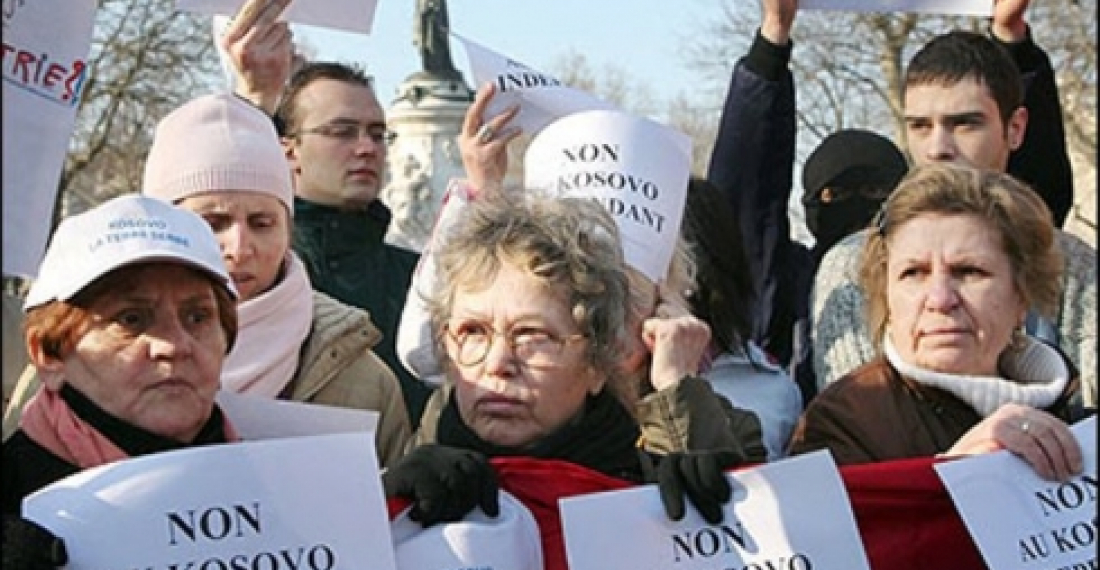
picture: Serbs in Paris demonstrate against the independence of Kosovo in February 2008 (Archive picture courtesy of the BBC)

Related articles

Editor's choice
News
Council of Europe launches new International Claims Commission for Ukraine

Council of Europe launches new International Claims Commission for Ukraine

Thirty-four countries and the European Union have signed a new convention establishing an International Claims Commission for Ukraine at a diplomatic conference co-hosted by the 46-nation Council of Europe and the Netherlands in the Hague. The diplomatic conference was attended by leaders and high-level representatives from over 50 states, including the President of Ukraine, Volodymyr Zelenskyy, the President of the Republic of Moldova, Maia Sandu, and the Prime Minister of the Netherlands, Dick Schoof.  “Today marks a major step forward in ensuring accountability for Ukraine. The International Claims Commission represents justice and hope for tens of thousands of victims—our determination that those who have suffered will not be forgotten. I call for quick ratifications so we can get the commission rapidly up and running for the people of Ukraine,” said Council of Europe Secretary General Alain Berset. Ukrainian President Volodymyr Zelenskyy said: “We expect that every mechanism for compensation from the Register of Damage and Claims Commission to the actual payments – will start working and receive strong and sufficient international support, so that people can truly feel that any kind of damage caused by the war can be compensated. This war, and Russia’s responsibility for it, MUST become a clear example – so that others learn not to choose aggression.” “Accountability is about creating the conditions for peace that endures. And therefore, accountability is a condition of security – today and for the future. But accountability is not only about Ukraine. And it is not only about one aggressor and one victim. Accountability is about Europe. About every country in Europe. It is about whether Europe, as a whole, is willing to defend its peace,” said Maia Sandu, President of the Republic of Moldova, which currently holds the Presidency of the Council of Europe’s Committee of Ministers. The Prime Minister of the Netherlands, Dick Schoof, said: “Every day Russia is deliberately bombarding homes, destroying businesses and damaging infrastructure in Ukraine. Russia must compensate Ukraine for the damage caused. That is why we have launched the International Claims Commission for Ukraine and we are honoured to host it.” The International Claims Commission will be the second part of a comprehensive compensation mechanism related to Russia’s war of aggression, building on the existing Register of Damage for Ukraine. The claims commission will be established within the framework of the Council of Europe and will also be open to other countries. The Register of Damage for Ukraine, created in 2023, collects and records compensation claims submitted by individuals, organisations and public bodies in Ukraine. Forty-four states and the European Union have so far joined the Register, which has already received 86,000 claims. The International Claims Commission will review, assess and decide upon claims submitted to the Register of Damage for Ukraine and determine the amount of compensation, if any, which is due in each case. The convention establishing the commission will enter into force once it has been ratified by 25 signatories, as long as sufficient funds have been secured to support its initial work.

Popular

Editor's choice
News
Council of Europe launches new International Claims Commission for Ukraine

Council of Europe launches new International Claims Commission for Ukraine

Thirty-four countries and the European Union have signed a new convention establishing an International Claims Commission for Ukraine at a diplomatic conference co-hosted by the 46-nation Council of Europe and the Netherlands in the Hague. The diplomatic conference was attended by leaders and high-level representatives from over 50 states, including the President of Ukraine, Volodymyr Zelenskyy, the President of the Republic of Moldova, Maia Sandu, and the Prime Minister of the Netherlands, Dick Schoof.  “Today marks a major step forward in ensuring accountability for Ukraine. The International Claims Commission represents justice and hope for tens of thousands of victims—our determination that those who have suffered will not be forgotten. I call for quick ratifications so we can get the commission rapidly up and running for the people of Ukraine,” said Council of Europe Secretary General Alain Berset. Ukrainian President Volodymyr Zelenskyy said: “We expect that every mechanism for compensation from the Register of Damage and Claims Commission to the actual payments – will start working and receive strong and sufficient international support, so that people can truly feel that any kind of damage caused by the war can be compensated. This war, and Russia’s responsibility for it, MUST become a clear example – so that others learn not to choose aggression.” “Accountability is about creating the conditions for peace that endures. And therefore, accountability is a condition of security – today and for the future. But accountability is not only about Ukraine. And it is not only about one aggressor and one victim. Accountability is about Europe. About every country in Europe. It is about whether Europe, as a whole, is willing to defend its peace,” said Maia Sandu, President of the Republic of Moldova, which currently holds the Presidency of the Council of Europe’s Committee of Ministers. The Prime Minister of the Netherlands, Dick Schoof, said: “Every day Russia is deliberately bombarding homes, destroying businesses and damaging infrastructure in Ukraine. Russia must compensate Ukraine for the damage caused. That is why we have launched the International Claims Commission for Ukraine and we are honoured to host it.” The International Claims Commission will be the second part of a comprehensive compensation mechanism related to Russia’s war of aggression, building on the existing Register of Damage for Ukraine. The claims commission will be established within the framework of the Council of Europe and will also be open to other countries. The Register of Damage for Ukraine, created in 2023, collects and records compensation claims submitted by individuals, organisations and public bodies in Ukraine. Forty-four states and the European Union have so far joined the Register, which has already received 86,000 claims. The International Claims Commission will review, assess and decide upon claims submitted to the Register of Damage for Ukraine and determine the amount of compensation, if any, which is due in each case. The convention establishing the commission will enter into force once it has been ratified by 25 signatories, as long as sufficient funds have been secured to support its initial work.

