Brussels conference emphasises importance of CBMs for resolving conflicts.
At a conference focusing on the unresolved conflicts in Eastern Europe held in Brussels on Tuesday, 17 December, the importance of confidence buidling measures as a way of helping the resolution of the conflicts was highlighted by many of the speakers and participants.

The conference with the theme "Bringing peace to the EU's Eastern neighbourhood - Challenges, prospects and opportunities for the OSCE and the EU" was organised by the European Policy Centre (EPC) and Conflict Management Initiative (CMI) in collaboration with the Lithuanian Presidency of the European Union, and was held in the premisies of the Lithuanian Delegation to the EU in Brussels.

The issue of confidence building measures was prominent in the first panel which looked at the events of the past two decades. Speakers on the panel emphasised that such measures are essential to create the right conditions for the sides to conduct negotiations and to avoid misperception. The matter was of particular importance in the context of the conflict on Nagorno-Karabakh it was stated. This view was also supported by the representatives of the Embassies of Azerbaijan and Armenia who were among the hundred or so participants in the event, and who in their interventions also referred to current work being done and of the need for confidence building measures, although there were different views as to what measures should be prioritised.

The panellists also referred top recent events including the Vilnius summit, events in Ukraine and the recent meeting between the Presidents of Armenia and Azerbaijan.

source: commonspace.eu

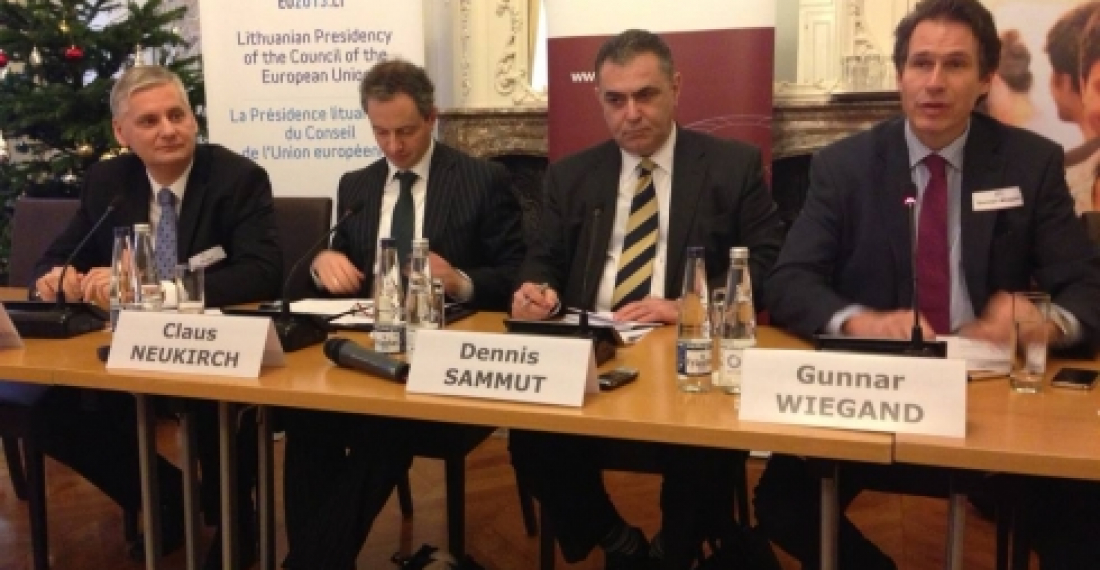
photo: Gunnar Wiegan, Director for Europe at the European External Action Service speaking during the first panel of the event held in Brussels on 17 December. Other panellists included Claus Newkirch from the OSCE Conflict Management Centre, Sergei Markedonov, an independent Russian analyst and Dennis Sammut (LINKS and EPC) who chaired the event. (picture courtesy of the EPC).

Related articles

Editor's choice
News
Aden under curfew, as problem in Yemen's south deepens

Aden under curfew, as problem in Yemen's south deepens

The port city of Aden, in Yemen's south, has been put under curfew, as the rift in the country between  the Saudi led coalition which  backs Yemen's presidential governing council, and the southern forces led by the Southern Transitional Council (STC), deepens. Abdul Rahman al-Mahrami, a member of the Yemeni Presidential Governing Council and commander of the al-Amalik brigades, has ordered a curfew in the temporary capital, Aden, "to maintain security". "A curfew has been imposed throughout Aden Governorate from 9:00 p.m. to 6:00 a.m., in accordance with the instructions of Commander Abdul Rahman al-Mahrami, a member of the Presidential Management Council," the statement said. It states that only security and military personnel, as well as medical and technical teams with approved permits, will be allowed to move in the area during these hours. Yemen's presidential council, which is backed by Saudi Arabia and which already is in a struggle with the Houthi Movement in the north of the country who also occupy the capital Sanaa, two days ago issued an order for the arrest of the head of the Southern Transitional Council (STC),, Aidarous al Zubaidi. The STC have wide support among people in the South, and advocate that South Yemen restores its independence. The coalition warned of further escalation in Aden, long regarded as an STC stronghold, as the Presidential Leadership Council (PLC) chief accused STC leader Aidarous Al Zubaidi of “high treason” and announced the revocation of his membership in the governing body. The moves mark a sharp escalation in tensions within the anti-Houthi camp, despite National Shield Forces, rivals of the STC and former allies, having recently retaken control of Hadhramaut and Mahra from southern fighters. The STC’s takeover of the two regions last month angered Saudi Arabia and contributed to igniting the current internal conflict. (click the picture to read more)

Popular

Editor's choice
News
Aden under curfew, as problem in Yemen's south deepens

Aden under curfew, as problem in Yemen's south deepens

The port city of Aden, in Yemen's south, has been put under curfew, as the rift in the country between  the Saudi led coalition which  backs Yemen's presidential governing council, and the southern forces led by the Southern Transitional Council (STC), deepens. Abdul Rahman al-Mahrami, a member of the Yemeni Presidential Governing Council and commander of the al-Amalik brigades, has ordered a curfew in the temporary capital, Aden, "to maintain security". "A curfew has been imposed throughout Aden Governorate from 9:00 p.m. to 6:00 a.m., in accordance with the instructions of Commander Abdul Rahman al-Mahrami, a member of the Presidential Management Council," the statement said. It states that only security and military personnel, as well as medical and technical teams with approved permits, will be allowed to move in the area during these hours. Yemen's presidential council, which is backed by Saudi Arabia and which already is in a struggle with the Houthi Movement in the north of the country who also occupy the capital Sanaa, two days ago issued an order for the arrest of the head of the Southern Transitional Council (STC),, Aidarous al Zubaidi. The STC have wide support among people in the South, and advocate that South Yemen restores its independence. The coalition warned of further escalation in Aden, long regarded as an STC stronghold, as the Presidential Leadership Council (PLC) chief accused STC leader Aidarous Al Zubaidi of “high treason” and announced the revocation of his membership in the governing body. The moves mark a sharp escalation in tensions within the anti-Houthi camp, despite National Shield Forces, rivals of the STC and former allies, having recently retaken control of Hadhramaut and Mahra from southern fighters. The STC’s takeover of the two regions last month angered Saudi Arabia and contributed to igniting the current internal conflict. (click the picture to read more)