


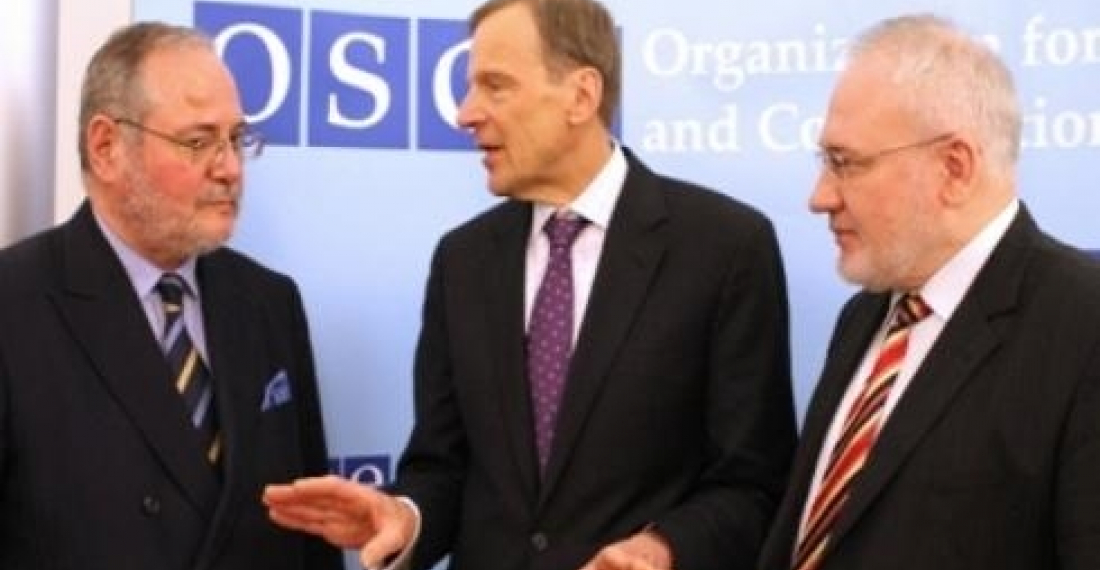
After a "positive and constructive" meeting yesterday in Paris with the Foreign Ministers of Armenia and Azerbaijan, diplomats will return to the region soon.

A meeting between the Foreign Ministers of Armenia and Azerbaijan and the co-Chair of the OSCE Minsk Process was held yesterday in Paris. A statement by the OSCE states that "the meeting was held in a positive, constructive manner". The statement adds that the co-Chair will visit the region in the coming weeks.

The statement says that "the Co-Chairs discussed with the Ministers the way forward on resolving the Nagorno-Karabakh conflict, as well as further work on development of humanitarian contacts and the creation of a mechanism to investigate ceasefire violations, and preservation of sites of historic and cultural value. The Co-Chairs also reiterated deep concern over recent incidents along the front lines and stressed the need to respect the 1994 ceasefire agreement. The Foreign Ministers expressed their determination to continue working with the Co-Chairs to reach a peaceful settlement, and their readiness to carry out confidence-building measures that could improve the atmosphere for negotiations." 

As has been the case on previous occasions the sides had no difficulty to agree to broad general statements. The OSCE press release however gave little indication of how the peace process will be taken forward, but the tone of the statement is meant to reassure the public in the region and beyond that the two sides are once more constructively engaged in negotiations. For the moment however, the priority of the international mediators is to stabilise the situation on the line of contact. An OSCE monitoring exercise, involving four monitors, will take place tomorrow. Over the last forty eight hours there were again reports of cease fire violations. One Azerbaijani soldier has been reported wounded.

source: commonspace.eu

photo: Diplomats from France, Russia and the US who co-chair the Minsk Group will visit the region again soon. (picture courtesy of the OSCE)
Related articles

Editor's choice
News
Aden under curfew, as problem in Yemen's south deepens

Aden under curfew, as problem in Yemen's south deepens

The port city of Aden, in Yemen's south, has been put under curfew, as the rift in the country between  the Saudi led coalition which  backs Yemen's presidential governing council, and the southern forces led by the Southern Transitional Council (STC), deepens. Abdul Rahman al-Mahrami, a member of the Yemeni Presidential Governing Council and commander of the al-Amalik brigades, has ordered a curfew in the temporary capital, Aden, "to maintain security". "A curfew has been imposed throughout Aden Governorate from 9:00 p.m. to 6:00 a.m., in accordance with the instructions of Commander Abdul Rahman al-Mahrami, a member of the Presidential Management Council," the statement said. It states that only security and military personnel, as well as medical and technical teams with approved permits, will be allowed to move in the area during these hours. Yemen's presidential council, which is backed by Saudi Arabia and which already is in a struggle with the Houthi Movement in the north of the country who also occupy the capital Sanaa, two days ago issued an order for the arrest of the head of the Southern Transitional Council (STC),, Aidarous al Zubaidi. The STC have wide support among people in the South, and advocate that South Yemen restores its independence. The coalition warned of further escalation in Aden, long regarded as an STC stronghold, as the Presidential Leadership Council (PLC) chief accused STC leader Aidarous Al Zubaidi of “high treason” and announced the revocation of his membership in the governing body. The moves mark a sharp escalation in tensions within the anti-Houthi camp, despite National Shield Forces, rivals of the STC and former allies, having recently retaken control of Hadhramaut and Mahra from southern fighters. The STC’s takeover of the two regions last month angered Saudi Arabia and contributed to igniting the current internal conflict. (click the picture to read more)

Popular

Editor's choice
Analysis
Analysis: Why what happens in Greenland matters

Analysis: Why what happens in Greenland matters

The snap elections for the parliament of Greenland last Tuesday (6 April 2021) attracted unusual interest from major powers who have been watching the political and economic impact of the election results on their interests in the Arctic region. Among them, the Chinese, who have invested in the Kvanefjeld mine on the island. Maximiliaan van Lange analyses the background to the recent Greenlandic general elections, and the Island's geostrategic position in the Arctic in this article for commonspace.eu.

