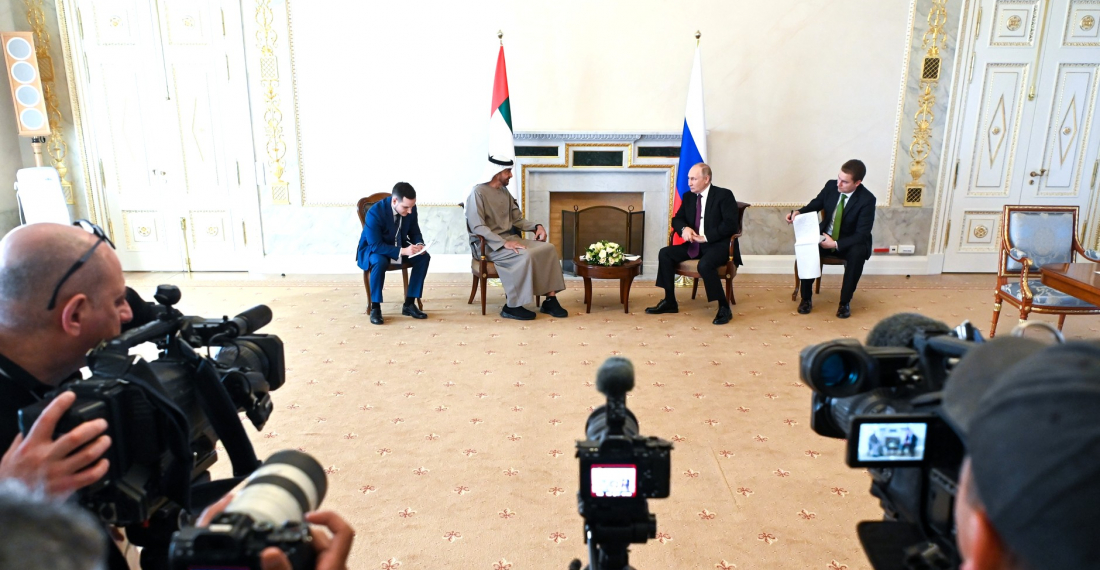
The president of the United Arab Emirates (UAE), met in Moscow on Tuesday (11 October) with president Valdimir Putin of Russia. Putin warmly greeted his UAE guest at the Kostantinovsky Palace.
Putin told his guest
Despite the complexity of today's relations in the world, relations between Russia and the United Arab Emirates are an important factor in stability in the region and in the world as a whole. We are grateful to you for your mediation efforts, which lead to the solution of a number of rather sensitive humanitarian issues. I know about your concern about the development of the situation as a whole and about your desire to contribute to the settlement of all disputable issues, including the crisis that is happening today in Ukraine. I would like to note that this is indeed a significant factor that makes it possible to use your influence in order to move towards a settlement of the situation. I am also aware of your concern about the Zaporozhye nuclear power plant and all the events that are taking place around it. I will tell you in detail about this.
Replying to the Russian president, Sheikh Mohamed briefly lauded the good relations between Russia and the UAE but refrained to make any reference at all to the international situation.
The Gulf and the new world order – managing the present; redefining the future
Even before the Russian invasion of Ukraine, the world order that had emerged at the end of the Cold War had clearly run out of steam. Russia and the West, instead of partners in the international system through membership of the G8, cooperation in space, and extensive arms control agreements, became first rivals, and, since February this year, enemies. China, whose rise over the last four decades as an economic power was first admired, has subsequently become a “systematic rival”. As it verges on superpower status it has become more assertive and less predictable. The US and its allies are seriously worried.
For the countries of the Gulf this new world order is uncharted waters. During the Cold War the Gulf was first a British lake, and later an American one. The American shield protected the Gulf states against intruders. When Iraq invaded Kuwait and occupied it in 1990, the US and its allies led the international community in a fightback, and Saddam Hussein was driven back across the border with a bloody nose. When he tried to rear his head again, the West finished him off. Then there was Iran. A huge American presence, with other allies in the wings, saw off Iranian ambitions in the region. It seemed that US-GCC relations were set in stone.
Yet as the world reverted back to a multipolar state - the parameters of which are as yet undefined - it was only the naïve who thought that the GCC states will simply slide back to their old role of doing the USA's bidding in return for protection. Things in the Gulf have changed dramatically in the last six decades, and in the last decade in particular, in political terms the region is unrecognisable. In Abu Dhabi, Riyadh, Doha and elsewhere the national interest has been re-defined.
Unfortunately the West has not kept up with these changes. For Europe, the GCC has hardly been a priority. There are the occasional visits, statements and thick policy papers, but a real strategy with teeth has been missing and that remains the case. Some EU countries engage with the region when it suits them. They forget about it when it doesn’t.
In the US the relationship with the Gulf was always seen as transactional. Usually everything could be solved if the right order for billions of dollars worth of arms was put in at the right time. From time to time some American presidents became squeamish, but this often did not last. In contrast, Donald Trump took the transactional relationship to new heights.
This is one of the reasons why Joe Biden and the Democrats entered the White House with crusading mantras on global democracy and threats to turn allies into pariah states. That could probably have been done in the 1990s when the USA was the sole hegemon. In 2022, however, it is all but impossible. Relations between the West and the Gulf need to be rebuilt on the new realities and taking into account the huge changes that took place, and are still taking place in these countries. Unfortunately, in Washington and in London the region is still read through an orientalist prism. In Brussels it is not read at all.
This is the background for developments in the last days that have caused irritation in western chancelleries, but which in fact should have led to some soul-searching. The decision of OPEC+ to cut two million barrels of oil production per day, just as the West was trying to increase supply to make up for disruption in Russian supplies to Europe, came as a surprise. Many had thought that during his summer visit to Riyadh, president Joe Biden had done enough to ensure Saudi support. Regardless of whether or not the decision was made for purely economic and commercial reasons there is no doubt it has political implications. In Washington DC, the Democrats are livid. Higher oil prices may lose them the mid-term elections. For the Saudis that would not be a bad prospect, a republican-led Congress is likely to be more friendly. But do the Saudis really want a rupture of relations with the US? The short and simple answer is no!
Another development seen ominously in western capitals is the visit this week of Sheikh Mohammed bin Zayed, the President of the United Arab Emirates, to Moscow. The timing of the visit could not be better for Russia, and more problematic for the West given Putin’s unleashing of a missile barrage on Ukrainian cities. It impacts the UAE’s relations with the West. The UAE has made it clear that it does not see Russia as an enemy, nor even a rival, but simply a friend. The visit confirms this and regardless of any wrapping of it being a part of some large peace offensive, this is in fact simply a political statement by the Emirati leadership that they will now do whatever is necessary for their country and will not be bullied by their patrons. Does this mean the UAE wants a rupture with the West? The short and simple answer is again, no!
So what happens now? No doubt we are going to see acrimonious exchanges in the coming days and weeks. They need to be kept within bounds, and more importantly the basis needs to be set for a new state of relations between the West and the Gulf countries. This needs to be built on more than simply transactional considerations but on mutual interests and mutual respect. That word “respect” has often been missing in the relationship. The GCC countries are basing their future economic hopes, beyond oil, on strong global business and trade performance. This can only be achieved within a rules-based international system which is also what western countries have been advocating for. The West also remains the leader in research and innovation, areas that GCC countries now covet. And yes, the Americans, the Brits and the Europeans are for the Saudis and the Emiratis and the others the devil they know, warts and all.
Urgently the debate on a new paradigm for the future of GCC relations with the West must start. It needs to be intensive and multi-tiered, involving foreign ministries, think tanks and civil society. For it is indeed one of the new realities in the Gulf that these and similar institutions now exist. Despite the vertical nature of the leadership these new institutions now feed into the decision making process, and although dealing with the GCC has become more complex, the end result need not be less successful.