Putin and Pashinyan met in Moscow

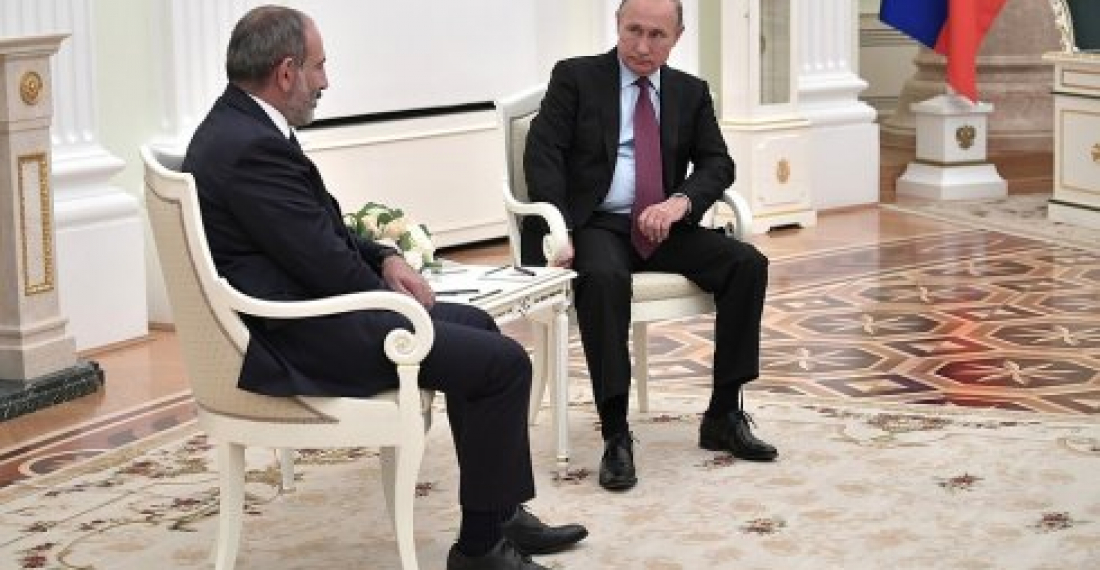
Russian President Vladimir Putin on Saturday (8 September), received in Moscow the Armenian prime minister Nikol Pashinyan. This was the third meeting between the two men since Pashinyan became prime minister of Armenia in May, and came amidst speculation in Russian and Armenian media that there were problems in the historically close relations between the two countries.

Welcoming the Armenian leader, president Putin said:

Dear Nikolai Vovaevich! I am very glad to see you.

Probably, there is no need to particularly go into the nature of our relations: they are of a very special nature, specific. And it manifested itself through the centuries, and not only during our joint work with you.

For today, the relations between Armenia and Russia are developing steadily in all directions. This concerns the sphere of political relations, military sphere, security issues, economic cooperation.

Russia confidently ranks first among the economic partners of the Republic of Armenia. We are the biggest investor in the Armenian economy, and here it can be noted that relations in this sense are quite diversified.

This is energy, and hydrocarbon energy, gas supplies, and at the lowest prices, for which only Gazprom sells gas in the world - for $ 150 per 1,000 cubic meters. This is nuclear power, thermal generation. We develop relations in the metallurgical industry, and in different areas, in mechanical engineering. In general, we have many things to talk about.

I am particularly pleased that last year the trade turnover grew by almost 30 percent, and for the first half of this year the growth was already 22.2 percent, that is, if things go on at this rate, we will exceed the figures of the previous year.

The scope of our cooperation is great. I am very glad to see you in order to compare co-operation in the current and medium term.

On his part prime minister Pashinyan said:

Dear Mr Putin!

First of all, allow me to congratulate you on the Day of Moscow. I already felt that a very big holiday is planned, and I am very glad that I visit Moscow in such an atmosphere.

Of course, I am very pleased to attend this meeting, our third in the last four months. I think that such regularity underlines the special character of relations between our countries. Let me say, there is also a special character between us, the special character of our personal relations.

I want to emphasize that, contrary to some pessimism, which now exists in the Armenian, Russian press, and social networks. our relations are developing very dynamically, very naturally, and I think that the main task is to find the full potential of the development of our relations.

This does not mean that there are no questions in our relations - God forbid from such a situation when there are no issues in the relationship, because this would mean that there is no relationship at all. I can say with confidence that there are no unsolvable issues in our relations, and we, of course, today will discuss a very wide range of issues.

source: commonspace.eu with kremlin.ru

photo: Vladimir Putin with Nikol Pashinyan at their meeting in Moscow on 8 Sepotember 2018 (picture courtesy of the press service of the president of Russia)
Related articles

Editor's choice
News
Council of Europe launches new International Claims Commission for Ukraine

Council of Europe launches new International Claims Commission for Ukraine

Thirty-four countries and the European Union have signed a new convention establishing an International Claims Commission for Ukraine at a diplomatic conference co-hosted by the 46-nation Council of Europe and the Netherlands in the Hague. The diplomatic conference was attended by leaders and high-level representatives from over 50 states, including the President of Ukraine, Volodymyr Zelenskyy, the President of the Republic of Moldova, Maia Sandu, and the Prime Minister of the Netherlands, Dick Schoof.  “Today marks a major step forward in ensuring accountability for Ukraine. The International Claims Commission represents justice and hope for tens of thousands of victims—our determination that those who have suffered will not be forgotten. I call for quick ratifications so we can get the commission rapidly up and running for the people of Ukraine,” said Council of Europe Secretary General Alain Berset. Ukrainian President Volodymyr Zelenskyy said: “We expect that every mechanism for compensation from the Register of Damage and Claims Commission to the actual payments – will start working and receive strong and sufficient international support, so that people can truly feel that any kind of damage caused by the war can be compensated. This war, and Russia’s responsibility for it, MUST become a clear example – so that others learn not to choose aggression.” “Accountability is about creating the conditions for peace that endures. And therefore, accountability is a condition of security – today and for the future. But accountability is not only about Ukraine. And it is not only about one aggressor and one victim. Accountability is about Europe. About every country in Europe. It is about whether Europe, as a whole, is willing to defend its peace,” said Maia Sandu, President of the Republic of Moldova, which currently holds the Presidency of the Council of Europe’s Committee of Ministers. The Prime Minister of the Netherlands, Dick Schoof, said: “Every day Russia is deliberately bombarding homes, destroying businesses and damaging infrastructure in Ukraine. Russia must compensate Ukraine for the damage caused. That is why we have launched the International Claims Commission for Ukraine and we are honoured to host it.” The International Claims Commission will be the second part of a comprehensive compensation mechanism related to Russia’s war of aggression, building on the existing Register of Damage for Ukraine. The claims commission will be established within the framework of the Council of Europe and will also be open to other countries. The Register of Damage for Ukraine, created in 2023, collects and records compensation claims submitted by individuals, organisations and public bodies in Ukraine. Forty-four states and the European Union have so far joined the Register, which has already received 86,000 claims. The International Claims Commission will review, assess and decide upon claims submitted to the Register of Damage for Ukraine and determine the amount of compensation, if any, which is due in each case. The convention establishing the commission will enter into force once it has been ratified by 25 signatories, as long as sufficient funds have been secured to support its initial work.

Popular