One hundred days ago, on 24 February, Russia invaded Ukraine in an attempt to overthrow the country's democratic government and install a puppet regime. This objective failed, but the war goes on, especially in the Donbass region where heavy fighting is taking place.
commonspace.eu interviewed Hanna Hopko, a Ukrainian politician and activist, who previously served as Chairman of the Foreign Affairs Committee of the Ukrainian Parliament and is today at the forefront of several important humanitarian initiatives. Hopko speaks about Ukraine's frustration with Europe's long standing failure to appreciate Ukraine properly. She speaks about the heroism of young Ukrainians who are fighting off current Russian aggression, and recalls the loss of some of her own friends who have died in battle or have been imprisoned.
Hopko however remains optimistic about the future, referring to the Ukraine Recovery Plan that is already being prepared. She speaks about the country's hopes to be granted EU candidate status later this month: "Ukraine will not except any plan B. Only candidate status. Our aspiration to apply to EU membership is a result of the long fight of Ukrainians for the right to be part of a free European family. It is based on our achievements in transformations of the country despite Russian continues efforts to break us."
Read the interview in full.
CS: It has been one hundred days since the start of the Russian invasion of Ukraine. Despite predictions that Ukraine will be defeated in days, the Russian offensive has been contained, and is now limited to the South of the country. How do you assess these one hundred days; What lessons can be learnt by Ukraine and by the international community from this experience?
Ukraine’s Victory is geopolitically important. In the 30 years since the country’s restoration of statehood and independence, Ukraine has become a reliable contributor to European security. Kyiv even gave up the world’s third largest nuclear arsenal in 1994 following the collapse of the Soviet Union. As a result, it can be argued that Ukraine truly represents a democracy in action.
A hybrid war started in 2014 by the Russian government, temporary occupation of Crimea and certain areas of Donetsk and Luhansk regions, full-scale Russian military aggression since the February, 24, 2022, led to significant damages, disruptions of infrastructure on Ukrainian territories, deaths and injuries of people, humanitarian catastrophe caused by disruption of life support of cities and settlements, suffering and massive flows of refugees.
More than eight years of Russian armed aggression has confirmed the ability of Ukrainians to defend their own state and to ensure that they will never return to Moscow’s sphere of influence. However, the dreams of millions, who for centuries have fought for statehood and believed in Ukraine’s special importance regarding the fate of Europe, will only come true when Kyiv becomes a full member of the European family of nations and NATO. From a pragmatic point of view, such a move is in the collective interest of the West, which should show greater readiness and political courage when it comes to Ukraine’s Euro-Atlantic ambitions.
As one of the initiators of the Verkhovna Rada’s 2019 “Resolution on the Protection of the Rights of Indigenous Peoples of the Russian Federation”, I believe that Ukraine’s current position will also ultimately help transform Russia and curb the expansion of authoritarian regimes. After all, Ukraine has for centuries borne the brunt of various international issues facing Europe. The future of the continent is thus located in Ukraine. From fighting off invasions to curbing authoritarian regimes in the 21st century, Ukraine’s position on the European continent has always been on the vanguard.
Exactly 400 years ago, events pivotal for Europe took place in Ukraine. Near the fortress of Khotyn, brave Cossacks repelled an invasion of thousands of Ottoman troops. The future of the entire continent depended on the result of that battle. If the battle had been lost, the way to Warsaw would have been opened to the Ottoman Empire.
However, it is unclear if Europe truly understands and appreciates these experiences.
CS: We keep hearing stories of heroism by young Ukrainians on the front line. What role have women played and are playing in the struggle to defend Ukraine from Russian aggression?
Our fight for freedom took many lives of our best friends. I give you examples. Roman Zhuk died defending Ukraine. His family was an example of optimism, love and everyday hard work to bring tangible changes. With his wife Lena they launched a social enterprise and an environmental initiative in the Zakarpattia region. But Russia claimed his life. Women are fighting in the battlefields. My friend medical volunteer Taira (Yulia Payavskaya) was kidnapped in March 16 in Mariupol. We are fighting to release her and 500 women civilians.
CS: How do you assess the international response to the Russian full scale invasion of your country. Are you satisfied with it? What could have been done differently?
In the 1930’s Moscow broke Ukrainian resistance by starving millions, dehumanizing them as mere “ethnographic matter.” The man-made hunger – Holodomor, a genocide, killed millions of Ukrainians. The West walked away, but at the time the U.S. legitimized it all by extending diplomatic recognition to Stalin’s regime.
Putin denies that Ukrainians even exist. Simultaneously, Russian calls to “kill all Ukrainians” are vitriolic. The second genocide of Ukrainians is happening in 21 century because of Russian totalitarianism.
The “democratic West” refused a no-fly zone for fear of “nuclear war” with Russia. This is straight from the Soviet playbook. This is also self-paralysis. The West needs to finally wake up to the threat Russia’s outlaw state poses to global peace and security. The West is largely responsible for helping the Russian regime grow stronger economically and militarily. European values were sacrificed. European security was sacrificed. Independent countries were sacrificed as buffer states. Dirty money = erosion of democracy ! Stop feeding the beast ! Russia should be recognized a state sponsor of terrorism.
Russia should be black-listed by the FATF and excluded from the organization. Limited sanctions over the Russian banking sector leave plenty of loopholes for the Russian Federation to continue financing the war of aggression against Ukraine as well as other of its malicious actions against global and regional stability. The war crimes, sponsorship of terrorism and atrocities committed by Russia and its proxies around the world undermine the current system of preventing money laundering, terrorist financing and proliferation financing (ML/TF/PF). So far, the global standard-setting anti-money laundering body Financial Action Task Force (FATF) has shown only a lukewarm reaction to Russia’s blatant breaches of international law. In order to mitigate the harm already to the integrity, accountability, and stability of global financial system, Russia shall be promptly expelled from FATF and designated as high-Risk jurisdiction (“black-listed” by FATF).
The Russian Federation has been a FATF member since 2003. When it was granted membership, Russia undertook an obligation to pursue the values, principles and mandate of the organization.
However, Russia’s undeclared and unprovoked war against Ukraine goes against these basic principles of international cooperation, dialogue and mutual respect among countries enshrined in the FATF Mandate. Russia committed war crimes and atrocities against civil population which sustain
terrorist activity as a state actor. Russia’s military activities against civilian infrastructure in Ukraine have inhibited national and international programs in Ukraine aiming at preventing ML/TF/PF. Russia is shelling the entire Ukrainian territory – from Luhansk region to Transcarpathia, while Ukraine has no missile systems, except for a few Neptune complexes and missiles for them, to hit Russian military and logistics infrastructure at least 300 km deep from the border. Again, ATACMS are needed.
CS: The war still rages on, but the Ukrainian government is already focused on the post-war situation. What will be the immediate challenges once the fighting stops. How can the international community contribute to Ukraine’s reconstruction and rehabilitation?
The Recovery Plan for Ukraine is being created and will be implemented by state authorities, local governments, enterprises of all forms of ownership, public and charitable organizations of Ukraine together with foreign states, international organizations, with the obligatory observance of the international obligations signed by Ukraine, in particular in the field of environmental assessments and protection, including international organizations, and charitable foundations.
The Recovery Plan for Ukraine is aimed at macro-financial stabilization, assistance to victims, refugees and the disadvantaged groups, business support, reconstruction of destroyed infrastructure, restoration of institutions and organizations, with the obligatory observance of the international obligations signed by Ukraine, in particular in the field of environmental assessments and protection.
The political, legal and economic parts of the Recovery Plan for Ukraine need to be discussed between the partners and will be based on multilateral or bilateral agreements between donors and recipients. as well as the principles of sustainability.
An important component of the Recovery Plan for Ukraine will be the Assistance Matrices, which each partner country will form based on the capabilities of its budget and the capabilities of legal entities and individuals of the country.
It is important for Ukraine to receive a substantial financial package of macroeconomic stability in the shortest possible time, as well as special assistance packages to restore and support large, medium, and small businesses
CS: It is amazing that in the middle of the Russian invasion, Ukraine submitted its formal application to join the European Union. How do you evaluate this step. What should be the next steps in the process of Ukraine’s full integration in the European family?
The EU will benefit from Ukraine’s integration. Ukraine with its abundant natural resources, the globally richest agricultural land, a very strong industrial basis, and a high-quality labor force is a very rich country, with a huge potential for growth, which up until now was not been fully realized.
Ukraine will not except any plan B. Only candidate status. Our aspiration to apply to EU membership is a result of the long fight of Ukrainians for the right to be part of a free European family. It is based on our achievements in transformations of the country despite Russian continues efforts to break us.
EU candidate status for Ukraine is also a way to secure Europe’s investment in resilience and recovery of Ukraine.
source: Dr. Hanna Hopko is an expert in advocacy and international relations and chaired the Foreign Affairs Committee of the Ukrainian Parliament from 2014-2019. Dr. Hopko was one of the civic leaders of the EuroMaidan during Ukraine’s Revolution of Dignity. She was elected to Parliament from the pro-European Self-Reliance Party in 2014 and later served as an independent MP. In 2014, Foreign Policy magazine named Dr. Hopko a “Leading Global Thinker”. That same year, she received the “Certificate of Merit” from Georgetown University’s School of Foreign Service Leadership Seminar and was honored with the National Democratic Institute Democracy Award for her efforts to further the cause of democracy in Ukraine. She is a co-founder of the International Center for Ukrainian Victory (ICUV).
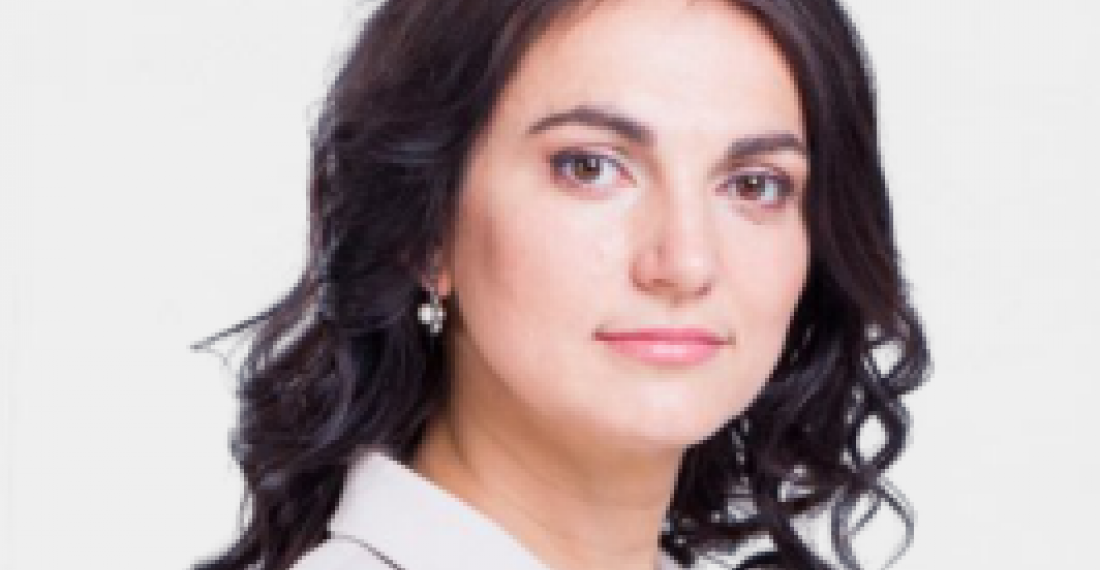
photo: Dr Hanna Hopko
The views expressed in opinion pieces, interviews and commentaries do not necessarily reflect the position of commonspace.eu or its partners