Turkey may be about to enter a period of political uncertainty. With many challenges on the horizon, no single man, not even an illustrious sultan, can have all the solutions says Dennis Sammut in this week's Monday Commentary
Turkey goes to the polls on Sunday in early presidential and parliamentary elections. The elections are, to the surprise of many, being very hardly fought, and although opinion polls indicate the incumbent president and his party will scrape through to victory, the figures are within the margin of error. An electoral process that was meant to be a coronation has turned into a hardly fought campaign as the opposition emerged from its long slumber, people put fear of intimidation behind them, and Turkish democracy proved it was more resilient than some had feared. Many consider that the elections will define Turkey's future for decades to come. If Recip Tayip Erdogan wins the presidency again, and his AK party secures a majority in parliament, he will have a mandate to pursue his grand vision of Turkey, domestically and globally. If he loses Turkey will veer to a new course.
Recip Tayip Erdogan has changed the Turkish Republic as no other leader has since the founding father, Kemal Ataturk. Apart from the deep social changes of the last decade and half - re-enforcing conservative Muslim norms, and the redistribution of economic wealth to a new emerging middle class from Turkey's Anatolian interior - Erdogan has taken on the previously omnipotent Armed Forces and won; has survived a coup attempt inspired by the Gulenist Movement - an organisation deeply embedded in Turkey's bureaucracy and government; and tamed nationalist forces through the sheer embrace of his hug. These victories came at a price. After the July 2016 attempted coup thousands were arrested; hundreds of thousands were purged from public office and many media outlets shut or taken over. Turkey has been under a state of emergency since. But it remains a functioning democracy, as these elections are showing, even if an imperfect one. Lumping Erdogan with Putin, as the Economist did this weekend, and other western media often do, is disingenuous. Turkey is a complex country, full of nuances. You miss the nuances, and you miss the point.
The outcome of the elections is at the moment uncertain and could throw up all sorts of surprises. The presidential elections are more important than ever, because under constitutional changes approved in a referendum in 2017, the president now has much more power. Erdogan is being challenged by a candidate put forward by the main opposition CHP party. Muharrem Ince has emerged as an antidote for Erdogan - his match for the long and animated election campaign. He has been able to pull the crowds - not as much as Erdogan, but perfectly respectable numbers. He, like Erdogan, has a way with words. No wonder he was brazen enough to challenge Erdogan to a televised debate. Erdogan declined.
Another candidate, a woman, Meral Aksener was initially thought likely to emerge as the most serious challenger to Erdogan. A former Minister of interior, with a solid nationalist agenda, she has somehow been squeezed in between the populism of Erdogan and Ince.
The election for president is also characterised by another factor. One of the candidate, the young and charismatic Selahattin Demirtas is in prison. Demirtas was the leader of the HDP party, which has strong support among the Kurdish population, but also among the left wing and intellectuals of Istanbul. Demirtas campaign from his prison cell is a reminder to many of Erdogan's excesses in power.
Erdogan needs to get 50% of the vote if he is not to go to a messy second round. He is close, but its not a done deal.
The parliamentary elections are even more hardly fought. The AK party can easily lose its majority in parliament, forcing it into trying to forge a coalition. The HDP may emerge here as the pivotal factor. It all depends on whether they will overcome the ridiculously high 10% threshold to enter parliament. If they don't the seats will go to the other parties - the AK party being the biggest beneficiary. If, as is likely, they will pass the threshold, they may well end up being the force that decides who governs Turkey for the next five years.
Recip Tayip Erdogan is a formidable political operator, and his role in redefining Turkey will be remembered for a long time. Some think that he has lost his Midas touch and spell like control over huge sections of Turkish society, and is slowly but surely fading away. That assessment may be premature. Erdogan has been down before, and emerged from the ashes stronger than ever. There is a possibility this will happen again, and that the old fox will find a way of playing his opponents against each other.
Turkey may be about to enter a period of uncertainty, and the election campaign has re-enforced the polarisation in society and divisions in the country. But this perhaps is the cost of democracy. The winners will be well advised to reach out to the losers. There are big economic challenges on the horizon; the Kurdish issue remains to be resolved, and Turkey's neighbourhood is more challenging than ever. No single man, not even an illustrious sultan, can solve all these problems on his own.
source: Dennis Sammut is the Director of LINKS (Dialogue, Analysis and Research). His Monday Commentary is published weekly on commonspace.eu. dennis@links-dar.org
The views expressed in opinion pieces and commentaries do not necessarily reflect the position of commonspace.eu or its partners
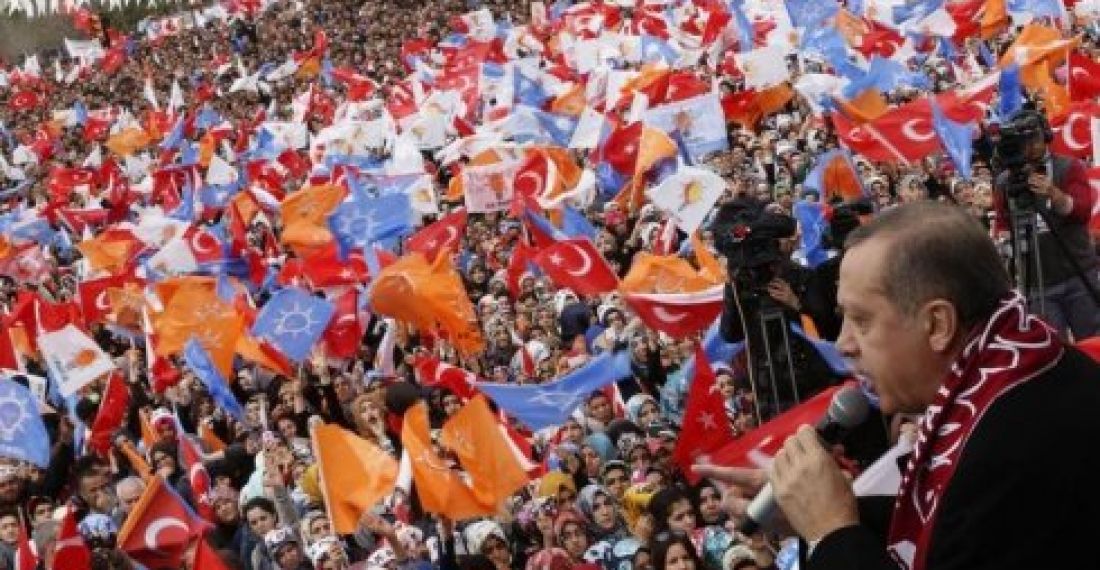
Photo: Erdogan addresses an AK Party rally (archive picture)