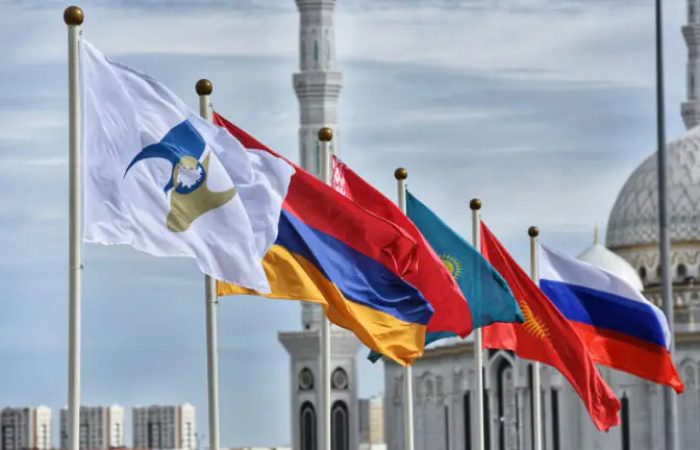
Armenian Prime Minister Nikol Pashinyan raised concerns over the Russia-led Eurasian Economic Union (EAEU) during a press briefing on Thursday (25 June), amid restrictions affecting Armenian goods in the bloc’s market.
Pashinyan said Armenia would continue to work with the EAEU and did not believe that “anything irreversible” had happened, or that Armenia should abandon cooperation with the bloc.
“We will work very actively. I am confident we will find solutions. If we cannot find solutions, that means something entirely different, first and foremost for the Eurasian Economic Union,” Pashinyan said. “The EAEU rests on several fundamental principles: the free movement of labour, goods, services and capital. If those principles do not exist, then the Eurasian Economic Union does not exist.”
He added that temporary disruption could be understandable, but warned that a prolonged failure to resolve the issue would call the bloc’s existence into question.
“The problem may last for one month, two months or three months. But if it remains unresolved in the fourth month, that means the EAEU does not exist,” he said. “If the EAEU itself says it does not exist, what are we supposed to do then?”
While trade between EAEU member states remains limited for a free trade bloc, and the economic impact of a potential Armenian exit would likely be modest for the bloc as a whole, Moscow’s response has underlined the EAEU’s political significance.
Earlier this month, Russian President Vladimir Putin has called for Armenia to hold a referendum to decide between continued membership of the EAEU and closer integration with the European Union.
Source: commonspace.eu with JAMnews and Jamestown