Editor's choice
Opinion
Opinion: After the visit of US Vice President JD Vance, the South Caucasus is being rewired

Opinion: After the visit of US Vice President JD Vance, the South Caucasus is being rewired

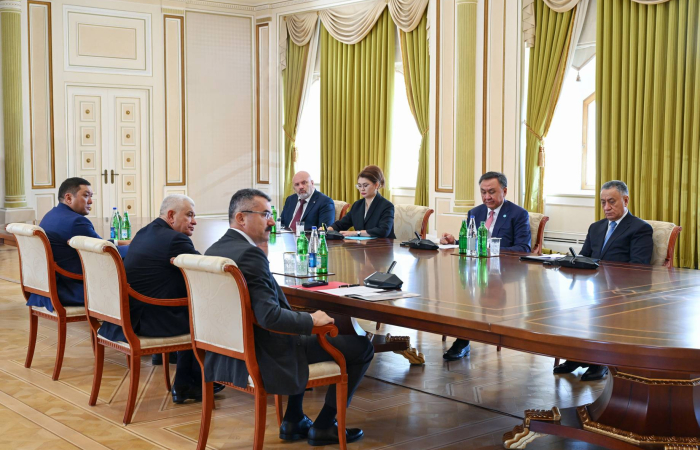
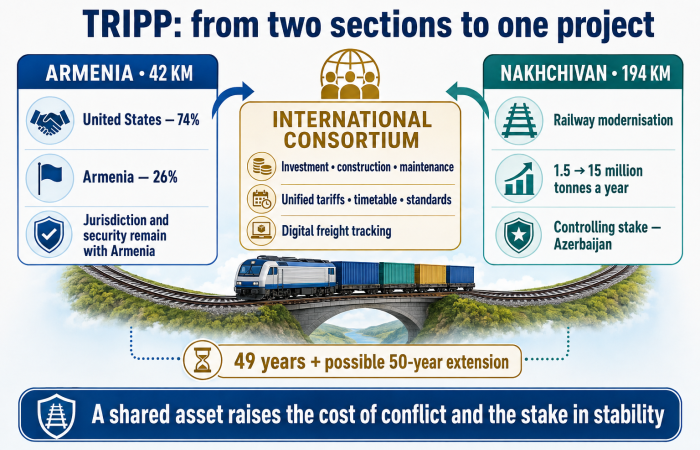
"Vance’s visit did more than consolidate a peace process – it began rewiring the South Caucasus through energy, AI, and infrastructure. The region’s future alignment may well be determined less by traditional security blocs and more by who controls the region’s transport routes, builds its reactors, powers its data centers, and lays its fiber-optic cables", writes Vasif Husseynov, in this op-ed for commonspace.eu Vance’s February 9–11 visit to Armenia and Azerbaijan marked a structural turning point in the South Caucasus. Unlike previous high-level engagements of the United States that generated rhetorical alignment but limited follow-through, this visit embedded the region into long-term American economic, technological, and strategic frameworks. Taking place on the heels of the latest agreement (January 14) between Washington and Yerevan on the implementation framework for the Trump Route for International Peace and Prosperity (TRIPP), the visit served to consolidate the American influence in the region and taking it to higher levels. The consequences are unfolding along two axes: domestically, within Armenia and Azerbaijan’s political economies; and geopolitically, in the region’s recalibrating balance between the United States and Russia, with Georgia seeking entry into the new configuration. (click the image to read the op-ed in full).
Editor's choice
Opinion
A new chapter in US relations with the South Caucasus

A new chapter in US relations with the South Caucasus

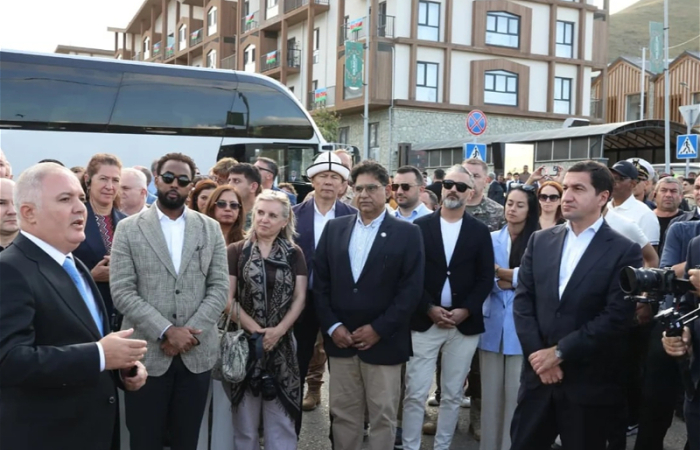
The visit of US Vice President, J.D. Vance, to the South Caucasus was a success and achieved all the main American immediate objectives. And this time the main American partner is not Georgia, but Armenia and Azerbaijan. This was not just a symbolic protocol visit, although there was a lot of that and the significance and symbolism would have come across clearly in both Moscow and Tehran. But there was also substance. The US Vice President visited Armenia on Monday (9th February), and Azerbaijan on Tuesday (10th February). In Yerevan, the Vice President and Armenia’s Prime Minister Nikol Pashinyan signed a joint statement on the completion of negotiations on a 123 Agreement, which establishes a legally binding framework for peaceful nuclear cooperation between the U.S. and partner countries. While in Azerbaijan, Vance and Azerbaijani President Ilham Aliyev signed a Strategic Partnership Charter between the U.S. and Azerbaijan that covers regional connectivity, economic investment, and security and defense issues. The guests were happy, and the hosts were delighted. Not so Russia. The Kremlin has always saw the South Caucasus as its backyard. Armenia had traditionally been compliant; Azerbaijan tried to present a balanced approach, and even Georgia, except for a fleeting moment in the second part of the Saakashvili’s government, never failed to understand Russian interests. The warmth with which the US Vice President was received in Baku  and Yerevan went beyond protocol niceties. It was genuine, and it would have worried the Kremlin. Neither Aliyev, nor Pashinyan, want a long messy problem with Russia. But they both basked in the warmth of the new found peace between them, that now is all but guaranteed by the United States. The visit of J.D. Vance to Armenia and Azerbaijan left the Georgian government looking silly. No amount of verbal massaging could hide the disappointment of being left out. The Georgians had got used to the fact that they were at the centre of the South Caucasus, and nothing could happen in the region without them. They now need to adjust to the new reality. Further mistakes and miscalculations need to be avoided. Where does that leave the EU? The European Union appears to have lost the initiative in the South Caucasus. Whilst there is some soul-searching going on in Brussels, there is a failure to accept that there is lack of strategy. Decisions are often taken as a result of momentary reflexes, or priorities of individual member states. The present lull must be used to articulate a clearer strategy towards the region. The summit of the European Political Community, in Yerevan, on 4 May, offers the EU an excellent opportunity to relaunch its message in the region. What next? The visit of J.D. Vance to the South Caucasus opened a new chapter in American relations with the South Caucasus. Yet for this chapter to be meaningful and long-lasting, there is yet a lot of work to be done.
Editor's choice
Opinion
Opinion: The upcoming visit of Vice President J.D. Vance to the South Caucasus consolidates the US position in the region

Opinion: The upcoming visit of Vice President J.D. Vance to the South Caucasus consolidates the US position in the region

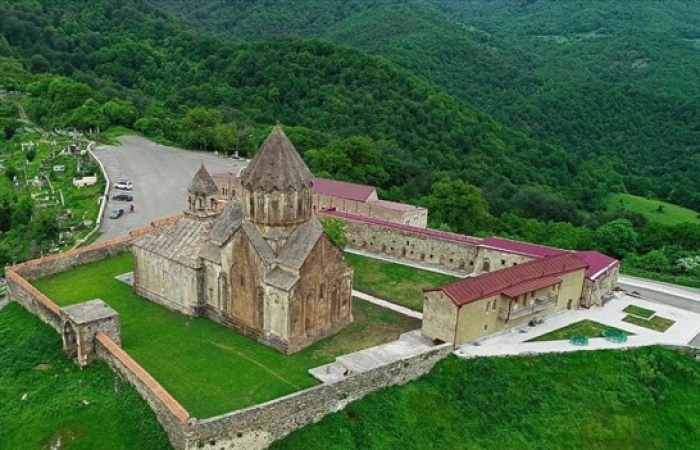
"On January 24, 2026, President Donald Trump announced on Truth Social that U.S. Vice President J.D. Vance will travel to Armenia and Azerbaijan in February 2026 to build on recent peace efforts and advance the Trump Route for International Peace and Prosperity (TRIPP)", writes Vasif Husseynov in this op-ed for commonspace.eu "In his statement, President Trump said the visit would “build on our peace efforts, and advance the Trump Route for International Peace and Prosperity,” signaling Washington’s intent to maintain high-level engagement in a region of growing strategic significance." The announcement came just days after January 14, 2026, when U.S. Secretary of State Marco Rubio and Armenian Foreign Minister Ararat Mirzoyan signed the Implementation Framework for TRIPP in Washington, D.C. The agreement translated commitments reached at the August 8, 2025, Washington Summit into a practical roadmap for achieving unimpeded multimodal transit connectivity between Azerbaijan and its Nakhchivan Autonomous Republic through Armenian territory. According to official statements, the framework provides mechanisms for planning, construction, operation, and oversight of infrastructure while fully affirming Armenia’s sovereign authority over the route. The expanded American role in the South Caucasus has elicited reactions from other regional powers. Russia, previously the primary security guarantor in the region and the former key mediator in the talks on the Zangezur corridor, has seen its influence overtaken by U.S. participation under TRIPP. Iranian officials have voiced objections as well, concerned about increased U.S. involvement near their borders and potential shifts in regional security dynamics. While both powers have expressed discontent, they have been unable to prevent these changes. Baku and Yerevan, however, understand that their region must remain a platform for cooperation among all external actors, not a theater of confrontation. These developments indicate that the South Caucasus has moved from the periphery to the forefront of U.S. foreign policy. The sequence of the Washington Summit, the January 14 TRIPP implementation framework, and the upcoming Vice Presidential visit reflects a sustained strategy aimed at consolidating peace, promoting connectivity, and advancing American influence. By anchoring peace agreements in infrastructural and economic frameworks, embedding strategic oversight in implementation mechanisms, and elevating regional partners within its broader peace architecture, Washington is consolidating its role in a region of enduring strategic importance. (You can read Vasif Husseynov's opinion piece in full by clicking the image)
Editor's choice
Opinion
Opinion: With a foot in every camp, Armenia seeks to create a niche for itself through a diversified foreign policy

Opinion: With a foot in every camp, Armenia seeks to create a niche for itself through a diversified foreign policy

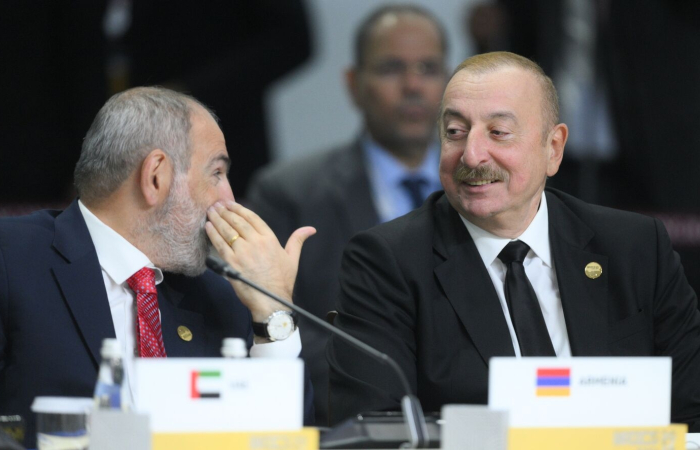
The days when Armenia was considered an outpost of Russia are long gone. Prime Minister Nikol Pashinyan has sought new relations with both the European Union and the United States. Relations with Brussels have peaked to new heights, with even talk of EU membership. And no lobbying by the powerful Armenian diaspora in the US could achieve that historical moment on 8 August in the White House, when Pashinyan and Azerbaijani president Aliyev, not only set the stage for peace between their two countries, but also opened the way for a new relationship with the United States. But Pashinyan has been able to do all this whilst at the same time keeping the relations with Russia warm. Armenia remains an active member of the Russia-led Eurasian Economic Union (EAEU). In December, Pashinyan participated in Eurasian Economic Union (EAEU) meetings in Moscow and St. Petersburg. Johnny Melikyan, Senior Research Fellow at the Orbeli Centre in Yerevan summed up the visit this way: The recent December 2025 visits of Armenian Prime Minister Nikol Pashinyan to Russia highlighted a practical and interest-based stage in Armenian–Russian relations. Rather than symbolism, the agenda was dominated by concrete issues of economic cooperation, connectivity, trade, and participation in Eurasian integration formats. You can read Johnny Melikyan's comment in full by clicking on the image
Editor's choice
Opinion
Opinion: The US strikes Venezuela, Consequences for Ukraine and Europe

Opinion: The US strikes Venezuela, Consequences for Ukraine and Europe

This is a Flash Analysis published on 3 January 2026 by the European Policy Centre in Brussels. Chris Kremidas-Courtney is a Senior Visiting Fellow at the European Policy Centre. As 2026 barely takes its first breath, we are already drifting back into an age where great powers manage their own neighbourhoods and look away from everyone else’s. It’s a world order that prizes control over legitimacy and stability over justice until neither one survives. The most immediate consequence of the US strike on Venezuela may be felt not in Latin America, but first in Ukraine. As foreshadowed in the Trump administration’s National Security Strategy, Washington is intent on rooting its power firmly in the Western Hemisphere while potentially leaving Russia and China greater freedom of action in their ‘backyards’. Seen through this lens, the strike on Venezuela looks more like part of a broader reversion to regional spheres of influence. The emerging message is that the United States will enforce primacy close to home but its willingness to underwrite security beyond its hemisphere is increasingly transactional and politically fragile. This is a 21st century version of the 1823 Monroe Doctrine, in which US hemispheric dominance was paired with strategic disengagement from Europe’s wars. It is also the world Putin has long argued for. It is hard to see an upside for Europe, but there may be one small silver lining. Prior to the strike, Caracas had been demonstrating how a sanctioned regime could survive and adapt by embedding itself into alternative economic and financial networks backed by China, Russia and Iran. That resilience was undermining the credibility of sanctions as a systemic tool, on which the EU relies far more heavily than the United States. By decapitating the Maduro regime, Washington has reasserted that sanctions are not an end state, but a step on an escalation ladder that can still culminate in the use of force. Yet this restoration of the credibility of sanctions comes at a great cost. It risks signalling to other revisionist or embattled regimes that force is the ultimate arbiter. All eyes are now on Moscow, since, as former US National Security Council official Fiona Hill testified in 2019, Russia had informally offered to end its support for Venezuela in exchange for US acquiescence on Ukraine.  Meanwhile, online advocates in China are calling on their regime to emulate the US and take similar steps against Taiwan. Worse still, Venezuela is now politically hollowed out. Any opposition figure who emerges now could be instantly labelled a US proxy. It is not yet clear what the thinking is in Washington about the day after, but the precedents of Iraq and Afghanistan are not encouraging. Once again, Washington has demonstrated its ability to act decisively – but also reminded us of its lack of staying power. For Ukraine, that distinction may prove fatal unless Europe can step up and support Kyiv more decisively in 2026.