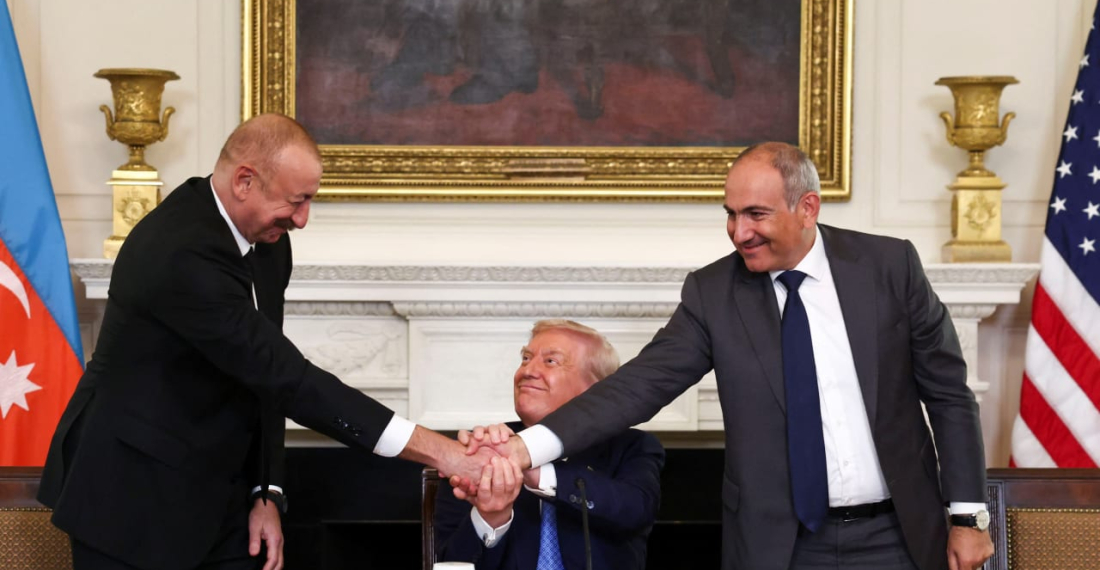
The TRIPP project (the Trump Route for International Peace and Prosperity) is seen as a key component of the Armenia–Azerbaijan peace process. For Azerbaijan, TRIPP promises access to the Nakhchivan exclave through Armenia; for Armenia, the route reaffirms the country’s sovereignty and territorial integrity. In addition, TRIPP is expected to open up regional trade and connectivity, while the presence of the United States on the ground in developing the route provides Armenia with an added layer of security reassurance. Many analysts argue that TRIPP is at the very heart of the peace agreement between Armenia and Azerbaijan, and they are not wrong. A possible delay in its implementation or a loss of interest from the Trump administration in advancing the route would raise big concerns regarding the peace process in both Baku and Yerevan.
Beka Bajelidze argues for the Institute for War & Peace that the US and Israel’s war in Iran could affect the implementation of TRIPP. This envisioned route would pass through Armenia’s southern territory and would be rather close to the border with Iran. Since the TRIPP plan was announced at the White House on 8 August 2025, Iran has remained suspicious of the project, viewing the road as a way for the United States to maintain a presence close to its borders. While both Baku and Yerevan have openly addressed these concerns with Tehran, highlighting that TRIPP does not pose a danger to Iran’s interests, the war that began on 28 February would definitely reignite these worries for the Islamic Republic. In an interview for Caucasus Watch, Iranologist Pooya Hosseini argues that “under the conditions of war, with the Iran–U.S. conflict deepening and mutual hostility prevailing, Iran’s position on TRIPP could become tougher. Iran maintains that in every region where the United States has entered with economic and humanitarian programs, those initiatives have eventually turned into a security and military presence. This is what worries Iran”. Before the war, analysts warned against portraying TRIPP as an anti-Iran geopolitical tool, as this risks backlash; for Iran, these concerns have now been amplified by this war.
In addition, there is a risk that prolonged war in the Middle East could disrupt plans of the route, as investors may remain more cautious given higher security risks. Since the war, Iran has targeted several US military bases and assets across the Middle East and has indicated it may continue targeting US-linked interests in the region. Armenian foreign minister Ararat Mirzoyan said on Monday (23 March) that “negotiations between Armenia and the United States on TRIPP have not slowed down and are proceeding normally.” While this is a positive signal, Armenia and Azerbaijan will need to maintain open communication with Iran, and continue advocating for TRIPP as a connectivity initiative aimed at supporting regional development and trade. Armenia should also underline that the route would not disturb Iran-Armenia connectivity and that plans could be developed to link trade routes in a way that would also benefit Iran.
There is also another argument to be made. As the war in Iran has affected many traditional trade routes, it has made investments in other trade routes more attractive, including TRIPP. From the beginning, TRIPP was proposed not as a simple route connecting mainland Azerbaijan to its Nakhchivan enclave, but rather as an important component of the Middle Corridor, which would provide connectivity between Europe, the South Caucasus, and Central Asia, bypassing zones that remain unstable.
While investors will assess both scenarios when it comes to the development of TRIPP, one thing remains clear: the war in Iran has undoubtedly raised questions regarding the development of this initiative. Armenia and Azerbaijan need to recognise this and come up with a strategy together that will get assurances from both Iran and the US that TRIPP can and will proceed as agreed.
Source: This briefing was prepared by the editorial team of Commonspace.eu, and was originally published in Caucasus Concise on Thursday (26 March).