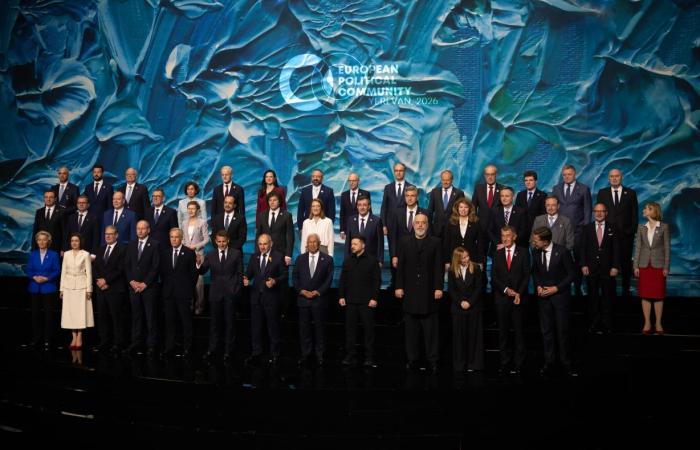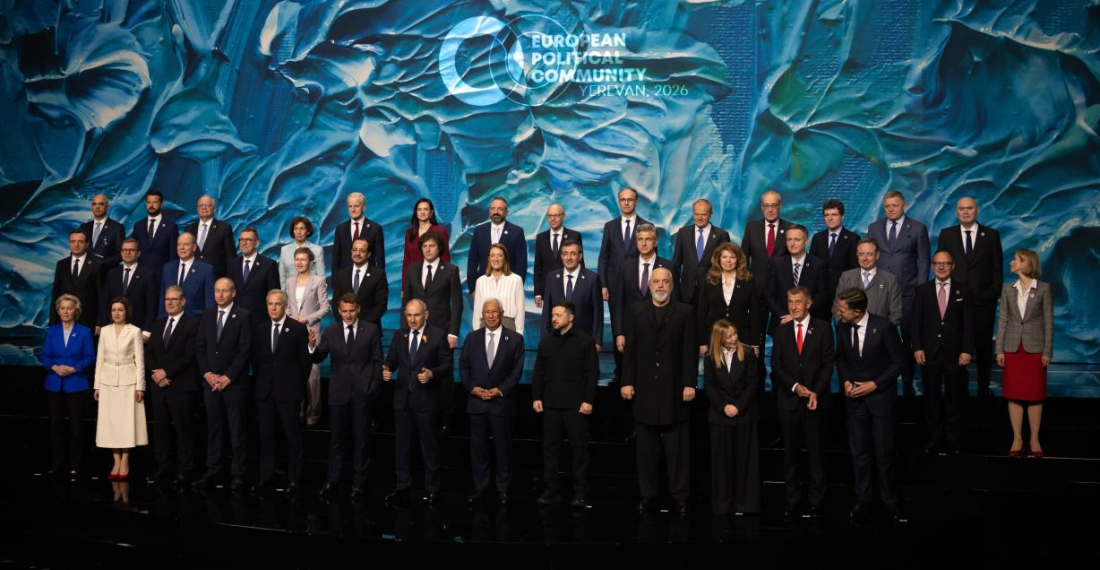
Leaders from more than 45 European countries and beyond gathered today in Yerevan for the eighth summit of the European Political Community (EPC). The summit was the largest gathering of European leaders ever held in the South Caucasus. Apart from the set piece events in plenary session, many leaders also held private bilateral meetings. commonspace.eu special correspondent, Alex Verge, was at the summit, from where he filed this report:
European Union Commission President Ursula von der Leyen, France President Emmanuel Macron, Italian Prime Minister Giorgia Meloni, UK Prime Minister Keir Starmer, and Ukrainian President Volodymyr Zelensky were amongst the myriad of European leaders that gathered on Monday for 8th summit of the European Political Community. Prime Minister of Canada Mark Carney was also present, making him the first non-European leader to take part in an EPC summit.
The summit marked the first of two days of high-level diplomacy in Yerevan, with the city also hosting the first ever bilateral EU-Armenia summit tomorrow. Both summits are signals of support from Europe for the policies of Armenian Prime Minister Nikol Pashinyan, in power since 2018. In particular, the Pashinyan administration has looked to develop new foreign partnerships, reduce Armenia’s reliance on historic partner Russia, and pursue a difficult peace process with Azerbaijan. A polarising figure in Armenian politics, Pashinyan is seeking re-election in June this year in parliamentary elections.
Bringing together all the EU member states and other European countries - including the UK, Balkans and South Caucasian states - the EPC was initiated by France President Emmanuel Macron in 2022 following the launch of the War in Ukraine. It aims to provide a regular forum dedicated to discussing common strategic and security interests. Although met with scepticism at first, the summit has continued to see strong attendance from world leaders over the years. According to Chatham House Associate Fellow Sébastien Maillard, the EPC’s informal and interpersonal format have proven useful for European countries to discuss critical matters and express political solidarity over international matters.
International developments since 2022 no doubt explain the continued relevance of the EPC. Speaking to reporters upon arrival at the summit venue, UK Prime Minister Starmer said Europe now faced war “on two fronts”, referring to Ukraine and Iran, and reiterated the need for coordinated responses. President Macron in turn urged the US and Iran to coordinate to re-open the Strait of Hormuz and ruled out French participation in a military solution.
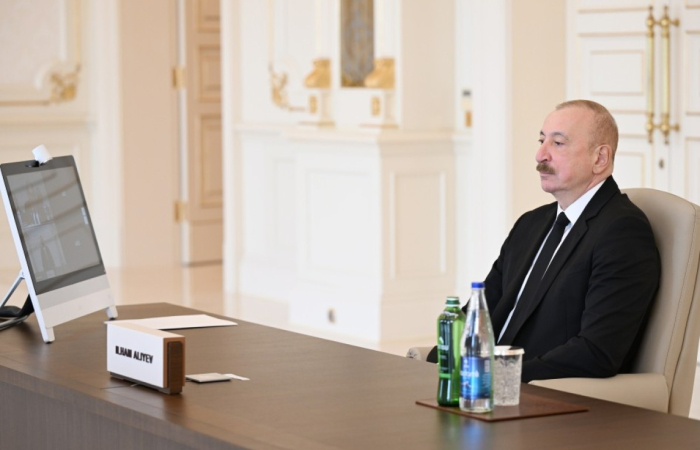
The main event during the morning of the summit was a plenary session held under the theme of “Maintaining European unity and coherence in times of polycrisis.” Opening remarks were delivered by Armenian Prime Minister Nikol Pashinyan, European Council President Antonio Costa, President Zelensky, President of Azerbaijan Ilham Aliyev - who joined via video call - and Prime Minister Carney.
In their remarks, each leader expressed support for the ongoing peace process between Armenia and Azerbaijan, which gained significant momentum in August 2025 with the signing of a provisional agreement under the aegis of the United States. President Zelensky also called for continued pressure from Europe to push Russia towards a diplomatic solution, adding that the country was increasingly suffering both economically and militarily. In his remarks, Prime Minister Carney said it was fitting that Canada was the first non-European country to take part in an EPC gathering, underling his country’s deep alignment and economic and security complementary with the region.
The opening session also featured a panel moderated by President of Cyprus Nikos Christodoulides, with President von der Leyen, President Macron, Prime Minister Meloni and Prime Minister Starmer as panellists. The leaders focused their answers on the need for Europe to reduce its overdependencies and achieve strategic autonomy in critical sectors - including defence and energy. They also spoke of the need to continue to find common alignment and solutions to deeply interlinked problems, among which democratic backsliding, economic competitiveness, hybrid external threats and irregular migration.
President Macron provided the most direct responses. He referred to uncertainty over US security commitments towards Europe and other allies as the “elephant in the room.” On Armenia, the French president referred to the work of the Pashinyan administration as “very impressive”, adding that prior to 2018 the country was viewed as “a sort of de facto satellite of Russia.”
In an otherwise agreeable opening session, President Aliyev accused the European Parliament of preferring to sabotage rather than support the peace process with Armenia. Aliyev thanked Armenia and the European Commission for their part in the process, but said that the European Parliament had repeatedly slandered and lied about his country since the Second Nagorno-Karabakh War in 2020. As Pashinyan was closing the plenary session later on, European Parliament President Roberto Metsola interjected to vigorously address Aliyev’s criticisms and defend the democratic character of European parliamentary resolutions.
Aliyev’s remarks come after a row erupted last week in response to a European Parliamente resolution adopted on 28 April. The resolution, although expressing support for the peace process, reiterated support for the rights of Nagorno-Karabakh Armenians and condemned the “unjust detention of Armenian prisoners of war” by Azerbaijan. Both issues remain key sources of tensions in Armenia in relation to the peace process and normalisation of ties with Azerbaijan.
During the afternoon, the summit featured a host of roundtable discussions, bilateral and multilateral meetings, held without media in attendance.
source: commonspace.eu special correspondent, Alex Verge, was at the EPC summit, from where he filed this report
photo: Family photo from EPC summit in Yerevan on 4 May 2026.