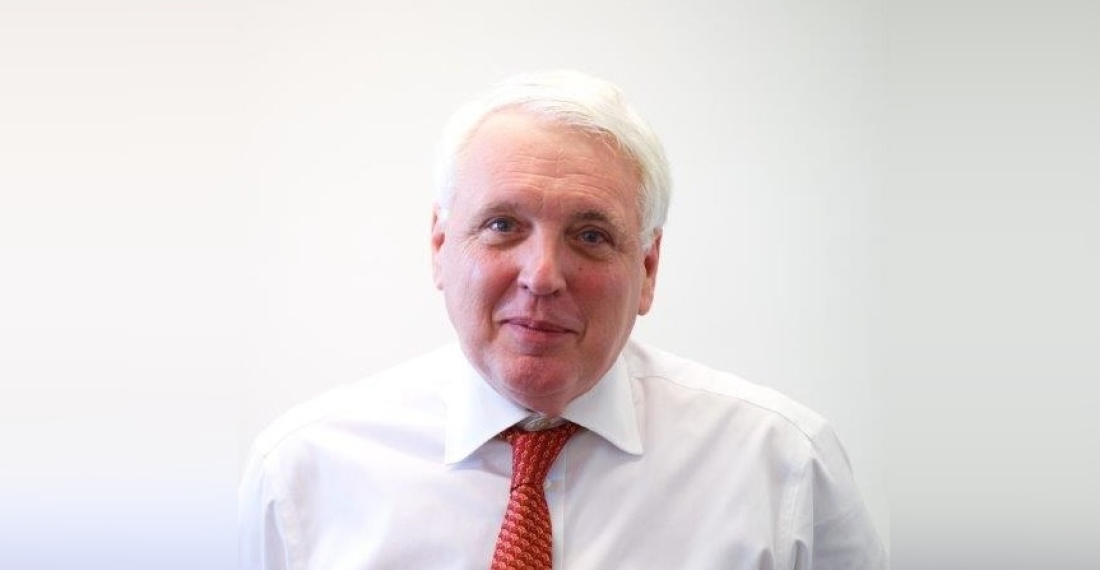
Tensions are rising in Iran and across the Middle East, uncertainty hangs over Donald Trump’s commitment to the Euro-Atlantic security umbrella, and war continues along Europe’s eastern border. Against this backdrop, commonspace.eu spoke this week with Dr. Jamie Shea, the former Deputy Assistant Secretary General for Emerging Security Challenges at NATO (North Atlantic Treaty Organization), about what lies ahead.
He held several senior positions during a 38-year career at NATO, and represented the Alliance on the international stage as its spokesperson during the 1999 Kosovo War, when he briefed the international press throughout NATO’s air campaign against Yugoslavia. Since retiring from NATO in 2018, he has continued his work as a professor, lecturer, speaker and adviser on European and transatlantic security affairs.
Dr. Shea discusses the strategic consequences of Russia’s war against Ukraine for NATO’s future, the need for the Alliance to adapt to a rapidly changing battlefield shaped by drones and technological innovation, and the importance of cooperation between NATO and the European Union in strengthening Europe’s defence capabilities.
He argues that instability in the Middle East could reshape the strategic balance for Europe:
“The one who smiles is Vladimir Putin, because an oil price of over $100 a barrel for a long period of time is going to refill the Russian war chest, as Putin funds a lot of his Ukraine war effort from his energy resources. You can see that the Americans have already lifted sanctions on Russia to allow Russia to export oil to India to keep international markets flowing.
This is what we call ‘robbing Peter to pay Paul’. Yes, it helps the situation in the Gulf temporarily. It removes pressure on the oil market. But the impacts of the war will also mean more inflation, higher energy prices, and higher gas prices in Europe.
You are then going to get a lot of European countries saying, ‘well, sorry, but I can’t spend 5 percent of GDP on my defence any longer.’”
Read the full interview below:
Welcome, Dr. Shea. My first question to you is, after decades of working inside the Alliance, what do you think is the single best idea that captures why NATO still matters today?
Well, I think NATO's greatest strength is to be a security community of big countries, medium countries, small countries, but which are all pulled together by a common interest in collective defence and collective security, based on the notion that protection in large numbers, like an insurance policy, is going to be a lot more effective than if they have to try to defend themselves alone.
I think that applies to large countries, even the superpower United States as well. The strength of the Alliance is that it gives all those countries, even the smallest ones, like Montenegro or Luxembourg, or Iceland for instance, a voice, a potential veto in debates, which means that everybody's interests have to be taken into account.
Nobody can be sidelined. Decisions have to be reached by consensus, which means only after proper discussion and proper analysis of plans and policies to make sure that they stand up to the test of relevance and effectiveness.
This said, a lot of people will probably answer your question by saying 'it’s all about defence and collective defence,’ that's true. Article 5 of the NATO Treaty, which provides for collective solidarity in responding to aggression, is the heart of the treaty.
For me, having been at NATO for 38 years, what really struck me was this idea of an organised security community, where problems are analysed together, discussed together, and common solutions are developed. That notion of equality among allies is the real reason NATO has lasted so long.
If you were to define the EU-NATO division of labour, what do you think NATO should do that the EU should not try to do, and what should the EU do that NATO cannot do as effectively? If the EU were ever to eventually develop a fully integrated defence capability, how should it relate to NATO — as a complementary pillar, or as a completely separate strategic actor from the Alliance?
It's a very topical question. It comes at a time when everybody's worried about the strength of the American engagement, and all of the talk about European self-reliance and European strategic autonomy. My view is that what NATO should do is the basic day-to-day military planning for collective defence. The reason is that NATO has the military infrastructure that the EU does not have.
It has big commands like SHAPE (Supreme Headquarters Allied Powers Europe) in Mons in Belgium. It has joint regional commands in Norfolk, Virginia; in Naples; and in Brunssum in the Netherlands. It has a network of land, air, and maritime headquarters across the Alliance, where thousands of officers, captains and colonels, are all working together, living together, day and night. It's this collective planning, this sort of military organization, which is very experienced in planning and very experienced in conducting operations. NATO has had these operations in the Balkans, in Afghanistan, in Iraq, in Libya, as well as collective defence in Europe.
This is a treasure trove of experience, and if you got rid of it, it would be almost impossible to recreate it. So that, I think, is what NATO should continue to do. In short, NATO should be responsible for the day-to-day collective defence arrangements for Europe.
Of course, there are big actors here that are not in the EU: the US, Canada, and obviously my own country, the UK, although I regret this personally after Brexit, but the UK alone accounts for about 25% of European defence spending and capabilities. You can't exclude the UK contribution. There's Norway, which is a very important actor. Indeed, this week a major NATO exercise called Cold Response, with ~25,000 troops, is taking place in Norway. And then, of course, Türkiye, which has the second-largest army in NATO, particularly at a time when events in the Middle East, Central Asia, and the Gulf are becoming more important for NATO security.
So, to my mind, NATO should stick to that: defence planning, exercising, training, mobilisation, conducting operations, and, if it ever happened, a war.
The EU role is basically to supply the resources. If I can give you the analogy of a football club. I'm a big fan of football, although my team is doing very badly at the moment.
You've got the football team on the pitch, which obviously has to play the game, score the goals, and try to win. But the football team can't function unless you have the stadium, somebody selling tickets to the fans, somebody buying and transferring players, somebody managing the finances, somebody running the bars and the restaurants in the stadium, somebody doing the marketing, the merchandising, and the promotion.
So behind every successful football team there is an extremely good business enterprise called the football club, which often has a brand. And to my mind, the EU is very much the football club, because what you see at the moment, particularly at a time when we're increasing defence budgets and trying to modernise our armed forces to cope with a larger Russian threat, there is a major need in Europe to manage capability programmes, to manage innovation, to provide common funding for greater investments in defence, to promote more multinational defence programmes and capabilities, and to bring civilian technologies — particularly in the drone area and artificial intelligence — closer to effective military applications.
And if nobody is doing this work in terms of promoting defence industry, getting defence industry to invest, and providing the long-term horizon for investments, then the football team on the pitch, even if it has some star players, is going to start losing games and run out of energy and skills, and not be renewed. It will weaken very, very quickly indeed.
And so I think this is where we are today: this symbiotic relationship between NATO for the immediate requirements, but the EU creating the defence ecosystem in Europe: investment, military–civilian technology, innovation, and multinational approaches through different defence consortia. This is going to keep that defence effort going over several decades, because given the nature of the Russian threat, this may not be something like a quick war, a Venezuela operation done and dusted in 24 hours. This could be an effort going on for a long time.
And therefore there is the need to keep modernising your forces, replacing equipment, and figuring out the relationship between traditional equipment and more innovative technical solutions. Europe also needs space capabilities for observation, early warning, targeting and communications. This is going to be very important indeed.
So I think that's pretty much where we're heading today. And the great thing for NATO is that the EU has grasped the nettle, as we say in English, by coming up with schemes like SAFE (Security Action for Europe), with €150 billion in funding for multinational projects. There is also the European Defence Industry Programme, and European decisions that allow countries to go into debt under EU rules to up to 1.5 % of GDP if this amount is allocated to defence investments.
These are very important things in providing those long-term capabilities for NATO.
Do you already see it happening, that the European pillar of NATO that's already been discussed for decades upon decades is becoming real?
I do, because clearly I don't think we're talking about an EU defence completely separated from the United States. The allies don't want this. It's true that there are questions about the American commitment.
But I speak to you today, on the 11th of March from Brussels, and today the Americans are sending ships and taking part in exercises in Norway for a NATO exercise. They've got the best part of 80,000 troops in Europe. They're still managing big bases, the second-largest American base outside the United States is at Ramstein in Germany, and it's still operating.
So from a day-to-day point of view, the Americans are still very much there providing security, participating in NATO commands, for instance in joint planning, and providing the nuclear shield, which is very important for deterrence as well.
What the Americans do is what the Americans do, but I don't think it is in Europe’s interest to try to conceive a European defence totally without the American contribution. As I said earlier, there would still be the question of what to do about the UK, what to do about Türkiye, and how far they would participate in all of that. Canada as well.
And the Europeans, I think, have got to be realistic. The International Institute of Strategic Studies in London has done a calculation that to replace all of the capabilities that the United States provides to NATO — reinforcements, satellite tracking, nuclear deterrence, ballistic and air defence, logistics, data fusion — the list is endless. It would cost $1 trillion. Not impossible, but difficult to replace all of those capabilities.
So I do think, yes, we're talking about a European pillar in NATO. And I think what has to happen is that the European units, elements and capabilities that are developed by the EU should correspond to NATO priorities and NATO military requirements, which the EU, by the way, has agreed to do, so there's no problem here. The EU says it will do this.
They should work to one single set of NATO plans, not duplicate different plans, and those capabilities should be designed to fit into the NATO command structure, like LEGO. Produce a new piece of LEGO, but make it in a way that is totally interoperable with other pieces of LEGO. That's the genius of LEGO as a game: everything corresponds to certain standards, and everything is instantly interoperable in different configurations.
I spent some time watching your lecture series, Jamie Shea’s NATO History Class. If you were updating your series today, what would you identify as the next major turning point for NATO? Russia's war against Ukraine, or something else entirely?
I think there are three things which are very important for NATO at the moment. I think I would start with Ukraine. I'm not claiming originality for this, because sometimes in military strategy, getting it right is more important than trying to be brilliant or original.
And I think Ukraine is the main thing, because clearly, if Putin wins in Ukraine and Ukraine becomes part of the Russian Empire, and Russian troops are on the border with Poland, Romania, and the Baltic states in the future, then the threat to NATO — and the cost of NATO's defence — with no Ukraine as a state between Russia and NATO, with no Ukrainian army to protect NATO as the first line of defence, means that the challenge and cost for NATO to deal with Russia as an immediate neighbour, as opposed to a distant neighbour, is going to spiral enormously.
If you're thinking, ‘how am I going to deal with an aggressive Russia,’ the first thing is not to lose the army which has the most experience and the most success at the moment in fighting Russia, and pushing Russians back. Nobody in NATO, not even the United States, has that kind of battle experience that the Ukrainians have acquired, tragically, over the last four years.
If Ukraine survives, if it has an army of 800,000 troops guarding a line of control in the Donbas in the future — not an ideal situation, but better than the alternative — which is supplied and trained and equipped by NATO, the strategic outlook for NATO, particularly for the Baltic states and for Poland, would be enormously better.
Frankly, if Putin does win in Ukraine and succeeds in showing that military force pays, then I do believe the risk to the Baltic countries, or Poland, or Finland becomes a big headache for NATO.
In insurance you have two approaches: you can either increase protection or diminish the risk. And diminishing the risk, where possible, is always a lot better, and a lot cheaper, than increasing protection against a risk which is greater. So I would start there.
I think the second big challenge for NATO is learning from Ukraine. I don't think NATO quite understands yet how Ukraine has changed the nature of the modern battlefield — with drones, with immediate equipment upgrades, with constant innovation, with getting the private sector on the front line to upgrade equipment, and mobilising the civilian economy behind the defence effort.
The old platforms like tanks, armoured personnel vehicles, and ships are now proving increasingly vulnerable. Look at Iran, where the American Air Force has destroyed the Iranian navy in a matter of 48–72 hours, because those ships are so vulnerable to precision missiles and drones.
The Ukrainians are constantly warning us that we are maybe not prepared to fight the Russian way of war. Russia is changing its army not after the war in Ukraine is over, but while the war in Ukraine is going on. Russia is modernising in situ every day. It's learning and adapting in the way it procures weapons, its tactics, its formations, and its command and control.
And NATO has to be careful not to think that military modernisation simply means producing the army we used to have during the Cold War. Let's get the tanks back, let's get all of the ships back, let's get all of the armoured personnel carriers back — the mass that we had.
Some of that may be necessary, but as we spend a lot of money on defence, making sure we spend on the right things, and not on obsolete equipment that is going to be less and less useful on the battlefield, turning up on the day ready to fight the adversary of tomorrow, not yesterday, is going to be key.
There was a NATO exercise in the Baltic states a couple of weeks ago which was alarming, where one single team of Ukrainian drone operators destroyed a NATO battalion (at least according to the scenario) in 24 hours. And the question is: is NATO prepared for that?
And I think that really is going to be the big issue: are we really prepared for the next war?
NATO needs to be very honest with itself and very rigorous in asking that question, because NATO is a big bureaucracy, and bureaucracies can sometimes be stuck in groupthink or tunnel vision.
Having people who play Team B, the Red Team, who ask those difficult questions and test assumptions before they become fossilised conventional wisdom is going to be important.
And then finally, the third element of your question, I think, is the hybrid warfare situation, because we already have a war going on in terms of Russia instigating all kinds of provocations against NATO.
Drones over airfields, sabotage operations, railway lines in Poland being blown up, cyber attacks, disinformation, ships in the Baltic interfering with cables. The list of these provocations is endless.
NATO has not yet found a way to really deter that kind of behaviour and activity, which is designed to test NATO's defences, sow divisions among NATO member states, and undermine trust in government as citizens increasingly suffer the consequences of these disruptions.
I think NATO has to be more agile in handling the home front and the civil dimension of warfare. Not just saying that if there's a classical military attack with lots of tanks across our border, then we respond — because that is the only scenario that we are organised for, both politically and militarily.
But this kind of grey-zone warfare that goes on every day now, no, we don't really have a response. We don't really know how to deal with it. We don't have the instruments, and therefore we are passive.
There needs to be a lot more focus on the home front and that civil–military interface, that grey-zone area, which is where the real war today is actually taking place.
So those would be my three elements.
Based on that, do you have some suggestions for NATO to improve adaptive capacity and learning from, for example, Ukraine, to integrate it faster into military planning today, instead of waiting until things go wrong?
Yes. We have this expression in the United Kingdom which says “the penny has dropped”. In other words, people have woken up.
I think that in NATO now there is this awareness. For example, much of the debate over the last couple of years, unfortunately, particularly over the last 12 months, has been about how to please Donald Trump, how to keep the Americans engaged, how to show Trump that the Europeans are serious about defence spending, and how to get to 5% (the proposed NATO target for countries to spend 5% of GDP on defence and security).
So there's been a lot of discussion about how do we get to 5%, and how do we prevent Trump from disrupting a NATO summit and making more threats about not defending the Alliance.
NATO has been very much like a rabbit caught in the headlights of a car, a little bit on the defensive, a little bit frightened, playing a very defensive game.
But the 5% target has now been agreed, albeit with Spain not signing up fully, but it's been agreed. Trump is now happier that his message has been heard. Defence budgets are going up.
Now I think NATO has to be less defensive, less fearful, less on the back foot, and more focused on pushing forward with concrete plans and ideas about how we are going to spend the money, who is going to do what, and how we are going to make sure that we don't waste the money.
The taxpayers won't be happy with that.
How are we going to stimulate the defence industry? How are we going to test, through exercises and logistics, our ability to carry out our defensive mission?
And I hope that the next NATO summit in July in Ankara will be not just a two-hour event, because everybody's worried that Trump could be disruptive and wreck the show, but a proper summit with real discussion, with ideas and plans to move forward, showing that NATO has got over its Trump fright.
But of course that also depends, to some degree, on the willingness of the United States to adopt a positive attitude.
If the United States turns up in Ankara announcing a lot of American troop withdrawals from Europe, or taking out a lot of air defence to send to the Gulf states or Israel in the wake of the Iranian campaign, or taking a lot of American ships out of the Mediterranean to put into the Gulf — if we have that kind of “guys, you're on your own, we've got other priorities” — then that would not set the right atmosphere.
The Europeans have got to develop a more positive agenda.
But we do need the Americans now to turn the page on this defence spending issue and also play their part in helping NATO develop the plans to move forward.
Finally, with violence spreading across the Middle East and Iran targeting infrastructure and regional partners, how concerned should NATO be about the risk that this conflict spills into the Euro-Atlantic security environment, and do you believe there's a plan in place to deal with that possibility?
I personally don't think there's a big risk of spillover, because Iran is a very isolated country. It has no friends. The only friends of Iran are Hezbollah, Hamas, the Houthis, and some of the groups in Iraq, and frankly they are also considerably depleted by Israeli strikes over the last couple of years since the attacks on 7 October 2023.
If you look at international actors, Iran has only one friend, which is Russia. Putin has given no assistance to the Iranians. Not one drone or missile. He's taken drones from Iran, particularly the Shahed-136 drones, but he's not given anything back.
So if you're a Gulf country, you think, well, can I rely upon Russia when push comes to shove? No.
China has offered to be a mediator. It consumes Iranian oil. But there's no particular sign of China rushing missiles to Tehran to help it defend itself.
So because Iran is very much alone, it's militarily very weak. Yes, it can cause a bit of disruption. It's sent a couple of drones in the direction of Cyprus, and two ballistic missiles in the direction of NATO ally Türkiye.
But can it really afford, at a time when it's being completely pulverised by American and Israeli bombing, to spread the war to Europe and bring France, the UK and Germany down on its head, getting them to participate directly in the war?
When thankfully, so far, they have been on the sidelines and very cautious. I cannot see what interest Tehran would have in provoking the Europeans. Frankly the strikes against NATO have been very small compared with the attacks on the Gulf states.
If Tehran wants economic warfare, the Strait of Hormuz, the Saudi oil terminals, the Qatari gas terminals, that's where you do it.
You don't need to go to Europe.
And of course Europe is also now sending a lot of ships, the French, the British now with HMS Dragon, to the Eastern Mediterranean with air defence assets. That is also going to make it very difficult for Iran to attack NATO targets.
So I don't see the overspill there, and I think the problems are more at the geostrategic level.
What worries me about Iran is the diversion of the United States back to the Middle East, with more American involvement. The Qataris said yesterday that they want more protection from the United States.
If Zelenskyy wants to buy a Patriot air defence system Trump may say, “I'm very sorry, but Qatar is now top of the priority list for more Patriot air defence systems”.
I'm a bit worried about the consequence of rearmament in the Gulf on the capacity of the United States to supply Ukraine, at a time when Ukraine is very dependent on that type of equipment.
If the oil price remains high for a long time, the one who smiles is Vladimir Putin, because an oil price of over $100 a barrel for a long period of time is going to refill the Russian war chest, as Putin funds a lot of his Ukraine war effort from his energy resources. You can see that the Americans have already lifted sanctions on Russia to allow Russia to export oil to India to keep international markets flowing.
This is what we call ‘robbing Peter to pay Paul’. Yes, it helps the situation in the Gulf temporarily. It removes pressure on the oil market. But the impacts of the war will also mean more inflation, higher energy prices, and higher gas prices in Europe.
You are then going to get a lot of European countries saying, ‘Well, sorry, but I can’t spend 5 percent of GDP on my defence any longer.’ ‘Sorry President Trump, I can't keep my target because my inflation problem is growing.’ This would mean higher costs for defence as well.
My pensioners need subsidies for their energy bills, unemployment is rising, welfare costs are going up. Butter is more important than guns as a priority. Welfare is going to be much more important for the voters.
So I worry not about the immediate risks of military escalation, but about those long-term consequences — a weaker Ukraine, a weaker Europe, a less engaged United States — a long-term corrosion rather than a short-term shock.