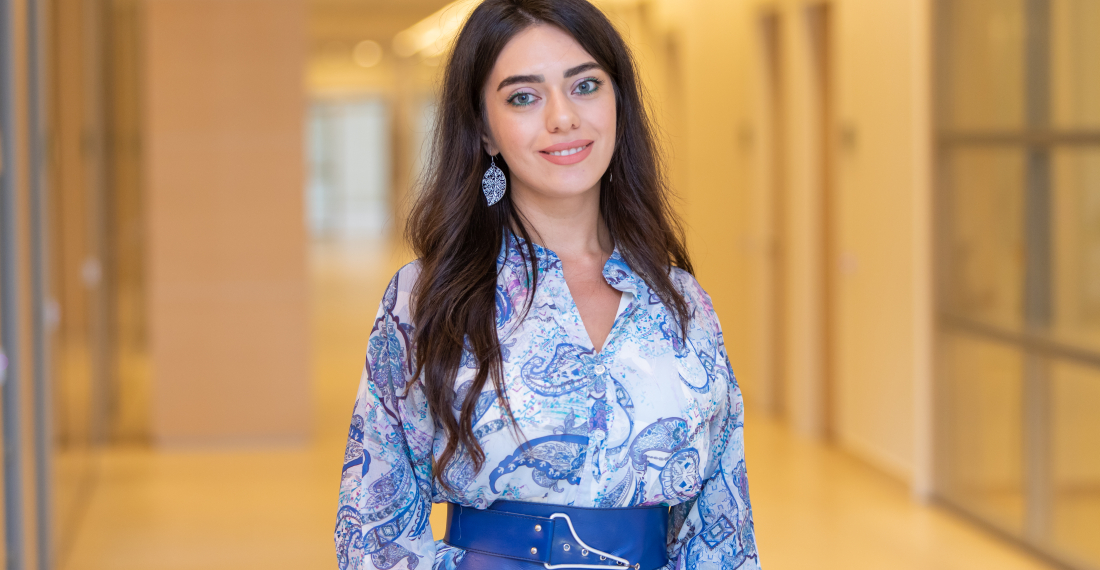
Ahead of International Women’s Day on 8 March, commonspace.eu spoke with Fidan Namazova, an Azerbaijani peace-building practitioner and researcher, about women’s inclusion in regional dialogue, environmental cooperation as a pathway to confidence-building, and her work on gender-sensitive urban development in the South Caucasus. She was joined in conversation by Alexandra Dumitrescu, Program Manager and International Coordinator at LINKS Europe.
Ms. Namazova has been closely involved in LINKS Europe’s Thematic Groups for a New Armenian–Azerbaijani Dialogue, serving as Chair of the Thematic Group on Environment. In this capacity, she contributed to shaping the Report of the Thematic Group on Environment, advancing the idea that environmental cooperation can provide practical entry points for rebuilding trust and fostering sustainable peace between Armenia and Azerbaijan.
"My message to young women starting their careers is simple: no one can stop you. Keep learning, keep working on yourself, believe in your abilities, and aim to make the world a better place for yourself and for future generations.”
Read our full conversation with Ms. Namazova below:
Thank you for joining us, Ms. Namazova. To begin, what motivated you personally to engage in peace-building and regional dialogue efforts with LINKS Europe and beyond? And based on your experience, how inclusive do you find these processes for women? Do regional dialogue platforms in the South Caucasus truly make space for women’s voices and leadership, or is there still a structural gap in your opinion?
Thank you for the invitation. I am Fidan Namazova, from Azerbaijan. I grew up in a conflict-affected country, and that is the very first reason I became interested in peace-building.
There is also a personal story behind this. My father’s side of the family is originally from the Karabakh region. I grew up surrounded by relatives who were internally displaced persons (IDPs), so from an early age I was closely aware of the problems and needs of people in the region, especially within displaced communities. That left a deep imprint on my worldview and future approach.
Later, my academic background supported these interests, and I began working directly with IDP women’s communities. In that sense, my career path was built from a personal story that gradually developed into professional engagement. Until today, I remain committed to ensuring that women’s needs, especially those of vulnerable women, are voiced and taken into consideration, both within the community and more broadly.
Regarding inclusivity, I would say that current processes are relatively inclusive for women. We now see many female peace-builders from both sides nowadays. However, it would be important to ensure broader representation, women from different backgrounds, with diverse experiences, and from different strata of the population. At present, representation is still more urban. It would be valuable to include more women from rural areas and vulnerable groups, particularly IDP communities and women with disabilities. Inclusivity should be understood in a broader sense.
As for structural gaps, they exist everywhere. But I would certainly prefer to see women’s voices more strongly represented. Today, many discussions focus on security, transportation, and regional connectivity. We still lack sufficient attention to human security issues such as poverty and food shortages. Bringing these issues more prominently onto the agenda would significantly enrich the peace process.
Let’s turn to your work with LINKS Europe’s Thematic Groups for a New Armenian–Azerbaijani Dialogue. Environmental policy is not traditionally the first area associated with post-conflict reconciliation. Why do you believe that topics such as ecology, climate change, shared water systems, and environmental education might succeed in bringing people to the table when purely political dialogues often struggle?
Security and military issues are still prevalent today, but over time their urgency may diminish. Climate change and regional environmental challenges, however, will remain pressing concerns. These are joint problems affecting the entire region and both countries (Azerbaijan and Armenia) directly.
Environmental issues have a direct impact on people’s daily lives. For example, energy security is becoming a major concern for both countries. Azerbaijan is currently facing serious water scarcity that has reached critical levels. Armenia faces deforestation and desertification, which are also linked to climate change. Over recent decades, both countries have experienced record increases in average temperatures.
These shared environmental vulnerabilities can become a basis for cooperation. Through joint dialogues, projects and common initiatives, countries can transform environmental challenges into opportunities for sustainable peace-building.
For example, Armenia could support Azerbaijan in areas related to water security, while Azerbaijan could assist Armenia in energy security. Such cooperation could open dialogue from a different perspective, one focused on solving common, practical problems and building solutions together. This, in itself, can become an integral part of the peace process.
Returning to women’s representation more broadly: given your research interests in women’s empowerment, how do you assess progress in representation within public administration and academic leadership in Azerbaijan and the wider South Caucasus?
Over the past decades, we have seen more women represented in public administration and academic leadership in Azerbaijan. Many women obtain PhD degrees abroad and return to work in the country, which is encouraging.
In addition, it is nice to see that now students of mine come and ask me about the peace initiatives taking place and how they can participate. This is relatively new, but it has been happening more and more. I think it is very important to have the youth engaged in these processes, especially as they themselves are encouraged to actively participate.
However, the challenge lies in the areas of representation. Women remain underrepresented in STEM (Science, Technology, Engineering, and Mathematics) fields and in security-related institutions. Traditionally male-dominated sectors are still largely controlled by men, while women are more present in so-called “female-accepted” professions. The government tries to incentivise women to study these subjects, but still, there is a gap which should be worked on. More or less, it is still the case in the entire region that women turn to these more “female-accepted” professions. Based on my observations, this pattern is similar across other countries in the region as well.
When we last spoke, you mentioned that you were considering pursuing a PhD focusing on women and urban spaces. Could you tell us more about this research idea?
Yes, thank you. Like much of my work, this research is also inspired by personal experience. As a woman living in a city, you encounter everyday challenges. Over time, you begin to analyse these experiences, and that is how my research interest developed.
I will be presenting this research at the World Urban Forum in Azerbaijan in May. My work focuses on how to design cities that are more inclusive for women, particularly in terms of urban planning, safety, and accessibility. In terms of the design, in terms of urban opportunity and security to ensure that the cities are comfortable, accessible and safe for women, and so that they do not create additional problems in women’s daily lives.
In many post-Soviet cities, including Baku, urban development has historically been shaped primarily by male perspectives, without sufficient analysis of women’s needs and concerns. The lack of a gender-sensitive approach has made cities less convenient and, in some cases, less safe for women.
My research explores possible solutions, the resources required for proper implementation, and ways to ensure that urban planning becomes safer and more comfortable for residents, especially for women.
I am starting with Baku. Even though Baku is the most developed city in Azerbaijan, women still face significant urban challenges. The recommendations developed there could later be adapted and implemented in other cities as well.
Finally, ahead of International Women’s Day, what advice would you give to young women interested in pursuing careers in international affairs, academia, or STEM fields as you said?
One of my favourite quotes is from Ayn Rand: “The question is not who is going to let me; it's who is going to stop me.”
I think this captures one of the biggest challenges women face. My message to young women starting their careers is simple: no one can stop you. Keep learning, keep working on yourself, believe in your abilities, and aim to make the world a better place for us and for future generations.
Believe in yourself and keep going.
Follow Ms. Namazova on LinkedIn