


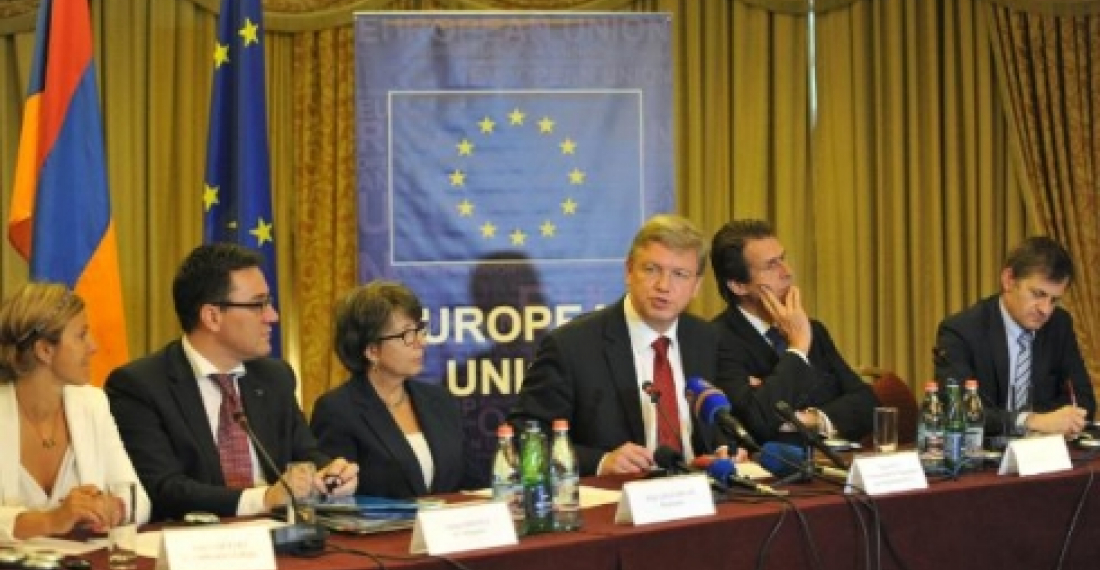
ФЮЛЕ: "Мы в этом вместе". Комиссар ЕС обратился к гражданскому обществу Армении; ЕС хочет всеобъемлющего партнерства.

Комиссар ЕС Штефан Фюле на этой неделе побывал на Южном Кавказе, где провел встречи с руководством Армении и Грузии, а также с представителями гражданских обществ этих двух стран.

В среду, в отеле Marriot в Ереване, Фюле выступил с речью перед представителями гражданского общества, студентами и мозговыми центрами. В своем выступлении Фюле обратился к представителям неправительственных организаций и подчеркнул важную роль, которую они должны играть в развитии отношений ЕС-Армения.

В своем выступлении Комиссар Фюле заявил:

"Мы очень близки к завершению нашего Соглашения об ассоциации, включающую углубленную и всеобъемлющую зону свободной торговли. Я уверен, что это принесет конкретные выгоды и новые возможности для всех граждан.

В дополнение к предложенному важному партнерству в торговле с ЕС - это рынок с 500 млн. потребителей, соглашение рассматривает многие конкретные вопросы, которые влияют на повседневную жизнь. В результате, например, защита прав потребителей, как с точки зрения безопасности продукции так и соотношения цены и качества или безопасность дорожного движения... Более того, это соглашение будет также способствовать укреплению связей между народами Армении и народами Европы.

Для Европейского Союза это партнерство не только экономическое, бизнес и нормативная база. Если мы серьезно подойдем к реализации наших обязательств, а мы должны быть серьезными в этом, то наши политические и торговые отношения станут намного сильнее: через конвергенцию экономических и правовых систем наших партнеров с Европейским Союзом и эффективный обмен ценностями. Права человека, демократия и основные свободы будут так называемыми "основными элементами" нашего нового Соглашения, другими словами, абсолютное ядро, которое обе стороны должны уважать и поощрять.

На Соглашение об ассоциации и глубокую, всеобъемлющую зону свободной торговли, которое это соглашение включает в себя, ушло много времени, чтобы договориться. Мы работаем с нашими армянскими партнерами, чтобы определить набор реформ, которые не только открывают новые возможности в плане доступа на рынки, мобильность и сотрудничество, но которые также позволят Армении использовать эти возможности в усилении государственных учреждений, рынка труда, и инфраструктуры.

Одна из причин, по которой я так сильно заинтересован, чтобы мы довели до конца эти переговоры и смогли подготовить Соглашение в его окончательной форме и поделиться его содержанием с гражданами - Я верю, что оно [соглашение] откроет новую главу ни только в отношениях Европейского Союза с Арменией, но и в собственном развитии Армении.

И мы готовы не только оказать финансовую поддержку, но и поощрять других международных доноров поддержать проекты реформ. Это может быть твердой основой для среднесрочного планирования, уделяя особое внимание общим целям...

Позвольте мне добавить несколько слов о более широком контексте нашего партнерства. Как вы знаете, отношения ЕС-Армения развиваются в рамках Восточного партнерства, то есть восточного направления Европейской политики добрососедства. Такое построение политики имеет большое значение как для Европейского Союза, так и для партнеров, потому что это позволяет нам вывезти наши отношения на новый уровень.

В дополнение к политическим аспектам нашего диалога с и между нашими восточными партнерами, есть еще и очень практичное сотрудничество по секторам, которое сейчас находится в стадии реализации в различных сферах, начиная от транспорта, заканчивая образованием. Например, в сентябре этого года в вашей прекрасной стране состоится неформальная встреча министров образования стран Восточного партнерства, на которой буду присутствовать я и  комиссар Василиу. На ней мы совместно будем стремиться к дальнейшему повышению возможностей для сотрудничества между ЕС и нашими партнерами в сфере высшего образования.

В конечном счете, Восточное партнерство позволяет нашим партнерам объединить усилия с Европейским Союзом политически и экономически. И вместе, Европейский союз и его партнеры, будут в лучшем положении, чтобы противостоять вызовам и возможностям. Само собой разумеется, я вижу серьезные основания для участия в многостороннем формате такого рода страны, не имеющей выхода к морю, чьи границы с двумя из своих соседей в настоящее время закрыты.

Позвольте мне также воспользоваться этой возможностью, чтобы развеять миф о том, что Восточное партнерство работает на основе универсального подхода, который ведет к однообразным отношениям и не учитывает индивидуальные особенности каждого из партнеров. Наоборот! Несмотря на то, что мы используем единый набор инструментов, в том числе в вопросах мобильности, приближения к стандартам и ценностям Европейского Союза, мы работаем с партнерами над поиском индивидуальных решений. Дифференциация – это ключевая концепция Восточного партнерства, и Армения не является исключением".

Фюле также воспользовался возможностью, чтобы прояснить отношение Европейского Союза к армяно-российским отношениям и заявил, что ЕС не просит Армению ослаблять свои отношения с Россией. Говоря о нагорно-карабахском конфликте Фюле сказал:

"Я не могу закончить не сказав ни слова о конфликте. Я знаю, что это болезненная и сложная тема, и это то, от чего Европейский Союз не может скрыться ни в Баку и ни здесь, в Ереване. Я призываю Армению активизировать усилия с Азербайджаном в достижении соглашения по Мадридским принципам, в соответствии с обязательствами, взятыми  президентами Армении и Азербайджана в рамках Минской группы. Мы будем продолжать оказывать помощь для стимулирования прогресса в урегулировании конфликта, а также поддерживать активность по построению мира".

Политический редактор Commonspace.eu в комментарии сообщает:

"Это, наверное, последний визит комиссара Фюле в регион в преддверии саммита Восточного партнерства, который пройдет в ноябре, в Вильнюсе. Этот саммит станет историческим для всего Южного Кавказа, так как он позволит региону стать ближе к ЕС, политически и экономически, как никогда прежде. Строительство этих отношении не является прерогативой только правительств, гражданское общество также играет важную роль. Посланием Фюле в Армении было "Мы в этом вместе". Отношения ЕС со странами Южного Кавказа вступают в интересную новую фазу. Еще многое предстоит сделать, но возможностей от этих отношений будет очень много."

Во время своего визита на Южный Кавказ Комиссар Фюле также посетил Грузию.


Источник: commonspace.eu по материалам Пресс-службы Европейского союза.

фото: Комиссар Фюле на встрече с представителями гражданского общества в Ереване, 10 июля 2013 года. (фото любезно предоставлено пресс-службой Европейского союза).

Latest

Editor's choice
Monday Commentary
Monday Commentary: PEACE IN OUR TIME?

Monday Commentary: PEACE IN OUR TIME?

Making peace between Armenia and Azerbaijan was never going to be simple, nor easy, nor quick. It is taking time, writes Dennis Sammut in this Monday Commentary. “There is a sense of realism coming from the leaders of the two countries – President Ilham Aliyev of Azerbaijan and prime minister Nikol Pashinyan of Armenia, that frankly, is necessary and welcome”, he writes. At a time when conflicts are raging all over the world – from Ukraine to the Gulf, from Africa to South Asia, the prospect that Armenia and Azerbaijan had finally, after decades of conflict that left thousands of dead and many more displaced, decided on embarking on a journey of peace was welcomed. Peace between Armenia and Azerbaijan can be top-down up to a point. Both leaders have spent political capital preparing for a peace deal. But both are aware that their people are not ready for peace yet. In fact, in Armenia, most of the elite are negative toward a peace deal with Azerbaijan. Pashinyan needs time to persuade his countryfolk. That is why 2031 is realistic. Ilham Aliyev runs a tighter shop, but he is also not immune to public opinion. Every time someone hits a landmine in Karabakh, which unfortunately happens often, peace comes into question. Which is why Aliyev chooses to sound hardline, more often than not. In pursuing the peace agenda, both Aliyev and Pashinyan need to proceed cautiously. But they are right in making peace the central issue in their agenda. It is the main issue, and the one that will define them in history. So forward, cautiously but resolutely! In pursuing the peace agenda, Aliyev and Pashinyan need to be supported clearly and unambiguously. There are too many people in Baku and Yerevan who are sitting on the sides, waiting. The international community is not doing enough. It is time to be counted. Otherwise, the spoilers will win, and the region will go back to its bad habits. (Click the image to read the full commentary).

Popular

Editor's choice
Monday Commentary
Monday Commentary: European-Azerbaijan relations need an intensive and multifaceted dialogue that is frank and honest

Monday Commentary: European-Azerbaijan relations need an intensive and multifaceted dialogue that is frank and honest

Last week I visited Baku, Azerbaijan. My visit was relatively short, but very intensive, and had many meetings with stakeholders and colleagues. When I arrived in Baku first time in 1996,  Azerbaijan was a different country: weak, poor, and shaken by defeat in war. For thirty year the Karabakh issue dominated the agenda: the political agenda but also the popular mindset. Now, thirty years later, Azerbaijan has returned to Karabakh, and peace with Armenia is on the horizon. It is a new era for Armenia-Azerbaijan relations, for the South Caucasus, but also for Europe.  But we cannot be complacent: the Peace agreement has been initialed but not signed; borders remain closed; TRIPP is ambitious but remains an idea; and there are spoilers who want to turn the clock back. We must not allow them, and in this Europe and Azerbaijan must work together. Europe’ vanguard organization is the European Union – it is a free union of 27 member states; it is a strong global economic force, and increasingly a diplomatic and military force too. But it remains “work in progress” and can often appear dysfunctional. It often lacks collective and institutional memory. In its dealings with Azerbaijan the EU has made many mistakes – not least opening the delegation here late – in 2008. It sometimes appears condescending. Some utterances from the European Parliament and from some quarters in some member states are not understandable even for me. They irritate the Azerbaijanis, but serve no other purpose But Azerbaijan has also not handled relations with the EU well. It has failed to respond when the hand of friendship reached out; and it confused irritating actions, sometimes by well-meaning people; sometimes by outright spoilers, with strategic action. In short, EU-Azerbaijan relations have suffered from a lack of proper dialogue. This dialogue must be frank, honest and multi-faceted involving different segments of society on both sides.   Is Azerbaijan Europe? When Azerbaijan applied to join the Council of Europe in the 1990s, there were some who opposed, saying this was not Europe. I was one of the people who argued that Armenia and Azerbaijan may be on the periphery of the continent geographically, but were European in essence. Certainly their elites. During the discussion on 4 September in Baku, my friend Farhad Mammedov, mentioned that Azerbaijan is not interested in joining the EU, and was now close to the Central Asian countries in the 5 plus 1 format. Neither things mean that Azerbaijan is not Europe. There are several European countries that are not in the EU, and do not want to be, for example Norway and Switzerland. Iceland has recently voted to stay out of the EU. The UK was a member and left. Europe is bigger than the EU, and the holding of the European Political Community summit in Baku in 2027 proves that. Despite all the rhetoric, I never heard the president of Azerbaijan  saying that Azerbaijan is not Europe, nor have I heard any European president say it either. Not wanting to join the EU and forging close relations with neighbouring regions does not make Azerbaijan any less European. It is only logical that when Europeans talk to Azerbaijan they talk like family. The conversation is often frank. It must also be honest, and Europeans need always to remember this too. A frank, honest and multi-faceted dialogue A frank, honest and multifaceted dialogue will contribute to relations between Azerbaijan and the rest of Europe: it will avoid misperception, which unfortunately is very common on both sides; it will provide a forum where problems can be discussed and resolved, and it will increase mutual trust, so that together common problems can be addressed. (click image to read the full Monday Commentary)
Editor's choice
Monday Commentary
Monday Commentary: “The barren rocks of Aden” and “These lands of Yemen are so ruthless”

Monday Commentary: “The barren rocks of Aden” and “These lands of Yemen are so ruthless”

There are two early 20th-century tunes that mark foreign attempts to occupy and “pacify” Yemen. The Scottish tune “The barren rocks of Aden” marks the mobilisation of Highland soldiers, enlisted to be deployed to the Yemeni port of Aden, that in 1837 became the last colony to be incorporated into the British Empire. The tune talks of the harshness of the terrain, but is celebratory, It was even played as a farewell tune to Sir William Luce at the parade in Sharjah celebrating his end as “British Viceroy” in the Middle East in 1966. The second tune is an Anatolian lament. As Ilker Sezer reminded us this weekend, in his weekly feature on “Turkiye Today”, it “mourns the tragic fate of Ottoman soldiers dispatched to the harsh, remote deserts of Yemen during the fall of the empire, young men who marched away from their villages and never returned home. Most of their names, and numbers, were never recorded. Yet, their fate left a mark on the Turkish psyche.” Subsequent invaders have discovered that Yemen is a grave that cannot be overcome by the strength of modern technology, and that whilst Yemeni society is splintered and divided, building a reliable alliance with Yemeni factions is difficult. These are the harsh lessons facing Saudi Arabia, as the Kingdom faces its biggest challenge in its modern history. The leadership of the Kingdom now has to respond decisively. At stake is their very credibility. This is likely to be a long and messy conflict. Saudi military objectives need to be focused: to box in the Houthis rather than destroy them. This is likely to include: (a) regaining territory lost on the Red Sea coast; (b) control over Bab el Mandeb Strait; (c) some kind of cordon sanitaire on the Saudi-Yemeni border; and if things go well (d) the capture of Sanaa. All this would not eliminate the Houthi problem, but it will contain it. In the end the Saudis will have to continue managing Yemen with a mixture of carrot and stick. For the moment, the stick is likely, but the carrot cannot be forgotten either. (click the image to read the Monday Commentary in full)

