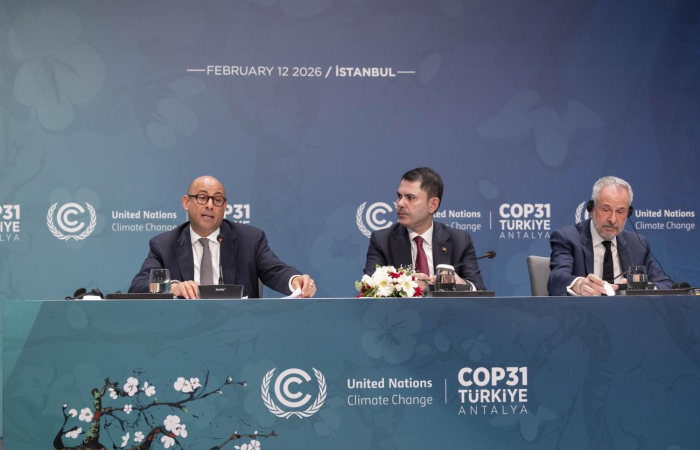
Discussions at COP 31 in Antalya, Turkiye, have so far focused on climate finance, methane reduction and the transition to cleaner energy, The World Leaders' Summit is taking place on 11–12 November. More than 90 heads of state and government are expected to participate in the high-level segment, although several prominent leaders, particularly from major European economies, will be absent.
UN Secretary-General António Guterres called for faster action to phase out fossil fuels, stressing the need to limit the scale and duration of global temperature overshoot. His remarks came as new scientific findings indicated that global fossil fuel carbon emissions had remained broadly stable in 2026, highlighting the gap between current progress and the objectives of the Paris Agreement.
Among the key developments was Kazakhstan's launch of the Qazaqstan Just Energy Transition Investment Platform (QaJET), established through a memorandum of understanding with the European Bank for Reconstruction and Development (EBRD) and other international partners. The initiative aims to mobilise approximately $20 billion for the country's energy transition. Kazakhstan estimates that achieving its carbon neutrality target by 2060 will require around $600 billion in investment.
Waste management and methane emissions have also been featured on the agenda. Senegal presented its forthcoming National Organic Waste Management Strategy, comprising 10 strategic pillars and 59 actions designed to improve municipal waste management, reduce methane emissions and support resource recovery. Separately, a new briefing by the Subnational Methane Action Coalition highlighted initiatives in Brazil, Argentina and Spain, calling for stronger national targets, improved emissions monitoring and greater financial support for regional authorities.
A session organised by the Climate and Clean Air Coalition (CCAC), UNEP and UNICEF also examined methane emissions from wastewater and sanitation systems. Preliminary findings estimate that these systems account for 7–10% of global methane emissions and 3–7% of nitrous oxide emissions. Existing solutions, including wastewater pond covers and treatment wetlands, could offer relatively cost-effective reductions.
Attention also turned to climate resilience in the Pacific, where representatives from Palau and Tuvalu discussed renewable energy, coastal adaptation and access to international financing. Tuvalu outlined plans to develop climate-resilient communities incorporating housing, water security and emergency preparedness.
Meanwhile, the (lack) of attendance by world leaders highlighted contrasting political commitments to climate action. Brazilian President Luiz Inácio Lula da Silva, whose recent re-election has encouraged climate campaigners, is expected to promote deforestation reduction and climate justice. However, US President Donald Trump and China's President Xi Jinping are not present at the summit, with Beijing represented by Vice-President Han Zheng. European Commission President Ursula von der Leyen will attend, while several leaders from major EU economies, including France, Germany and Italy, are absent.
The summit also faces questions over the credibility of national climate commitments. In the UK, reports that the government is considering substantial reductions to its electric vehicle targets have raised concerns about its commitment to decarbonisation. These tensions are little mitigated by Türkiye’s voluntary initiative to increase electricity's share of global energy consumption to 35% by 2035.
Source: commonspace.eu with France 24 (Paris), Climate & Clean Air Coalition (Paris) and The Guardian (London).
You can read more about COP 31 in Antalya through regular updates prepared
Update 1: A Summit Focused on Implementation, Electrification and Climate Finance here
Update 2: Summit Opens in Turkey Amid Growing Pressure to Turn Climate Commitments into Action here
Update 3: Global Push for Electrification Meets Turkey’s New Oil Discoveries here