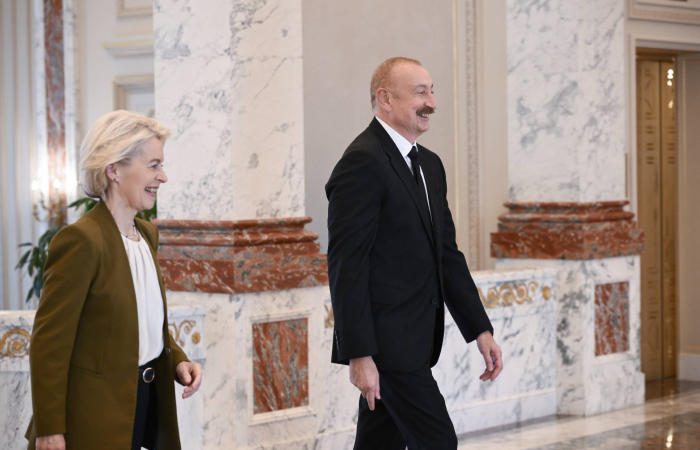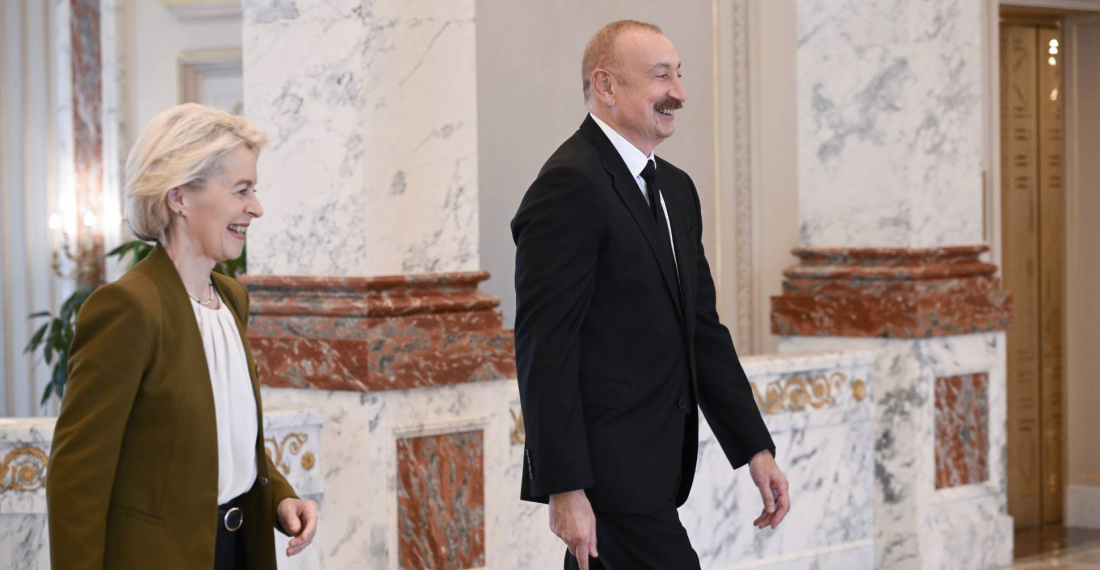
After years of bickering, during which relations reached "diplomatic lows", Azerbaijan and the European Union appear to have found a common language on how to build relations between them. The president of the European Commission on Wednesday (1 July) visited Baku for meetings with president Ilham Aliyev..
In a key speech, addressing president Aliyev, president Van der Leyen outlined the position of the European Union on various asspects of EU-Azerbaijan relations.
"I am here today to deepen a partnership that matters greatly to the European Union. And one that has real momentum, as the President just described. But first, let me turn to the most important development in this region in decades. Peace. Let me congratulate you on initiating an historic peace agreement with Armenia. You showed personal leadership in promoting peace and cooperation across the region. And it is creating new opportunities for stability, trust and shared prosperity. The EU strongly supports this process. And we will continue to do so. Together, we can turn peace on paper into peace in practice. That is why we are working here today together.
This brings me to my first announcement of today.
We want to foster peace through connectivity. Through our Global Gateway Investment Programme, we will invest up to EUR 200 million in grants for transport, energy and digital links across the South Caucasus with the potential to mobilise up to EUR 2 billion in public and private investment. Projects could include the railway connection through Nakhchivan, or developing the Port of Baku. The South Caucasus is one of the world's great crossroads – connecting Europe, the Caspian and Central Asia. Its strategic importance continues to grow. And Azerbaijan has a central role to play. Few countries are as well placed as yours to drive regional cooperation and stability. Azerbaijan tactfully combines its strategic geography with its growing economic, political, and regional influence. This is why we are proposing to launch an EU–Azerbaijan Connectivity Partnership. This goes hand and hand together with a High-Level Connectivity Dialogue, covering transport, energy and digital connectivity. We will also work on the organisation of a Regional Connectivity Investment Conference, preferably right here in Baku. And thus bringing together Europe, the South Caucasus and Central Asia.
My second announcement is on a new EUR 20 million peace-fostering programme, together we want to help peace take root in the region, to make the benefits of peace visible in people's everyday lives, those who live in border regions. We will invest in better healthcare, for example with the procurement of ambulances. We will also focus on safety through demining. And we will invest in strong local economies through rural development, water management, precision farming – you name it - and of course support for small and medium enterprises.
Let me turn now to energy. It remains one of the strongest pillars of our partnership. In recent years, Azerbaijan has proven to be a reliable trusted energy partner for Europe. We have not forgotten that at the time when Russia weaponised energy and turned off the gas, Azerbaijan stepped up. The Southern Gas Corridor strengthened Europe's energy security, and it is a remarkable success story. And I want to thank you for that. Now we are preparing the next chapter. Azerbaijan is investing in the energy of the future. Such as your plans to develop offshore wind energy in the Caspian Sea. You have both the ambition and the potential to become a hub for clean electricity. This fits perfectly with Europe's own clean transition. So, we see enormous potential to deepen our cooperation. On renewables. On electricity interconnections. And on regional energy networks. We welcome your plans to build a Green Energy Corridor, linking Azerbaijan with the European Union. Greater renewable generation can also free up more gas for export and thus help reinforce regional energy security, by sharing with the neighbours. We very much welcome your suggestion of an electricity cable to Armenia. So, renewables are powering the future of our economies. And here in the South Caucasus, they can also help power peace.
Finally, we discussed how to deepen our economic partnership. The EU is already Azerbaijan's largest trading partner and biggest investor. Now we want to build on that. The resumption of discussions on a new comprehensive agreement is an important step. This can open the road for even more trade between Azerbaijan and the European Union, and we will work together to make progress happen.
The European Union believes in a bright future for this region. So let us work together. For a peaceful South Caucasus. For a South Caucasus connected to Europe, the Caspian and Central Asia. And for an ever-stronger partnership between us.
President Aliyev replied in kind:
This is unprecedented dynamism in our relationship, which reflects the mutual will of both sides to intensify our cooperation and to strengthen our partnership. We highly value the relationship with the European Commission, and today, with Madame President and the delegations, we broadly discussed a very impressive agenda.
The European Union is Azerbaijan's main trading partner. More than 40% of our trade is with the member states, and for the European Union, Azerbaijan is the main trading partner in the South Caucasus. Almost 70% of trade in the South Caucasus is trade with Azerbaijan. Of course, we broadly discussed our cooperation in the field of energy, and the visit of Madame President four years ago to Azerbaijan was also very important.
From this point of view, we signed the MoU on Strategic Partnership in the energy field, and since that time Azerbaijan's natural gas export to the European Union member states has increased by almost 65%. Today, half of our gas export goes to the member states of the European Union, and in total, 10 member states of the European Union are recipients of Azerbaijani gas, with the potential to expand this geography.
Energy security for every country is today a very important factor of national security, and Azerbaijan has invested a lot of its political efforts, diplomatic activity, and also financial investments in building infrastructure for the transportation of our oil and gas. The Southern Gas Corridor is a remarkable example of our common activity. The 3,500 kilometers of integrated pipeline systems today are the main artery for the transportation of natural gas from Azerbaijan to Europe.
Connectivity definitely was one of the important parts of our discussions. Azerbaijan is an active participant and, in many cases, an initiator of the regional transportation projects. The East-West and North-South transportation corridors cross Azerbaijan, and having good relations with our neighbors and the neighbors of our neighbors has allowed us to establish a very broad cooperation format, which is to the benefit of all the actors.
Today, the volume of cargo through Azerbaijan in all directions is growing. We invested largely in transportation infrastructure in Azerbaijan and in the neighborhood, and are continuing to do it. And with respect to the new geopolitical situation, we see that there is a need to expand the capacity of our trade sea ports and of our railroad infrastructure. We are doing all of that in line with the schedule and with our own financial resources.
A relatively new part of our relationship with the European Commission is renewables. We also largely discussed it with Madame President, including the potential of Azerbaijan in solar, wind, and hydropower, and the existing transmission lines, as well as those to be built. We can also become strategic partners from this point of view.
I informed Madame President that the contracts with foreign and local companies signed so far will allow us to have eight gigawatts of solar and wind energy over the next five to six years. This is only what has been signed, which is a contractual commitment. But definitely there'll be more.
Of course, we also discussed the regional security issues at length, especially the normalization process between Azerbaijan and Armenia, which is progressing successfully. Last August in Washington, at the White House, in the presence of President Trump, Armenia and Azerbaijan signed the Joint Declaration. President Trump also signed it as a witness, and Armenia and Azerbaijan also initialed the text of the peace agreement. So, de facto, peace is done, and we see the benefits.
We have taken many unilateral steps in order to demonstrate that peace is not only on paper, but that we can feel it in day-to-day life. Azerbaijan lifted all the restrictions on the transit of goods through its territory to Armenia. Those restrictions were imposed because of the occupation of our internationally recognized territories by Armenia. We also started to supply Armenia with critical fuels, particularly gasoline and diesel. In today's geopolitical situation, this has even bigger importance than ever before.
So, we are demonstrating that, for us, peace is something we can already touch, we can feel, and we are learning to live in peace. We lived under occupation for 30 years, and we restored our sovereignty and territorial integrity ourselves by force and by political means. And we offered peace to Armenia.
So now peace is a reality, but we must work hard in order to strengthen it, to make it long-lasting, to make it eternal, and, of course, we highly appreciate the support of the European Commission.
Madame President also informed me that the European Commission can and wants to be very helpful. And we appreciate any help, any assistance from this point of view. And I think that this will strengthen the dynamism in the region and will allow the South Caucasus to be an area free from any territorial claims, any conflicts, and an area of partnership, cooperation, and peace."
From what Aliyev and Van der Leyen said on 1 July, relations between the two is entering a new, positive, phase.
source: commonspace.eu with the European Commission (Brussels), the press service of the president of Azerbaijan (Baku) and agencies